
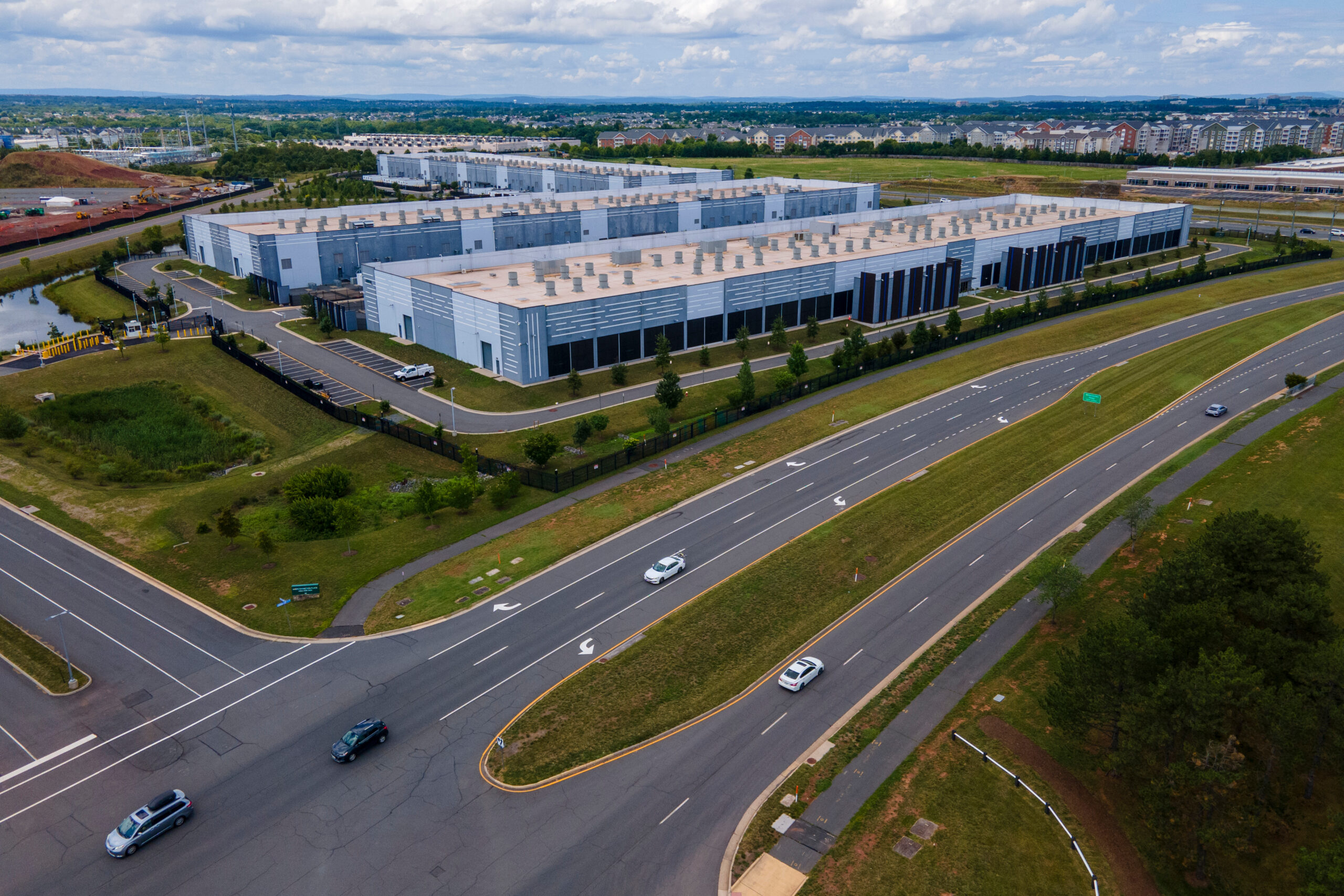
Image Credit: Associated Press
Listen to the audio version of this article (generated by AI).
Key Points
- AI’s biggest constraint is no longer software or chips, but securing enough electricity and cooling capacity to keep data centers operating.
- The rapid expansion of AI is driving what some analysts estimate will be a $7 trillion capital-spending cycle, comparable in scale to the railroad boom of the 1880s.
- Companies that provide the “picks and shovels” of AI infrastructure—including power equipment, cooling systems, and communications networks—stand to benefit from the long-term buildout.
Jensen Huang has been warning that we’re approaching a physical limit with AI for years…
His company, Nvidia (NVDA), is world-famous for making high-performance chips that power AI data centers.
Nvidia’s products are so valuable that practically every tech company in the world depends on them. As a result, Nvidia is now the largest company in the world by market capitalization, with a valuation hovering around $5 trillion. That surpasses top tech titans like Alphabet (GOOGL), Apple (AAPL), and Microsoft (MSFT).
The company’s graphics processing units (“GPUs”), such as the Nvidia Blackwell and Hopper architectures, are the gold standard for training and running generative AI models.
And Huang has watched each new generation of GPUs draw more electricity and throw off more heat than the last. He knows that, at some point, physics fights back.
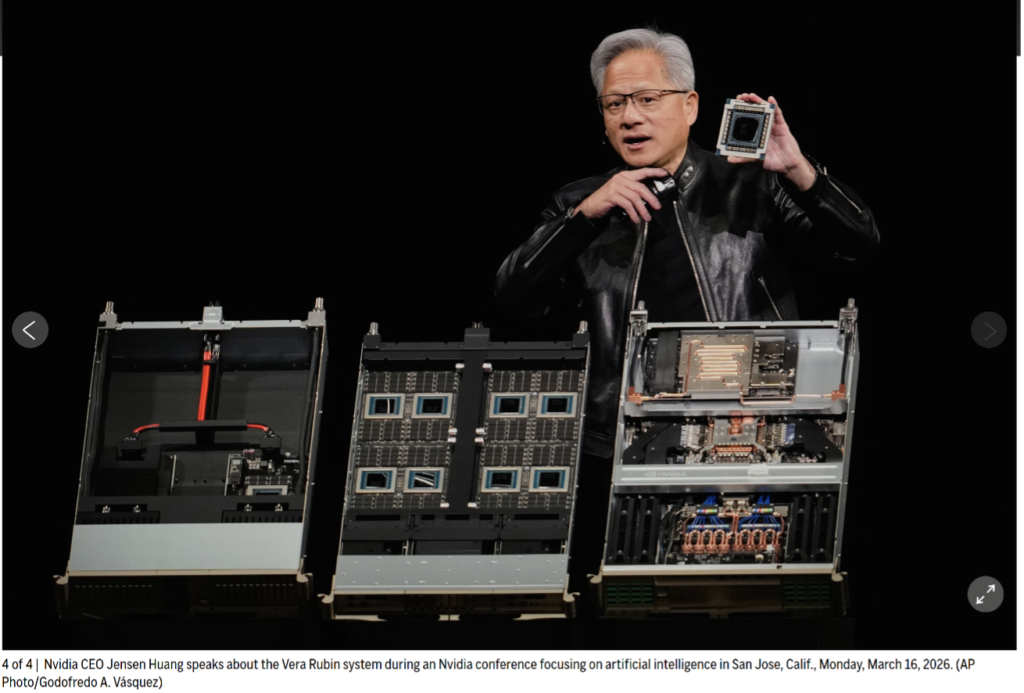
Huang has warned that the real limit on AI isn’t how many chips Nvidia can sell. It’s whether anyone can keep those chips fed with power and cool enough to function properly.
You see, Nvidia can design the world’s most powerful AI processors. But if they overheat, or if the electrical systems sag under the workload, then they’re useless… nothing but expensive paperweights.
The Challenges of Powering the AI Build-Out
The Department of Energy is aware of this growing problem. It sees a future where AI and high‑performance computing could drive data centers to use up to 9% of U.S. electricity by 2030.
We’re already seeing limitations on the power grid play out in real time. Across the U.S., developers have drawn up plans for large AI data centers, only to find that utilities can’t deliver the amount of electricity needed on the timelines that the projects require.
In some markets, dozens of facilities are vying for connections to the same overworked power grid. Of the 110 data-center projects slated to come on line in 2025, more than a quarter were delayed due to power, permitting, and construction constraints.
As a result, hyperscalers – massive cloud-service providers that own and operate colossal data centers, such as Microsoft, Alphabet, Amazon (AMZN), and Meta Platforms (META) – are increasingly willing to accept the additional complexity of building and managing on-site power.
We’re talking about things like high-voltage transmission lines and electrical substations to deliver massive amounts of power from the grid to data centers, as well as on-site electrical distribution and battery-storage systems.
In other words, when a cloud provider or AI startup wants to build a new data center, they don’t just need chips. They also require adequate power and cooling.
And these systems are only going to become more crucial going forward.
AI Data-Center Growth Is Massive and Developing Rapidly
Over the past few years, AI has moved from a lab experiment to something millions of people use every day for things like chatbots, image recognition, and smarter search results.
But this is only the beginning…
Behind these tools are powerful computers that sit in data centers. And data centers are quickly becoming some of the most important buildings on the planet.
Think of a data center as a giant, high‑tech factory for information. Instead of making cars or shoes, it generates answers, images, videos, and AI results.
Inside, there are long rows of servers stacked in racks, miles of cables, and huge machines with specially designed equipment to bring in power and carry away heat.
These buildings require massive amounts of electricity and water because the computers inside are working around the clock. Each rack of AI-capable servers already uses enough electricity to power several homes. And as AI gets more powerful, those racks will only require more energy.
When we access information from data centers virtually over the Internet, we refer to it as “the cloud.” The cloud sounds soft and ambiguous, but it consists of millions of computers sitting in these data centers all over the world connecting users virtually.
Programs and AI models run on those computers, and they reach into massive databases to find patterns and answers. And every time an AI model gets larger and more complex, it needs more chips, more memory, and more storage.
For the data-center build-out, that means more racks of servers, more power lines, more cooling units, and more construction.
Over the next few years, the amount of work being done inside data centers is expected to soar. Researchers now expect AI to make up roughly half of all data‑center workloads by 2030, up from about a quarter in 2025.
To handle this, data centers are projected to grow from around 82 gigawatts (“GW”) of capacity in 2025 to 219 GW of capacity in 2030, according to market research firm McKinsey.
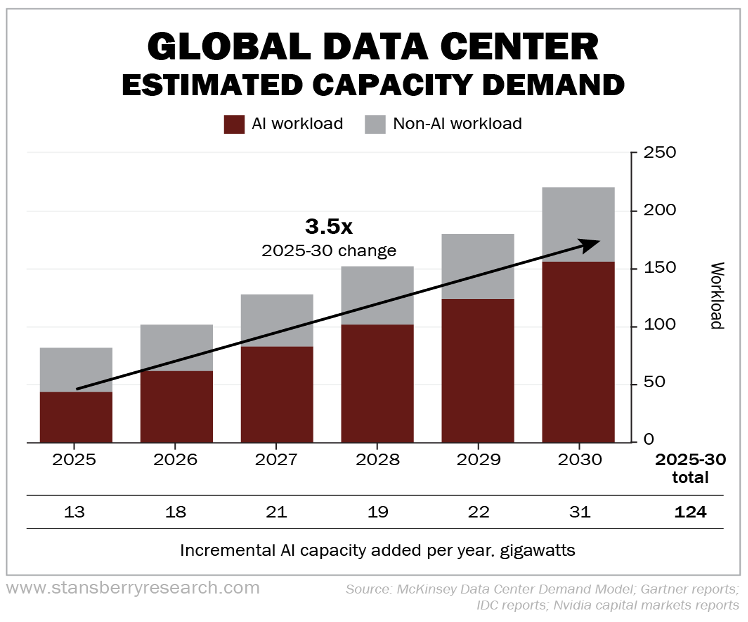
This rapid growth will be driven mostly by AI workloads – which McKinsey estimates will expand 3.5 times from 2025 to 2030.
Essentially, data-center capacity is expected to triple in less than five years. This explosion in demand means a huge construction wave is just getting started.
Estimates vary, but McKinsey is placing the price tag on the AI data-center build-out – from 2025 to 2030 – at around $7 trillion.
That bill includes the cost of constructing new data‑center buildings… filling them with servers, storage, and network equipment… installing power systems, backup generators, and batteries… adding cooling systems (chillers, cooling towers, fans, and more advanced systems like liquid cooling)… and laying miles of fiber and other connections to tie it altogether.
The U.S. government, every major tech company, and many large businesses are racing to secure enough capacity so they don’t fall behind. It’s setting off a capital-spending cycle equivalent to the 1880s railroad boom.
Moreover, the data-center build-out will continue well past 2030… making this one of the biggest investment opportunities the world has ever seen.
But as Huang has warned, electricity is a big physical limit that can stall the build-out. Data centers are consuming power faster than the electrical grid can keep up.
Many places simply don’t have enough electrical capacity nearby to support a giant new AI data center.
Global data-center electricity consumption is projected to increase from around 600 Terawatt-hours (“TWh”) in 2026 to more than 1,000 TWh by 2030, according to Bessemer Venture Partners . To put that in perspective, that’s roughly equivalent to Japan’s current total electricity consumption.
The growth in power will be driven by natural gas-fired power plants and renewable energy (like solar and wind). Take a look…
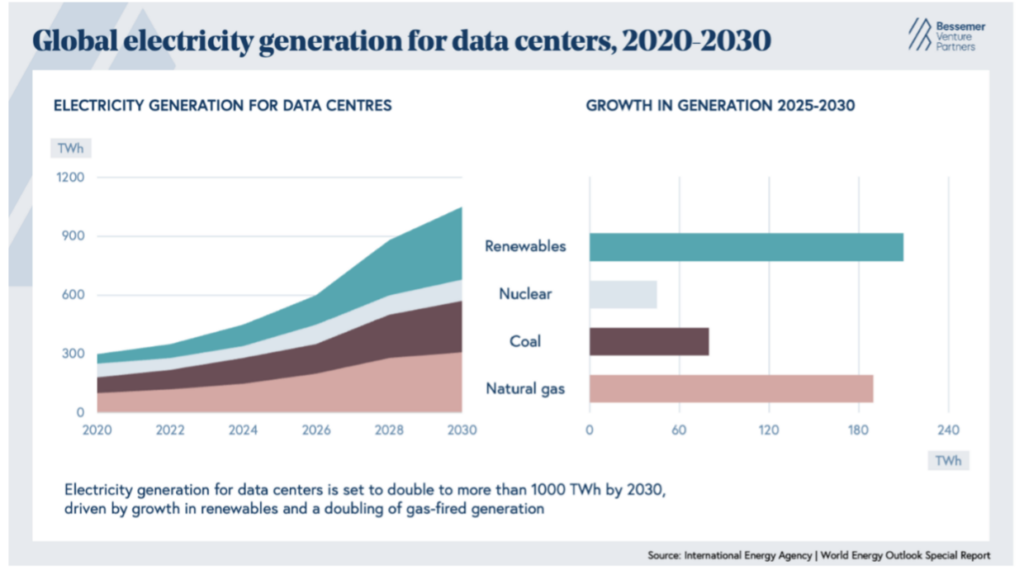
Data centers will account for nearly half of all electricity-demand growth between now and 2030.
This will require new substations, new high‑voltage lines, and smarter systems to manage electricity inside the buildings. It also means there’s a growing need for companies that know how to design, install, and maintain complex power systems safely and reliably at a massive scale.
Heat is another major challenge. All the electricity that goes into the servers eventually turns into heat that must be removed so the machines don’t overheat and break down.
As AI servers get denser, traditional air‑cooling methods – like air conditioning – are reaching their limits. To keep up, data centers are adding more advanced cooling systems, including big chillers (massive refrigeration machines), cooling towers (which use evaporative cooling), and newer forms of liquid cooling that bring cold liquid directly to chips.
This shift requires new equipment, new plumbing, and new control systems that can be trusted to run nonstop.
As a result, it’s not just the companies making the AI models and chips that will profit in the AI build-out…
What the AI Picks and Shovels Boom Means for Investors
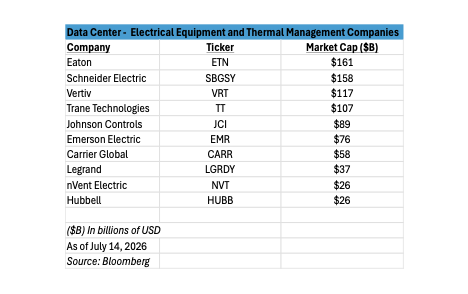
There’s also a tremendous opportunity for the picks and shovels companies that supply and integrate power equipment, cooling systems, and electrical and communications networks into data centers.
They provide products like switchgear, busways, racks, cabling, power-management tools, building controls, backup batteries, air handlers and coolers, as well as other advanced solutions needed to handle high‑density AI and cloud workloads.
On top of that, these companies help with ongoing maintenance, upgrades, and expansions in data centers as AI models continue getting more powerful.
In short, they keep data centers running reliably and continuously. They are the backbone of physical data-center infrastructure, enabling operators to deliver resilient, energy‑efficient power and cooling at scale.
Here are a few of these kinds of companies to keep your eye on…
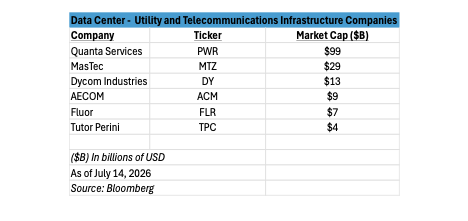
Now, there are also stocks that design, engineer, and build the off‑site and on‑site utility and telecommunications infrastructure that makes large-scale data centers feasible in the first place.
They construct high‑voltage transmission and distribution lines, substations, fiber networks, and related civil works that deliver reliable power and connectivity to data-center campuses.
In addition, they provide engineering and construction services for complex data-center and network facilities, coordinating everything from site development and permitting to installation of critical utility interconnects and telecom backbones.
You can see some of these companies below…
In sum, if you’re looking for one of the best ways to invest in AI, it’s important to look past the chipmakers and hyperscalers.
The more durable opportunity may be in the businesses that solve the bottlenecks those chips create. As Huang has warned, future data centers are increasingly power-limited.
Because of that, the smartest way to play the AI boom may not be to chase the brains of the system, but to own the picks and shovels that make everything possible in the first place.
Good investing,
Bill McGilton
Editor’s Note: Whitney Tilson — the hedge fund manager CNBC called “The Prophet” — says America has reached its “Ripping Point.” The old financial order is being torn apart, and he believes most investors have no idea what’s coming in the next six months. He’s named the stocks he thinks will be destroyed in the chaos — and the ones he believes will soar. Watch his free presentation while it’s still available.