
On January 9, 2007, Steve Jobs took the stage at a San Francisco technology conference and delivered one of the most important business presentations in U.S. history.
The Apple CEO told the audience, “Every once in a while, a revolutionary product comes along and changes everything.”
Jobs explained how Apple’s new product was part mobile phone, part Internet device, and part music player with a touch-screen interface.
Jobs called this 3-in-1 product the “iPhone.”
You know the rest of the story.
The iPhone became one of the most popular consumer products in history. It fundamentally changed the way people live.
Apple has sold more than 3 billion iPhones since Jobs’ presentation. The iPhone played the primary role in Apple becoming one of the world’s largest and most valuable companies.
Jobs made good on his promise. The iPhone changed everything.
In the years after the iPhone’s release, more and more of our everyday machines became computerized and connected to the Internet: our cars, appliances, watches, homes, and medical devices.
They all went digital and went online.
This “megatrend” represented one of the biggest technological revolutions in history… and created massive demand for semiconductors.
Semiconductors are the “little engines” that power our devices. During the smart device boom of the early 21st century, annual revenues for many leading semiconductor firms climbed more than 1,000%. The world couldn’t get enough of their products.
The Semiconductor ETF – which holds a basket of leading semiconductor stocks – climbed 2,555% from January 1, 2010, to mid-2025. The stock price of individual leader Nvidia appreciated more than 400-fold, and another semiconductor leader, Broadcom, saw its share price rise more than 200-fold.
The semiconductor boom was a true “megatrend”… a time where all the stars align for an industry, an economy, or asset class and it enjoys years of tremendous growth. During a megatrend, stock prices, bonuses, and salaries soar year after year.
Building wealth as an investor, a business owner, or an employee during a megatrend can be easy. During a megatrend, money flows freely into and around the businesses involved.
In a megatrend, you’re having the seafood tower for an appetizer at business dinners instead of the free bread service… and people are buying second homes with bonuses instead of second cars.
When you have a megatrend working in your favor as an investor, employee, or entrepreneur, success comes easier and faster than it does otherwise. A megatrend turns a good idea into a great idea. It turns a big, expensive mistake into a tiny mistake. A megatrend allows mediocre people to make big money, and it allows great people to make huge money.
When you have a megatrend working in your favor, even your morning coffee tastes better. I’ll go so far as to say that knowing how to get megatrends working in your favor as an investor, employee, or entrepreneur is one of the great secrets of life. Working and investing in booming megatrends is driving in the wealth creation fast lane.
Focusing on getting megatrends to work for you is like using a cheat code in a video game that gives you superpowers. It’s like running a 100-meter race, but you start at the 50-meter line.
Sure, you can make money doing business in a declining industry, but it’s a hell of a lot harder, and your wins are comparably smaller than they would be if you have the “megatrend advantage” working in your favor. So please, urge, plead with, bribe, and cajole your children into doing business inside megatrends. Show them how it’s better to work or invest where it’s raining money. They will thank you someday.
We live in a $100 trillion global economy.
That’s a mindboggling amount of business activity.
Every day, billions of decisions to buy or sell something are made worldwide. Every day, innovative geniuses are working on new technologies and new business models. Every day, exponential technological progress creates winners and losers at a rapid rate.
Given the size of the global economy and its highly dynamic nature, there’s always a bull market somewhere.
There’s always a trend about to take off and generate significant wealth for people “in the know” who get in before the crowd.
Over and over and over again, we see how jumping on a megatrend at just the right time can create life-changing wealth…
**Could be a powerful new technology such as AI, smartphones, blockchain, or the internet.
The AI megatrend helped the stock of semiconductor maker Nvidia increase 1,115% in a three-year span, while AI defense firm Palantir climbed 1,978% during the same time span.
The electric car megatrend helped send Tesla’s shares up 29,000%.
The smartphone megatrend helped send Apple’s shares up by 3,065%.
The internet megatrend helped send shares of Cisco up more than 69,000%.
The blockchain/crypto megatrend helped send Ethereum up 380,000%.
**Megatrends can also happen thanks to a big rise in the price of a commodity such as oil, gold, lithium, uranium, copper, corn, sugar, or natural gas.
Shares of uranium miner Uranium Energy Corp climbed 985% in the 2020s thanks to a surge in uranium prices.
Shares of gold miner New Gold climbed 828% in the 2020s thanks to a surge in gold prices.
**Big countrywide economic booms can create megatrends. Over the past 25 years, we’ve seen many of these explosive trends in places such as India, Brazil, Argentina, Turkey, China, and Australia.
Shares of Argentina-based oil producer Vista Oil & Gas soared 1,150% after the country moved towards free market capitalism in the early 2020s.
**Megatrends can happen thanks to changes in government laws. For example, the cannabis and sports betting industries have generated big winners over the past decade thanks to changing government regulations.
Shares of cannabis company Canopy Growth climbed 1,800% after North American governments eased laws related to cannabis in the mid-2010s.
The government choosing to spend big on defense or infrastructure can also ignite profitable megatrends. Shares of space transport firm Rocket Labs climbed 700% in part due to U.S. government spending on space.
As you can see from the semiconductor industry’s 2010 to 2025 return figures, you only need to catch one investment megatrend early to generate significant wealth.
Many successful investment careers have been built on catching just one megatrend. And if you catch two, three, or more over your career, you’re in the Hall of Fame.
Legendary investor William O’Neil urged investors to own “the leading stocks in the leading industries.” His research showed that over one-third of a stock’s price movement is tied to the performance of its industry group. Billionaire trader Steve Cohen has said that’s been his experience as well.
As a megatrend investor, you’re taking a page from O’Neil’s playbook.
You’re starting with a broad view of the markets and the economy. You’re looking for industries with awesome growth prospects that can draw in hundreds of billions of dollars (or trillions) in capital flows.
After identifying such megatrends, you “drill down” and find the leading companies operating in them. You’re looking to own “the best of the best.”
This is the approach that has yielded giant stock market winners like:
Google (an internet megatrend leader)
Amazon (online retail megatrend leader)
Nvidia (AI megatrend leader)
Tesla (EV megatrend leader)
Vertiv (AI megatrend leader)
Palantir (AI megatrend leader)
Arista Networks (AI megatrend leader)
Shopify (online shopping megatrend leader)
Broadcomm (AI megatrend leader)
Kratos Defense (drone megatrend leader).
Why many of the most profitable megatrends come from the technology world
On June 27, 2024, Joe Biden and Donald Trump squared off for the first debate of the 2024 election cycle, the earliest presidential debate ever.
Over the next 6 months, stories from a wild presidential race dominated media headlines and influenced financial markets.
Because so much attention was paid to politics during this time, most people missed one of the most incredible happenings in stock market history.
As the country focused on the election, four small companies –unknown to the average person – were working on a revolutionary technology that could change the world forever.
This technology could drastically lower the price of energy… eradicate diseases… and usher in an era of super intelligent AI.
Very few people knew it, but the list of those four companies and their stock tickers was the most valuable information on the planet at the time.
The tickers are: QUBT… IONQ… QBTS… and RGTI.
These stocks went on to stage one of the most incredible rallies in American history.
Over the course of just two months, QUBT would climb 3,600%… RGTI would climb 2,400%… QBTS would climb 910%… and IONQ would climb 480%.
This lightning-fast bull market minted groups of millionaires and billionaires fortunate enough to own stakes in the companies.
To give you some perspective of what a 3,600% return can do, consider that it turns a stake of $50,000 into $1,750,000… and a stake of $500,000 turns into $17.5 million, in just two months.
QUBT is a company called Quantum Computing.
RGTI is a company called Rigetti Computing.
QBTS is a company called D-Wave Quantum.
IONQ is a company called IonQ.
All four companies are working in a bleeding-edge technology field called Quantum Computing. This technology promises supercomputers that are more than 1,000 times faster and more powerful than today’s supercomputers.
And in late 2024, their innovations led investors to send stocks in this sector up by an average of 1,847% in two months.
The jury is still unsure whether quantum computing will live up to its lofty expectations.
But the industry’s explosive 2024 rally that created extraordinary wealth is very real… and provides a great example of how today’s rapidly evolving technology can quickly create great wealth.
Here’s the incredible story…
Making the Jump to Lightspeed
Think of the extraordinary change someone born in 1900 could have seen over a long life.
As children, they saw horses on city streets. As they grew up, they saw those streets full of cars.
They would have seen the invention of the radio… the airplane… air conditioning… antibiotics… personal computers… and the list goes on.
Those of us who live the next 30 years will see a similar set of changes. We’ll see the world change more rapidly than any other group of people in history.
The way we work, play, travel, receive healthcare, and entertain ourselves will be totally different from how we currently do it.
Huge new industries will be created at warp speed.
Old industries will be demolished at warp speed.
And it’s all thanks to a phenomenon called Exponential Progress.
If you’re on the right side of exponential progress, we believe you’ll do very well financially over the coming years. If you’re on the wrong side of it, you could really struggle. You could get left behind.
Exponential progress differs from conventional progress massively…
Conventional progress – the kind of advancement ingrained in the minds of most people – is like going for a walk…
You take one step, you advance one step. After taking ten steps, you’re ten steps away from where you started.
Pretty simple.
Well, exponential progress – the kind of progress taking place in technology labs and businesses right now – radically changes the equation… and radically accelerates the pace of change in the world.
Exponential progress is progress that multiplies in power and scope with each step.
Exponential progress is progress that “snowballs” and builds on itself.
It ensures that each new step is larger than the one before it.
Specifically, the progress made in a step is double the amount made in the step that came before it.
For example, if you make exponential progress while taking a walk, you take one step.
Now double that…
… and your second step is the equivalent of two regular steps.
Now double that…
… and your third step is the equivalent of four regular steps.
Now double that…
… and your fourth step is the equivalent of eight regular steps.
By the time you reach the 10th step, your step is the equivalent of 512 steps!
And by the time you take the 20th step, your step is the equivalent of more than half a million steps!
Again, exponential progress is progress that “snowballs”… each step in the advancement is double the one before it.
Knowing the difference between linear growth and exponential growth instantly sets you apart from your fellow investors and gives you a huge advantage in the markets.
It can literally make you millions of dollars over the coming years.
We’re Entering the “Lift Off” Phase
When a small number grows at an exponential rate, the first stages of growth don’t produce eye-popping figures.
The growth shown on a chart does not soar upward during the early stages.
The extraordinary growth happens at an “inflection point” in time…when the exponential growth begins to snowball and makes things change at stunning rates.
This is the “lift off” point you see on this chart.
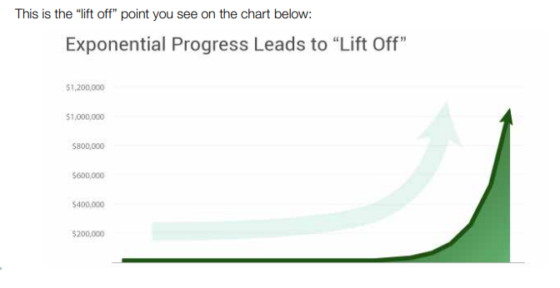
Over much of the last four decades, advancements in computing power, data storage, communications gear, and other technologies have followed a trajectory like you see on the left side of the chart.
This is because they started at very low levels.
But after many years of advancing at exponential rates, the technologies I just listed are entering the “lift off” phase.
Computing power is advancing at incredible – and accelerating – rates.
At the same time, the cost of that computing power is plummeting.
Although computers and communications gear have changed our world over the past 40 years, they are set to change it a lot more.
Remember, our “new economy” – our software, our AI, our smartphones, our apps, our websites, our email – rests on a foundation of computing power.
Computing power makes FaceTime and email possible. It makes AI and smartphones possible. It makes electric cars, spreadsheets, and high tech factories possible. It makes a lot of amazing health care advances possible.
After years of relatively modest advancement, computing power is now entering the “lift off” stage.
This key ingredient of our modern world is exploding in power and speed.
The world around us is changing at never-seen before speeds… and catching lots of people off guard.
Over the last few decades, it took on average about 20 years for the typical Fortune 500 company to reach a market capitalization of $1 billion.
In 1998, Google reached $1 billion in market cap in just eight years, which was considered incredible.
By 2004, Facebook had done it in just five years.
By 2009, Uber had done it in under three years.
In 2012, virtual reality firm Oculus did it in under two years.
Here in the age of AI, it can happen in less than a year.
The chart below displays the amount of time it took for companies to hit a billion-dollar market cap.
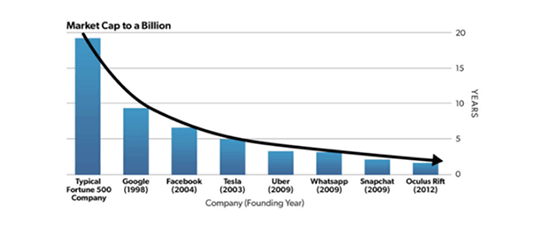
As you can see, it’s taking less and less time to generate incredible wealth.
Investors are enjoying the benefits.
Early Amazon investors have made over 160,000% gains.
Early Nvidia investors have made over 28,000% gains.
Early Tesla investors made over 10,000% gains.
By now, you can see how the time it takes for massive change is getting “compressed.”
The pace of creative destruction is getting faster and faster each year…
… and transforming industries over short time spans.
New industries are springing up at rapid and ever increasing rates… while old industries are being demolished at rapid and ever increasing rates
As Uber soared to a billion-dollar valuation, the old taxi industry was devastated. It lost hundreds of millions in revenue.
As Apple’s iPhone dominated the smartphone market, the losing competitor, Blackberry, saw its share price plummet more than 90%.
As Amazon stock soared thousands of percent, it decimated traditional brick and mortar retailers.
These huge industry shifts used to take 20-plus years to play out.
Now, they are playing out in less than 5 years.
This ever increasing rate of change will drive ever increasing upheaval in corporate America.
Back in 1964, the average time companies spent in the S&P 500 was 33 years.
By 2016, that “tenure” period has shrunk to just 24 years.
It is forecasted to shrink to just 12 years by 2027.
Innovation experts are predicting that nearly 50% of the current S&P 500 will be replaced over the next ten years.
In other words, we’re about to see a ton of upheaval. We’ll see a “revolving door” in the ranks of corporate America.
One day, a company is big and powerful.
The next day, it’s roadkill.
And it’s all thanks to exponential progress.
The world is changing at the fastest pace we’ve ever seen… and that rate of change is speeding up every year.
The rate of change in we saw in the world 10 years ago is much faster than it was 20 years ago.
The rate of change in we saw in the world 5 years ago is much faster than it was 10 years ago.
And yes, the rate of change we’re seeing now is much faster than the rate of change we saw 5 years ago.
We call this epic change to our world The Great Acceleration.
Our world is like a car that has accelerated from 10 miles per hour to 50 miles per hour to 150 miles per hour.
For one, exponential progress is making it so businesses can grow to huge sizes faster than ever before… with fewer employees than ever before.
As I mentioned, it used to take a decade for a company to grow to $1 billion in market value. Now, it can happen in months.
And here’s another amazing fact: From early 2017 to mid 2020… in less than four years… Amazon quadrupled in size.
That kind of growth from an already large company was unheard of 40 years ago.
These days, it’s a regular occurrence.
Right now, you can make big money in stocks faster than at any time in history.
With all the major advances in blockchain, AI, robotics, self-driving cars, quantum computing, batteries, space commerce, DNA sequencing, and more, we are guaranteed to see massive opportunities every year… for many years to come.
There’s no doubt in my mind that coming years will be the greatest period ever to be a technology investor.
There will be more disruption in the next 20 years than in the previous 80 years combined.
The now-explosive nature of technology trends was on display in late 2024 when quantum computing stocks soared thousands of percent in just a few months.
But don’t think it’s an isolated story of lightspeed wealth creation.
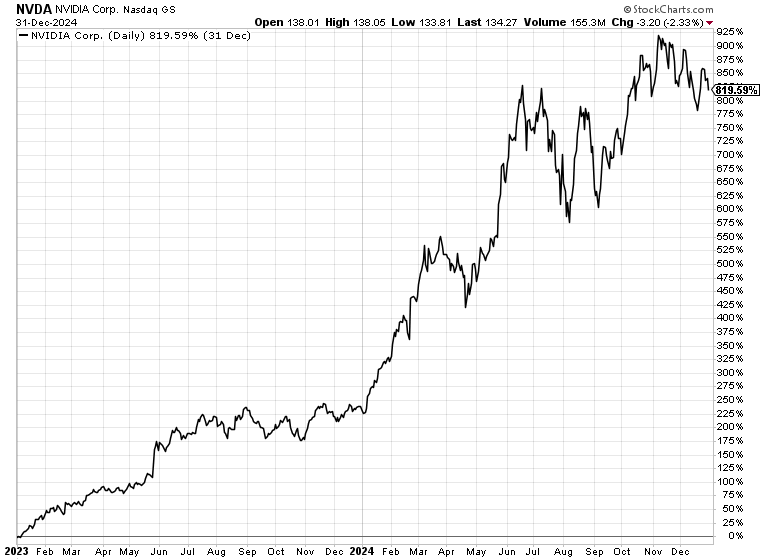
**Consider how AI semiconductor leader Nvidia soared 819% over two years… a run that started after Chat GPT went worldwide.
We’ve never seen a big company soar this much, this fast ever before…
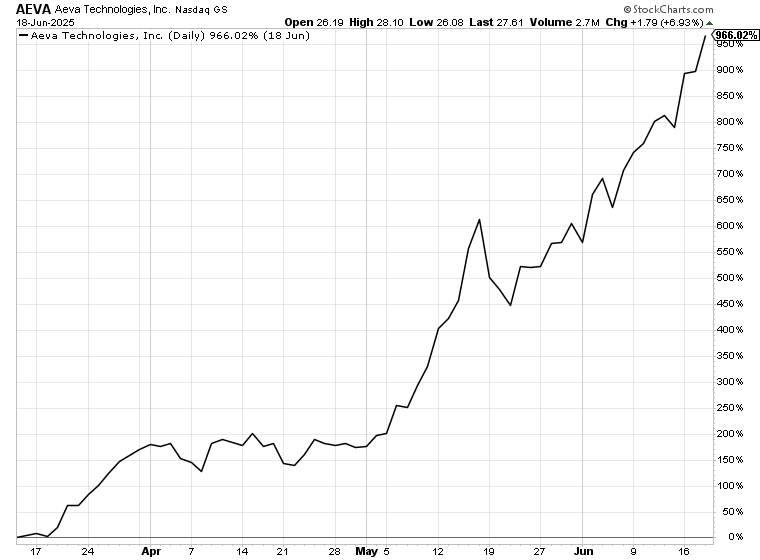
**Consider how autonomous vehicle technology firm Aeva Technologies soared 966% over a two month period in 2025.
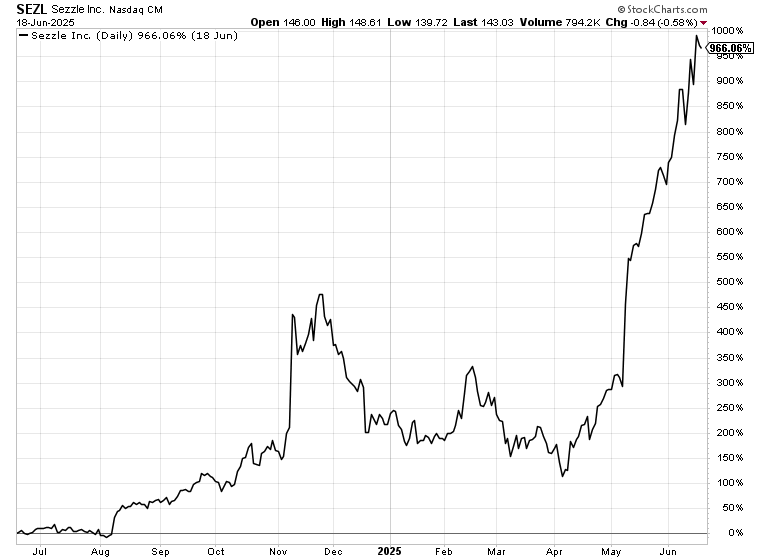
**Then there’s the meteoric rise of fintech firm Sezzle, which skyrocketed 935% over a one year period from mid 2024 to mid 2025.
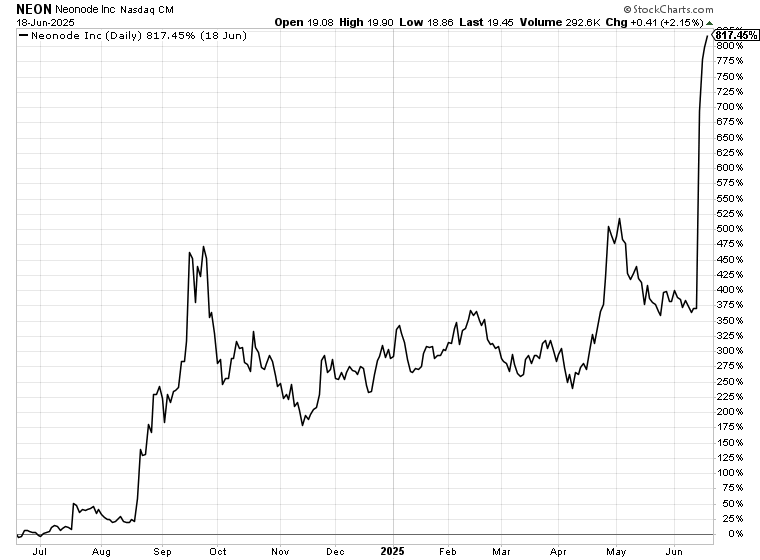
**Then there’s Neonde, a company that makes sensors for human/machine interaction. It soared 817% over a one year period recently.
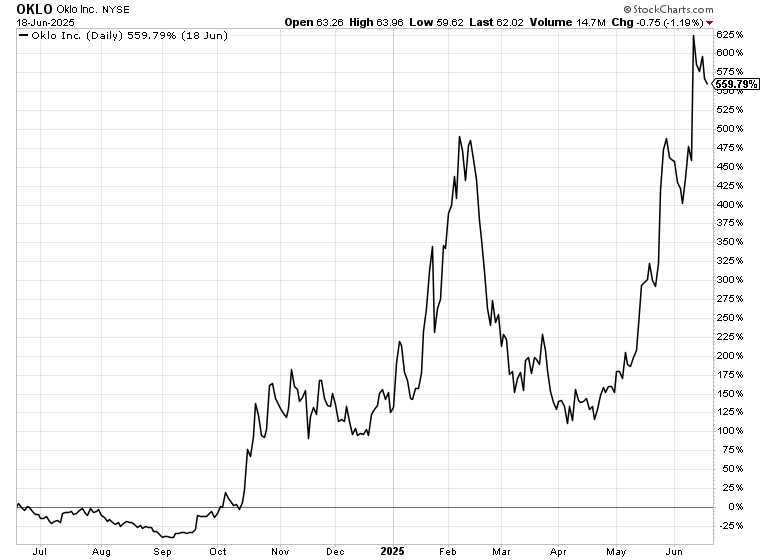
**Then there’s Oklo, a nuclear energy technology stock that soared 559% over a one year period from mid 2024 to mid 2025
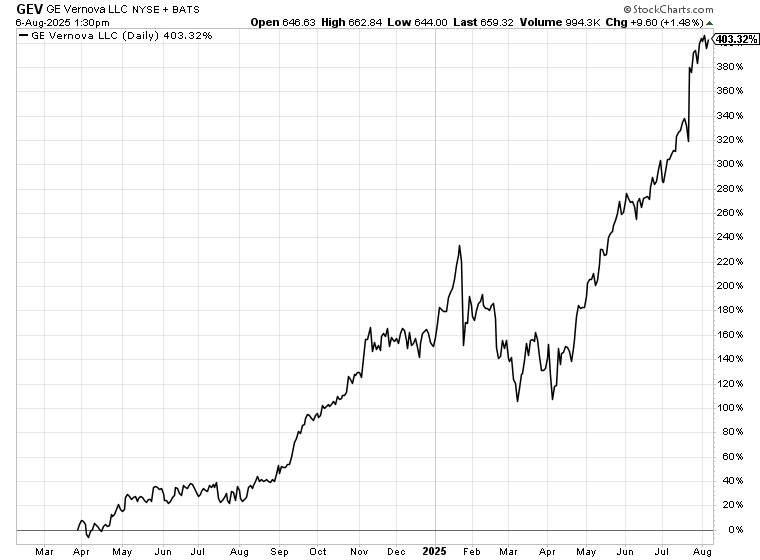
**Then there’s GE Vernova, which makes the electrical infrastructure that powers AI data centers.
Over a 17 month period, GE Vernova soared 403%.
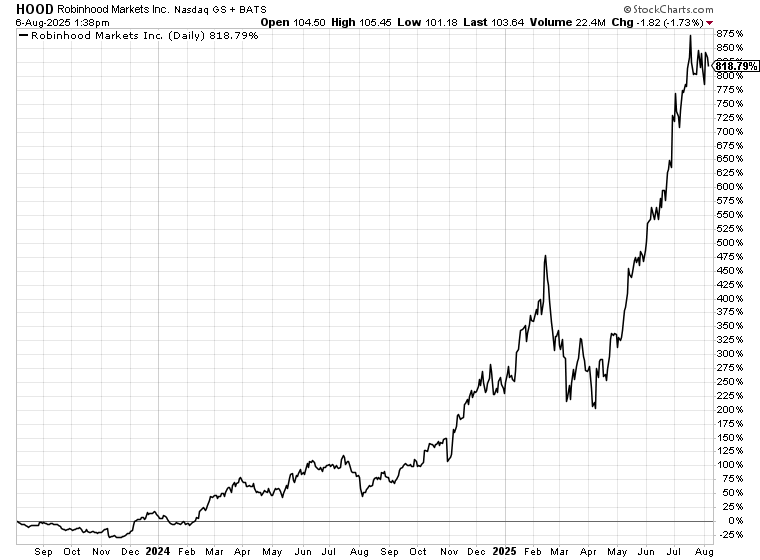
**Don’t forget the incredible story of RobinHood. Thanks to its mastery of financial technology, it has quickly become one of the world’s leading stock and crypto trading brokerages. RobinHood’s market value soared more than 810% over a two year period.
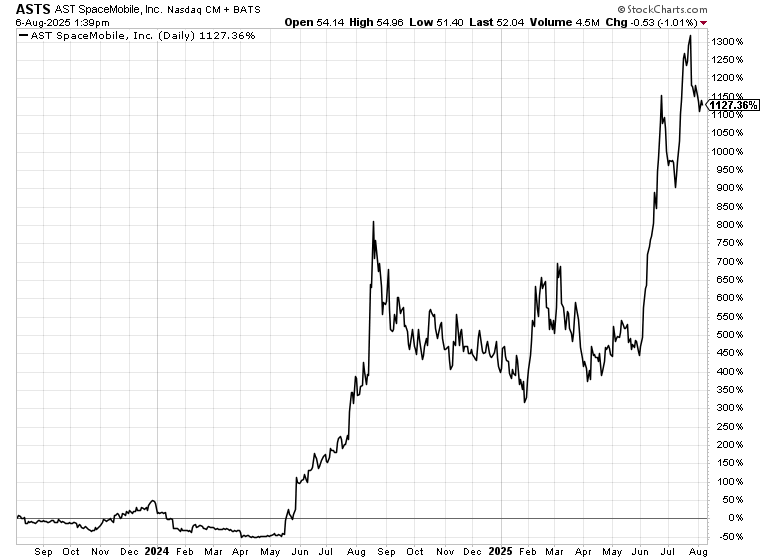
**Then there’s AST SpaceMobile, a company that provides 5G broadband connections via its fleet of Earth-orbiting satellites.
AST’s market value recently soared 1,127% over a two year period.
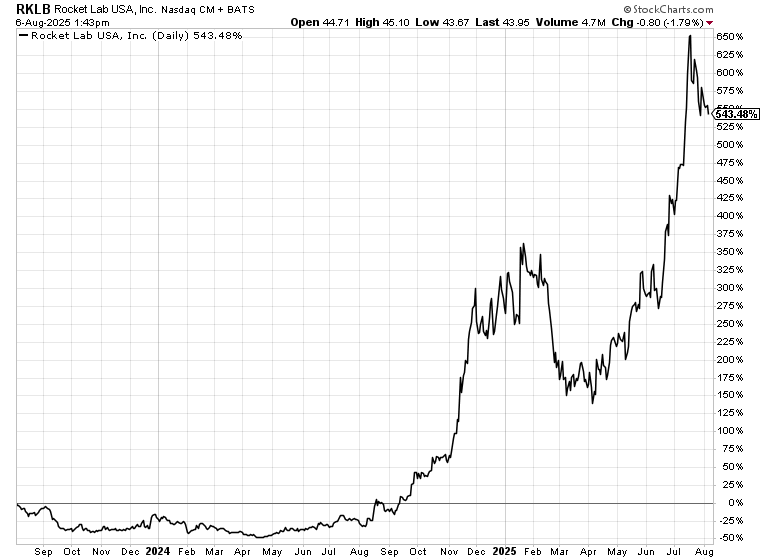
**The market value of Rocket Lab Corp soared 834% over a two year span. Rocket Lab is one of the world’s leading space freight firms.
I could go on and on and on with examples of exponential technology firms rising more than 100% in short periods of time.
This is not your father’s stock market…
We’ve never seen so much wealth created so quickly in the stock market.
Thanks to the astonishing level of technological progress in AI, robotics, space travel, personalized medicine, drones, blockchain, and battery technology, more and more stocks are generating life-changing gains over short-time frames.
Right now, you can make big money in stocks faster than at any time in history.
How Technology’s Ripple Effects are Creating Wealth at Light Speed
All the big stock market winners I’ve showed you so far are what you could call “pure tech” plays.
By owning these companies, you own companies working directly on bleeding edge technology.
But investing in pure tech isn’t the only way to profit from extraordinary innovations.
That’s because many winning companies aren’t the ones developing breakthrough technology.
Instead, they are either leveraging it or providing tech companies the key inputs they need to thrive.
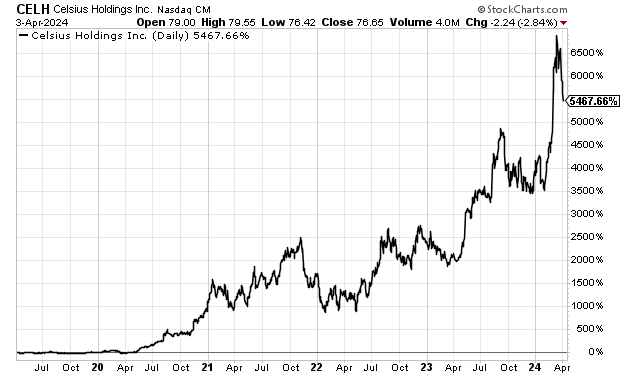
Take the energy drink maker Celsius…
In 2019, barely anyone had heard of Celsius.
It generated $75 million in revenue that year.
In 2020, Celsius hit upon a magical mix of digital advertising and product acceptance. It mastered the art and science of marketing to young people on their smartphones.
Not a pure tech company… but most definitely tech enabled.
Over the next two years, Celsius revenue climbed 4X and the company’s market value skyrocketed 20X.
Trends happen fast these days. Blink and you’ll miss them.
The AI trend sent shares of data center infrastructure firm Vertiv skyrocketing more than 300% in less than a year. Vertiv does not design AI, but it builds the infrastructure AI can’t live without.

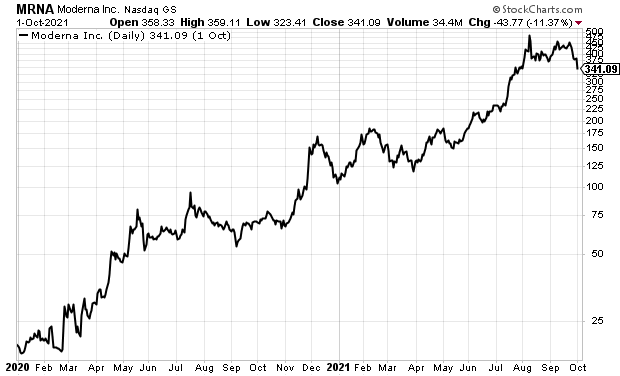
Shares of the COVID-19 vaccine maker Moderna climbed 850% from early 2020 to December 2020. Moderna leverages bleeding edge technology to formulate and test medicines.
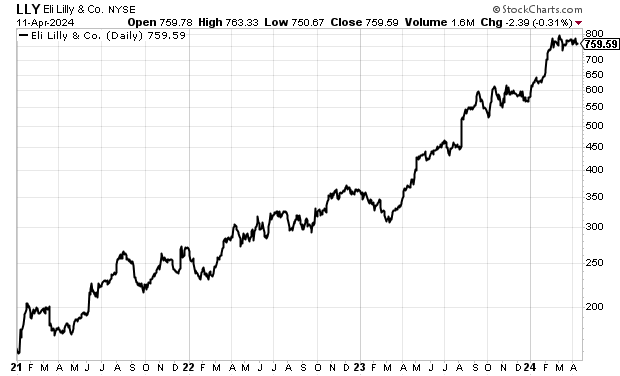
The big drug maker Eli Lilly uses advanced computer models to formulate and test new drugs.
This high tech approach to drug development allowed Eli Lilly to get to market fast with its hit weight loss GLP-1 drug. Eli Lilly quadrupled in value over a three year period thanks to the trend.
Exponential progress is sending the prices of old fashioned mining firms skyrocketing as well.
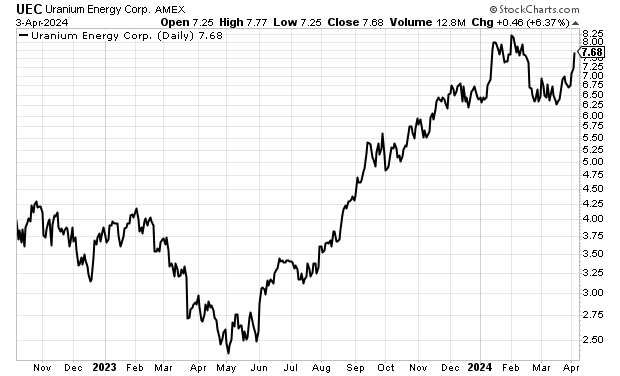
Thanks to AI’s surging electricity consumption, the world is in a mad rush to build fresh electrical capacity… which benefits nuclear power producers and companies that sell nuclear fuel like uranium.
Thanks to this explosive trend, one of the top uranium plays – UEC – doubled in less than a year.
Explosive technology-powered trends like the ones I just detailed are playing out every day, every week, every month.
If you pay close attention to what’s happening in the stock market, you see how our world is changing at blistering rates.
Explosive technological trends are taking off all the time… much like how airplanes constantly take off from the runway of a busy airport.
On any given day, there’s always trends emerging, playing out, and ending.
Said another way, there’s always an innovation-powered bull market somewhere.
Timing Your Megatrend Buys to Maximize Profits and Minimize Losses
Okay… we know our dynamic, global $110 trillion economy generates huge opportunities every week and every month.
We know profitable trends – most by blazing technology progress – are always playing out.
So what’s the right time to buy them?
How do you seize those opportunities and consistently turn them into a source of earnings?
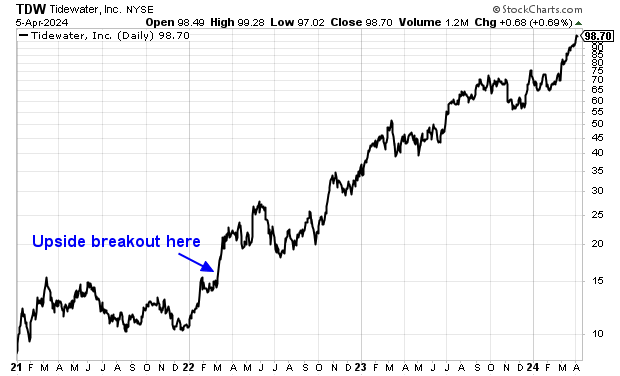
This is where we must pay close attention to upside breakouts.
If you want to consistently turn explosive trends like the ones I just described into a source of cash earnings, you must become a monitor and connoisseur of upside breakouts.
A breakout occurs when the price of an asset reaches a new high or a new low for a given period.
It’s when the price of an asset moves into fresh new territory.
An “upside breakout” is when the asset hits a new high.
A “downside breakout” is when an asset hits a new low.
Breakouts can be either short-term (5 -10 days), intermediate-term (30 – 60 days), or long-term in nature (over 200 days).
Breakouts serve as a starter’s pistol to signal the beginning of a trend.
No uptrend can start without an upside breakout…. and no downtrend can start without a downside breakout.
For example, here’s that chart of offshore oil drilling firm Tidewater again with the upside breakout called out.
Breakouts are not magic indicators.
They don’t predict market moves.
Breakouts simply indicate that the forces acting on a business, an industry, or a trend are starting to manifest themselves in the market.
No uptrend can begin without an upside breakout.
No downtrend can begin without a downside breakout.
Waiting on an upside breakout before jumping on a trend helps prevent you from trading in “dead money” markets and going nowhere.
It prevents us from getting in too early.
However, we also don’t want to get into a trend too late…
Since a profitable trend can play out so quickly these days, we want to know ASAP when one may be starting.
Getting in a few weeks too late can cost you a lot of money.
Effective trend trading is hugely dependent upon nailing the “sweet spot” of a trend… where you aren’t too early or too late.
For example…
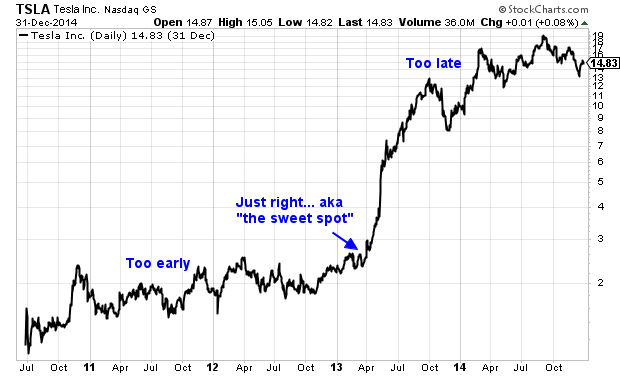
Now that Tesla is one of the biggest and most successful companies on the planet, some might think investing in Tesla stock was always a winning move.
However, as you can see in the chart below, Tesla shares moved sideways for years after its IPO… turning funds invested into the company into “dead money.”
It was only in 2013 that Tesla caught on with lots of consumers and investors.
That’s when the stock started to perk up and traded north of $2.50 per share, which is where the upside breakout occurred.
That level was the “sweet spot” for trend investors.
Not too early. Not too late.
Tesla shares skyrocketed over 300% in less than a year.
At Money & Megatrends, we use a finely tuned “early detection” system to identify emerging trends breaking out to the upside and in their sweet spot.
Again, that’s not so early that we sit on dead money for years… but just as the trends start to spark public interest… just as they stage upside breakouts.
“The When” is more important than “The Why”
We put a lot of time and effort into “The Why” part of what we do.
We work hard to determine why various market trends could create serious wealth. But this component of our system is of secondary importance to “The When” part of our work.
“The When” is the component of our system that seeks to precisely time and trade trends using breakouts.
And this part of what we do is of critical importance.
Mastering “The When” is what separates masters from pretenders.
This is because, in our experience, the vast majority of widely followed investors and investment analysts are right about half the time. Even the most accurate forecasters are right less than two-thirds of the time.
This might sound like a damning criticism of financial forecasters and money managers, but it’s not.
You can be right half the time and make incredible returns. But you must win a lot when you are right and lose a little when you are wrong. You must follow the Golden Rule of Trading: Ride your winners and cut your losers.
Of course, a high “win rate” on your trades helps. If you can pair that with large wins and small losses, you have a heck of a system.
But remember that large fortunes have been built on “win rates” in the 50% range.
We believe that in the pursuit of large wins and small losses, mastering The When – or waiting for an upside breakout – is one of your best friends.
Waiting for a stock, ETF, or asset class to breakout means waiting for a trend to move in the direction of a forecast or expectation. This is often called waiting for “market confirmation.”
If you’re bullish on semiconductor stocks and they are going up, the market is “confirming” your investment thesis.
Or, you could be foaming at the mouth bullish on gold, but if gold is going down every month, then your thesis is wrong. You are on the wrong side of the market. You don’t have market confirmation.
Despite the optimistic and confident forecasts made by financial analysts, markets and stocks spend a lot of time moving sideways or down. These periods of sideways or down movement are hazardous to strong annual returns.
This is why, as much as possible, we only want to bet on markets that are moving in our expected direction.
We want to wait on market confirmation… which comes in the form of upside breakouts.
How we identify, monitor, and trade investment megatrends
As I mentioned, business and technological megatrends like the ones I just detailed are playing out every day, every week, every month.
If you pay close attention to what’s happening in the stock market, you can see these megatrends changing our world at blistering rates.
On any given day, there’s always trends emerging, playing out, and ending.
Said another way, there’s always a bull market somewhere… and there’s always a bear market somewhere.
Every week, the opportunity to make money from rapid change and the market trends it produces knocks on your door.
This, of course, means that tracking all this activity is a huge job… one that can only be performed adequately by computerized analysis.
It’s the kind of huge computational task TradeSmith was made for…
Money & Megatrends is a publication of MarketWise.
MarketWise is one of the world’s largest independent research and financial data firms. It’s the parent company of leading fintech company TradeSmith. It’s a company I work closely with.
TradeSmith has invested over $20 million and 12,000 manhours into its data crunching systems and strategies.
We have a staff of 25 people working on maintaining and developing our trading technology.
Over 122,000 people entrust TradeSmith technology to track and monitor more than $30 billion in assets.
Given the enormous wealth-producing power of getting into explosive market trends at just the right time, the TradeSmith team recently took on one of the most important research projects in company history…
The goal of this project was simple…
Develop a financial “early warning system” that tracks every market and industry trend and alerts investors when they are poised to generate significant investment returns.
In other words, develop a system for “getting in early”… and at just the right time.
This research project took us a tremendous amount of time and energy. But the results are well worth all the time and expense.
I’m pleased to report that we’ve developed a finely tuned “Global Trend Tracker” that can spot every major profit-producing theme and megatrend the stock market generates for the rest of your life.
We believe this system can help you increase your net worth by hundreds of thousands—even millions—of dollars every year.
Here’s how the technology works…
We employ a big data-based approach to “thin slice” the stock market into over 150 individual themes and sub industries… and track those trends in our custom-built database.
For example, you’ll find Quantum Computing, Robotics, and AI Semiconductor Makers on the list of themes we track in our database.
Our customers have access to this database, which contains dozens of data points about every theme, including short-term trend status, long-term trend status, revenue growth, volatility, short-term price performance, and long-term price performance.
We believe it’s critical to use “thin slicing” analysis and examine the market’s 150+ sub-industries, niches, and themes because Wall Street’s traditional sector analysis is far too blunt a tool.
Wall Street advisors spend a lot of time talking about the economy’s 11 sectors as identified by the company S&P.
Those sectors include Financials, Energy, Health Care, and Industrials.
Financial networks like CNBC or Bloomberg frequently report on these broad sectors.
This kind of thinking might be useful for some people, but it’s too imprecise for our analysis and trading.
This is because each big industry, like Health Care, is made up of many different subindustries that move independently from each other, operate differently from each other, and are affected differently by various economic climates.
For example, in the Health Care sector, you have Big Pharma… medical devices… health insurance… biotechnology… hospitals… and so on.
Each one of these industries is a very different breed of cat.
And a serious trend trader must acknowledge these facts.
Given this, we track over 170 distinct themes and trends and the companies that operate inside those trends.
Each day, our Global Trend Tracker database monitors these themes and ranks them according to various metrics such as revenue, price momentum, and earnings growth.
We’re looking for trends and companies starting to register strong growth and institutional money flows.
How we track over 150 themes and megatrends
You can think of our trend detection technology as the financial version of wave-detecting buoys set miles out into the ocean that let us know the size of waves heading towards the shore.
Every minute of every day, we monitor over 150 trends and evaluate them using Stage Analysis.
Our Global Trend Tracker monitors thousands of stocks and investment funds.
At any given time, most of the stocks and funds we monitor are in “consolidation” stages… they are moving sideways and not in the middle of explosive uptrends.
However, the day that a trend registers a 1-month upside breakout, our system flags it.
It sounds the “potential profit ahead” alarm.
That’s when the starter’s pistol fires on a potentially explosive trend.
That’s when we look at the trend, consider the potential upside, and determine whether we want to be involved.
Once we identify an emerging trend, we evaluate it and consider taking a position… usually by buying the trend’s leading stocks.
Once we take a position, we look to surf on the trend’s momentum and generate profits. If the trend powers higher, we stick with it.
If the trend stalls out and loses momentum or even turns lower, we get out immediately.
Rinse and repeat.
It’s that simple.
By applying this edge day after day… week after week… month after month… we can generate consistent profits.
An Investing Legend Shows us the Way
Buy the Strongest Stocks in the Strongest Industries
Once we find a megatrend or compelling theme poised to create wealth, how should we play it?
Should it be one stock?
Should it be a dozen stocks?
One investment fund?
I like to answer this question by saying, “Buy a basket of the best.”
Buying a basket of an industry’s top three to six companies is usually the smart way of investing in megatrends and profitable themes.
More on buying baskets in a moment.
But first, let’s discuss ETFs, which are a popular way to invest in megatrends and themes.
An ETF is an investment fund that trades like a stock. Most ETFs hold dozens or hundreds of different companies. This is one of their big allures. They can give you diversified exposure to a sector or a big trend.
ETFs can be useful investment vehicles.
If you don’t have much time to manage your portfolio, an ETF is usually a great way to invest in a megatrend.
You can buy it with one click, sock it away, and get on with your life.
I use ETFs myself.
However, you can often generate larger megatrend returns by taking advice from stock trading legend William O’Neil.
O’Neil was a successful stock trader profiled in the book Market Wizards. He was also the founder of investment newspaper Investor’s Business Daily.
O’Neil focused his time and capital on megatrends… on industries poised to grow by leaps and bounds.
Once O’Neil found a megatrend he wanted to be in, he would “drill down” into the industry and find the fastest-growing, highest-quality leaders. O’Neil encouraged people to “buy the leading stocks in the leading industries.”
This way of megatrend investing makes a lot of sense.
Buying a single company to play a trend can pay off big. But it’s very risky. If your chosen company has a major problem (like an accounting scandal or a crazy management decision), you could suffer a significant loss.
But, some ETFs hold over 50 stocks. The chances are good that any ETF will hold more than a few weak companies that will dilute your returns.
That’s why I like taking the middle-of-the-road approach whenever possible… “buying a basket of the best.” Pick three to six industry leaders and buy all of them.
For example, if you’re bullish on artificial intelligence, don’t buy an artificial intelligence-themed ETF. Instead, buy three to six of the best AI plays.
Or, if you’re bullish on oil, buy three to six great oil stocks.
Then, treat that basket as one position. If you have $50,000, chop it up into equal pieces and buy equal amounts of each stock.
Buying a small basket of the best stocks in an industry gives you some diversification and reduces single-stock risk… but you still get the focus and upside of owning the best companies.
It’s not always possible to buy a basket. Sometimes there aren’t many good individual companies trading at good prices in a sector or industry group.
If you’re pressed for time or mental energy and want a straightforward and low-maintenance way to invest, go for an ETF. But when you have the time and energy, “buying a basket of the best” is a good way to capitalize on megatrend opportunities fully.
Don’t think of it as a stock market. Instead, think of it as a market of stocks.
A mental framework that will open up a world of opportunities to you
When the mainstream press reports on the economy and business, they almost always cite the performance of “the stock market.”
“The stock market climbed 2% today…”
“The stock market fell today on news of higher inflation.”
That sort of thing.
Reporting on the economy and businesses with simple concepts like “the stock market” makes sense for the media. It’s fast. It’s easy. And that’s all many people care to understand.
However, I believe there’s a much smarter and more useful way of thinking about the economy, businesses, and your investments.
Instead of focusing on what “the stock market” is doing, I recommend you adopt the mindset of “Don’t think of it as a stock market. Instead, think of it as a market of stocks.”
This mental framework will guide you to many more financial opportunities than the one employed by the mainstream media and its average customer.
“Don’t think of it as a stock market. Instead, think of it as a market of stocks.”
In other words, realize that the stock market is a place where you can buy and sell ownership stakes in many different types of businesses that operate in many different industries. And realize that various economic climates affect those businesses and industries differently.
Something good for one industry isn’t necessarily good for another industry.
For example, the 2020 COVID-19 crisis was great for video conference and delivery companies because so many stayed home. It was also great for grocery stores.
From February 19 to March 19 – a period when many stock prices crashed – shares of retailer Walmart advanced in price. So did grocery giants Sprouts Farmers Market and Kroger. So did video conferencing company Zoom.
Meanwhile, businesses in the travel and entertainment industry were crushed. Cruise ship operators Royal Caribbean and Carnival lost more than 75% of their value, and amusement center Dave & Buster’s lost more than 85% of its value.
Next, consider how a long period of declining oil prices is bad for oil producers… but great for airlines, since fuel is a major cost for them.
The behavior of their stocks will reflect that.
It’s also worth noting that something good for one company in an industry isn’t necessarily good for another company in the same industry.
The iPhone was great for Apple, but terrible for Apple’s competitor, Nokia. Thanks to the iPhone rollout in 2007, Apple’s market value soared, and Nokia’s crashed.
Instead of thinking of “the stock market” as a monolithic entity into which you put money, I prefer to focus on individual industries, unique market trends, and how those affect individual companies.
A whole lot is happening behind the curtain we call the Dow Jones Industrial Average.
***I believe this way of thinking about stocks is much more helpful and profitable than thinking of it as “the market.”
That’s because at any given time, there’s almost always a set of big opportunities in the industries and asset classes with the strongest outlooks and tailwinds working for them.
Plus, there are always reasons to avoid industries with the worst outlooks.
As I mentioned earlier in this guide, we live in a $110 trillion global economy. That’s a mindboggling amount of business activity.
Every day, billions of decisions to buy or sell something are made worldwide. Every day, innovative geniuses are working on new technologies and business models.
Every day, old, established companies such as Blackberry and Kodak make missteps and become roadkill.
Given the size of the global economy and its highly dynamic nature, it’s no wonder that many industries “zig” while other industries “zag.”
It’s no wonder one company’s innovative business model and success is often hugely destructive to other companies.
Put differently, there’s always a bull market somewhere… and there’s always a bear market somewhere.
For example, from January 1, 2015, to December 31, 2019, Amazon’s market value increased by 495%.
Amazon’s value increased so much because it steadily acquired a growing share of American retail sales.
During Amazon’s boom time, the market value of department store giant Macy’s fell by 66%. The market value of retailer Bed Bath & Beyond dropped 74%. The market value of retailer JCPenney dropped 82%.
Many retailers went bankrupt.
Amazon and other masters of online retail “ate their lunch.”
Or, consider what happened to technology stocks at the turn of the 21st century.
After soaring throughout the 1990s, the technology sector grew to be the focus of a speculative investment bubble by 2000.
When that bubble popped, technology stocks plummeted. The tech-focused Nasdaq index declined 76% and many tech companies went bankrupt.
As money flowed out of technology stocks, much of it found its way into the real estate markets. The S&P Case-Shiller U.S. National Home Price Index increased 27% from January 1, 2000, through December 31, 2002.
Homebuilder stocks also performed well while tech suffered. Shares of big builders like DR Horton and Toll Brothers tripled in value.
The Power of Investing in the Right Industries
A great type of visual drives home the power of investing in the right industries.
This visual is called a “return quilt.”
A “return quilt” or “quilt of returns” is a graphic that shows the returns generated by major stock market sectors by year. Here’s one below:
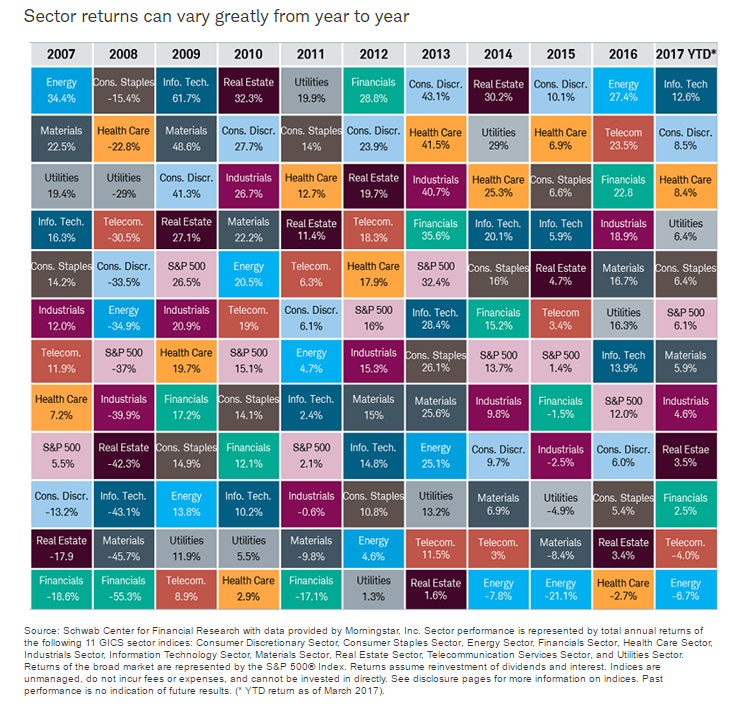
For example, check out the returns generated by various industries in 2014.
Real estate investors had an incredible year. The sector gained 30.2%. On the other hand, oil and gas investments performed terribly. A big decline in oil prices sent the oil and gas sector down 7.8%.
And check out 2016. Energy stocks enjoyed a rebound year and posted a 27.4% return that year. Health care stocks, on the other hand, slumped 2.7%.
One Sector Can Be Home to Many Different Kinds of Businesses
If you drill down further into broad market sectors like health care, energy, and industrials, you see even greater disparity in the performance of different types of stocks.
For example, the health care sector comprises different industries or “sub-sectors.”
The health care sector includes medical device makers that produce things such as heart monitors, diagnostic machines, respirators, and X-ray machines.
It also includes “Big Pharma” companies, such as drug makers Pfizer and Merck.
The health care sector also includes the biotech subsector. This industry conducts extensive research and development to create individual drugs.
And don’t forget health care businesses like hospitals, assisted care facilities, and psychiatric clinics.
By now, you can see that one sector can be home to many kinds of businesses. Industries inside a sector can also generate different returns each year.
All this is why I think of it as a market of stocks and not a stock market.
As an investor, I’m especially interested in how individual industries can experience massive megatrends like I’ve detailed in this guide.
Slowly and steadily investing in the broad market can double and triple your money over the long term.
And for some people, that’s good enough.
But when you study market history and the returns made by the world’s greatest investors, you see that investing in megatrends can be far more lucrative.
Reaction, Not Prediction
Why obsessing over financial forecasts and stock picks is a loser’s game
For more than a billion people around the world, the Christmas season means getting together with family, opening gifts, eating good food, and taking a break from work.
But for many people in the investment world, Christmas time means forecasts. It means making predictions.
Every December, a blizzard of financial forecasts hits the world’s newsstands, websites, and inboxes. Magazine racks get packed with “Stock Market Outlook” issues. Investment advisors produce lots of projections and send them out to clients.
Forecasts of rising stock prices… of falling stock prices… of geopolitical shocks… of rising interest rates… of “top stocks for the next year.” Around Christmas time, these forecasts are everywhere.
As someone who has spent the past 28 years investing his own money and working inside the financial research industry, I can tell you that an enormous amount of work goes into forecasts.
And you know what?
Most of it is a colossal misallocation of time and energy.
If you don’t know why spending lots of your time and energy obsessing over investment forecasts is a bad idea, please pay attention to the next 10 pages.
It could make you a lot of money and a much better investor. It could transform you from an average investor into an outstanding investor relatively quickly.
Don’t Gripe at Wall Street… Look in the Mirror
I just said spending a lot of your time on forecasts is silly.
Yet, Wall Streeters and the financial media spend lots of time and energy producing and selling forecasts.
What gives?
Forecasts – at year-end or any other time – are what the clients want.
Forecasts make clients happy. Forecasts drive clicks and revenue. Forecasts attract investor dollars. Forecasts sell magazines and financial research and investment funds by the truckload.
The typical investor – both pro and amateur – loves a forecast.
When it comes to forecasts, the bigger and bolder, the better.
We love to pay attention to confident forecasters. We love “big calls” that predict giant rallies and horrible bear markets. The bigger and bolder the prediction is, the more interest it generates.
The customers want big, bold forecasts, so that’s what they get!
However, if you want to be a successful trader or investor, my advice is to become a lot less obsessed with predictions and a lot more obsessed with reactions.
This is important, so let me state it again: Reactions… not predictions.
That is the path to market mastery and financial freedom.
Become obsessed with reactions, not predictions.
You may have read how Wall Street analysts are notoriously bad at forecasting stock prices and interest rates.
Study after study shows they are no better than the flip of a coin.
These people are as smart as they come. They went to the best schools. They have the most prestigious degrees. They have access to the most powerful computers. They are incentivized with big bonuses. They’ve got high connections in government and business.
And their predictions, on average, stink.
The big-name analysts, economists, and gurus get as many right as they get wrong.
You could flip a coin and base your investment decisions on the outcome, and do just as well as listening to financial forecasters. It turns out, people, businesses, and economies are very hard to forecast.
That’s the bad news.
The good news is that when you focus on what really drives great investment and trading performance, predictions don’t matter.
When you focus on what drives great investment and trading performance, predictions become a tiny (or non-existent) part of your investment life and performance.
Obsess About Process, Not Opinions
Let’s take two investors.
There’s Jim, who spends a lot of time reading, listening to, and thinking about predictions.
Then there’s Mitch, who learned the hard way that most financial gurus can’t reliably predict financial markets… and that he’s far better off spending his time and energy on reactions and the systematic process by which he carries them out.
I’m talking about reactions like what you do if a stock you buy declines 20% from your purchase price.
Or, what do you do if a stock doubles in price.
Or, how you react to the broad market falling 30%?
As for the process, I’m talking about your methodology for deciding how much capital to place into a given investment or trade. And, your process for deciding how much of your capital to place into a given asset class, like stocks or commodities.
Reactions and process.
Your reactions related to how you manage positions after you buy them. Your methodical process by which you decide how much capital to place into a given asset class and individual positions.
These are far, far more important to your success as an investor or trader than predictions.
Reaction and process are the critically important fundamentals of stock market investing.
Mitch figured that out the hard way.
So now, Jim and Mitch spend their time and energy in very different ways…
Throughout the year (especially at the end), Jim spends dozens of hours reading forecasts and predictions.
He thinks a lot about whether he should buy this or that sector based on a forecast he read from a top Wall Street analyst or money manager. Jim wonders if he should get totally out of stocks because a newsletter guru said a market crash is coming.
The bulk of Jim’s time is spent reading, thinking about, and worrying about predictions
Mitch used to do all that stuff.
For years, he never achieved much investment success. He would get fixated on predictions and bet big on bold guru forecasts and stock picks. He’d make some money on the winning calls, but he’d lose more on the losing calls.
He spent virtually no energy or time figuring out how much capital he should invest in the positions or how he would manage them.
The losers hurt him far more than the winners helped him.
So, he started studying. He started learning.
Eventually, he stumbled upon the Market Wizards book series by Jack Schwager.
The Market Wizards books are uniquely wonderful. They are not conventional books where an author describes his or her investment strategies and career. Instead, the Market Wizard books consist of interviews with the world’s greatest investors and traders.
For less than the price of a nice dinner for two, you can buy a handful of Market Wizards books and tap into the accumulated wisdom of some of the smartest, most successful traders and investors to ever live.
You cannot beat Market Wizards regarding knowledge received vs. time and money invested.
If you pay close attention to what the all-time greats say, you notice a powerful “golden thread” in how they think and act… a common mindset.
By and large, the greats do not talk about the importance of trying to figure out where this or that market is going.
They don’t talk about the importance of forecasts and predictions.
Those things are relatively unimportant to the wizards.
Instead, they emphasize the extreme importance of a systematic process that dictates how much capital they place into their positions and how they REACT in various outcomes after they take positions.
These Hall of Fame Market Wizards all obsess over reaction and process.
When all the Hall of Famers in any given field say the same thing is of critical importance, it’s a good idea to listen to them.
Elite investors and traders think about what they will do if a position goes down 15% after they buy it.
They think about what they will do if a position goes up 100% after they buy it.
They think about what kind of developments will lead them to exit the position.
They think a lot about how much capital they will place into any trade or investment.
Elite investors flip the script used by the average investor or trader.
The average investor thinks, “If I can just figure out where the market is going or find a great stock picking system, I’ll succeed.”
Then he spends a lot of time and energy on that idea.
He spends lots of time trying to spot “the next Apple” or the next big market move as forecasted by a financial guru. He obsesses over stock picks and forecasts.
The elite performer knows that is a loser’s mentality.
The elite investor or trader thinks, “The market could go in a variety of directions. I may have an idea of where it will go, but I could be wrong. So, I’m going to plan out how I will react in a variety of outcomes. By planning ahead and following that plan, I won’t act emotionally and “wing it” by making rushed, emotional, low-quality decisions.”
Then, he spends lots of time and energy on that idea.
This time is spent on planning what to do in the event of various outcomes playing out… planning potential trades… making exit plans to be used if needed… following the rules and the process… plus analyzing past trades to see how the reaction process is working.
If any of his time is spent thinking about where the market will go, it’s thinking about what potential outcomes are possible… and what he will do to react to those outcomes.
Reaction and process… not prediction.
The elite performer may study or create a variety of forecasts… but he does not get married to them.
Instead, the elite performer gets married to limiting risk by having great reactions and a great process.
The elite performer does not get wedded to the “bull case” or the “bear case” for the stock market or interest rates or a given commodity.
She does not “pick a side” and maintain allegiance to that side no matter what. She does not get married to one stock with enormous potential.
Instead, she thinks through potential outcomes, looks at probabilities, and plans out what he will do in various outcomes.
She lets the market lead… then she reacts.
She is water that will flow where the terrain takes her.
Or, as the legendary stock trader Mark Minervini says, he is the caboose and the market is the train.
Mark knows the train is going to go where it wants to go.
Mark is the caboose that reacts to the market.
Top performers focus obsessively on things that have nothing to do with forecasts and predictions. Most elite performers will tell you that their trade selection or forecasting process is one of the least important aspects of their success. We recommend you do the same.
Insight from One of the Most Stressful Jobs on the Planet
Managing your money is stressful. After all, it’s your hard-earned savings and financial future on the line.
We all know the decisions we make, rushed and under stress, are likely to be of lower quality than the decisions we make when we are calm.
When we are in a big hurry or when we’re angry or dealing with a traumatic event, the rational part of our brain doesn’t work well. It can even seize up and leave us in a frozen state.
Now throw in the stress of managing our money.
Do you really want to “just wing it” when it comes to these critical decisions?
Do you want to make up your plans on the fly when you’re rushed and under a lot of stress?
I didn’t think so!
It’s a no-brainer.
It’s a no-brainer to have a preplanned strategy for every investment or trade… and have its execution automated when possible.
I can’t state this emphatically enough…
Creating a plan for every investment and trade you make – knowing how much capital you can put into it and how you will react in a variety of different outcomes – is a major difference maker in your financial life.
It’s one of the major things that separates the financially literate from the financially illiterate.
The financially illiterate are prone to “winging it.” Most of the time, they get excited about a big forecast and buy investments or enter trades with no exit plan.
Their decision-making is chaotic. There’s no plan and there’s no rhyme or reason. They just make it up as they go along.
They focus on that big, bold forecast… or a stock’s big upside potential. This leads to plenty of low-quality decisions during times of stress.
But don’t just take it from me… take it from one of the most stressful “pressure cooker” jobs on the planet: NFL head coach.
Being an NFL head coach during a big game is one of the world’s most stressful jobs. There are millions of dollars on the line. There’s a lot of people watching, screaming, and scrutinizing every move you make.
You’re working side-by-side with extremely competitive, extremely aggressive people who are also stressed. The air on an NFL sideline is filled with intensity and urgency.
And during games, coaches must make big decisions with very little time to think about them.
It’s an intense mixture… a real “stress cocktail.”
Given the stress of coaching an NFL game and the complexities involved, it’s no surprise that head coaches are huge on planning how they will react in different situations. They are huge on pre-planned decision-making.
This is a massive thing every coach learns early on in their career…
… Have a plan for every kind of situation.
Know in advance what you will do in every situation.
There’s a lot on the line, so for goodness’ sake don’t “wing it.”
During every game, coaching staffs have big lists of potential situations they could face and the pre-planned moves they will make in those situations.
They know what they will do in a given situation before it even happens.
After all, it’s tough to make great decisions about complex situations when you are in a hurry, under pressure, and have a lot on the line. There’s too much on the line to “wing it.”
For example, if you’re down by 4 points, there are 40 seconds left, and you have the ball at the 50-yard line, what do you do?
Coaches have a plan for that. The team has practiced what it will do in that situation.
Or, if a team is up by 1 point after scoring a touchdown in the fourth quarter, do they kick an extra point or go for a two-point conversion?
Coaches have a plan for that.
They’ve done the math. They know the probabilities. They have created a strategy in advance. They don’t wing it.
There’s too much on the line to wing it.
Managing your money should be no different. Your money is too important to “wing it” with your investments and trades.
You should give yourself the advantage of knowing in advance what you’ll do in a given situation. Give yourself the benefit of higher quality decisions… made with plenty of time to think and when you’re in a calm state.
Reaction and process, not prediction.
Being obsessed with reaction and planning isn’t as exciting as big bold predictions and stock ideas, but this is the stuff masters spend their time and focus on.
This is the stuff that truly matters. The critically important stuff.
Yet, most investors barely devote any time or attention to it.
You can even say that the widespread focus on forecasts, predictions, and stock picks at the expense of the critically important “foundational” aspects of investing and trading – which include processes that determine how much you’ll buy of a position, how the position fits into your overall wealth strategy, and having a detailed exit plan for each position – is one of the most egregious misallocations of time, energy, and money in the world.
This may sound bizarre coming from me. For a long time, I’ve made my living from forecasting trends and making predictions. I’ve nailed some big ones and made a lot of money thanks to my ability to figure out what may happen next.
But forecasting is one of the most overrated things in the world. You can believe a trend or market is about to go way up or way down all you want, but if the trend isn’t moving or moving in the opposite direction, your idea is a loser.
What you buy is far less important than how you buy.
Position sizing… timing your buys by waiting for breakouts and market confirmation… respecting trend movements… cutting losses when a trade or trend moves against you… avoiding industries and asset classes in the midst of declines.
These things are of critical importance.
They are far more impactful to your long-term results than forecasting accuracy. Forecasting accuracy is of secondary importance, if that.
Don’t take my word for it. These ideas are what the Market Wizards emphasized over and over and over. If you choose to ignore their wisdom and experience, I’m sorry. This game isn’t for you.
You can be right with stock picks or trend forecasts 75% the time and go broke if you’re terrible at position management.
You can be right with stock picks or trend forecasts 25% of the time and become a billionaire if you’re great at position management.
Forecasts? Your or my interpretation of fundamentals? Those ride in the back of the bus. Respecting and trading price action drives the bus.
When it comes to stock trading, the impact of one trend forecast or trade on your results will be much, much smaller than the cumulative impact of how you size and manage your positions.
Don’t fall in love with a trend like AI, robotics, gold, or crypto.
Fall in love with managing how you trade those trends.
That’s how you’ll win.
I enjoy reading financial forecasts. I make plenty myself.
I like forecasts as much as the next guy. Maybe you do too.
But I know reaction and planning out what to do in a variety of potential outcomes is 100 times more important to our success than any forecast.
Again, please read Market Wizards and see for yourself. These concepts practically fly off the pages at you… over and over and over.
When all the Hall of Famers in any given field say the same thing is of critical importance, it’s a good idea to listen to them.
Acting on any given forecast or stock recommendation is not bad by itself. It can generate substantial wealth.
But if you’re serious about winning, this kind of action must be consistently paired with a methodical process for deciding how much capital to place into the position… and how you will manage that position in a variety of different outcomes.
Reaction and process, not prediction.
That is the path to mastery and success.
A Plan for Taking Profits: Trend Harvesting
Take the money and run.
If we remember one lesson from trading stocks in 2025, let’s make it to know the value of “take the money and run.”
In other words, be ready to sell a winner after it has generated substantial profits in a short time.
Below, I’ll show you how this strategy can mean the difference between having a great trading year or a year where your significant other suggests that you find a new way to spend your time that doesn’t cost so much.
In 2025, several big, thematic stock rallies generated wealth quickly.
- Gold stocks rallied 60% from August to mid-October.
- Quantum Computing stocks rallied more than 100% from September to mid-October.
- Stocks in an AI data center niche called “neoclouds” rallied more than 600% from June to November.
- Leading space-related stocks rallied more than 150% from June to November.
- Cryptocurrency related stocks rallied 105% from August to October.
- A handful of U.S. critical resource stocks rallied more than 100% from June to October.
- Nuclear power company Oklo rallied 130% from September to mid-October.
These big rallies generated billions of dollars in wealth, and that was great.
But each one was followed by a significant decline.
Quantum computing stocks dropped 40% after their rally.
Blockchain stocks dropped 35%.
Leading space stocks dropped more than 25%.
Oklo dropped 42%.
Anyone who held positions into these declines suffered losses or gave back big portions of their profits. In many cases, if you didn’t take the money and run, you ended up losing money.
In 2022, I wrote a book called The Age of Chaos: Why the 2020s Will be one of the Most Dangerous, Most Chaotic, and Most Opportunity-filled Decades in History.
The book detailed how, after centuries of slow change, our society and economy now changes at a breakneck pace. Economic cycles of boom and bust are speeding up. Huge new industries are being created at the fastest rates in history. The rate of change we are witnessing in the world is accelerating.
This acceleration is driven by blazing technological progress in fields such as AI, robotics, genomics, blockchain, and energy storage. Throw in the tectonic changes to our geopolitical landscape, and you get a rapidly changing world that feels chaotic to many people.
The new, massively increased rate of change means that right now, you can make money in stocks faster than at any time in history.
Twenty years ago, the market didn’t regularly generate short-term industry rallies of 50% or more in months.
Now, it’s a regular occurrence.
But there’s another side to this coin…
Right now, you can make money in stocks faster than ever… but you can also lose money in stocks faster than ever.
As 2025 showed us, one day you can be on top of the world and have a large stack of capital gains in your brokerage account.
Just one month later, you can be flat or down on the year.
Today’s big capital gains can be gone tomorrow.
This is why a “harvesting” mentality is a great idea for stock traders.
In a rapidly changing world, you must be willing to sell a trend that has made you money and harvest the gains. You must be ready to ring the cash register.
You must be ready to take the money and run.
You should think about stock market profits the same way a farmer looks at a corn crop. You plant it in April. You harvest it in October.
The whole process takes about six months.
Some crops should be harvested in less time, some take more time.
But it’s not a year-long process.
These days, explosive and highly profitable stock market trends can emerge and play out in fewer than six months. They burn bright and hot … and then they’re gone.
In 2025, we saw that with gold stocks, quantum computing stocks, nuclear stocks, space stocks, and blockchain stocks.
For better or worse, stocks are now experiencing significant volatility on both the upside and the downside.
Giant stock moves of 100% or more are often followed by giant declines of 25% or more.
This is why you need to harvest your gains.
This sounds easy.
Buy a stock. Watch it go up. Sell for a profit.
Take the money and run.
You probably think you’re great at this.
But you’re not as good as you think you are.
Nobody is.
All too often, we get emotionally attached to stocks. A stock goes up and makes you money and makes you feel good, so you resist the idea of selling.
We enjoy seeing the winner in the brokerage account every day. It can give you validation and joy. You scored a big win. And bang, you just got emotional about a stock that could plummet 30% any week now.
But if you want to consistently profit in today’s rapidly changing stock market – where stock trends can soar 100% or more in months – then you must be willing to say goodbye to your winners and ruthlessly sell them when the time comes.
Remember, this is not your father’s stock market. Trends are playing out much faster than they used to. This means many of the market’s most profitable trend trades now have lifecycles that last only 3 – 6 months. All the trades I just mentioned experienced the same thing.
If you’re a long-term investor who mostly owns passive index funds, none of this should concern you. You’re investing in the overall market for the long haul.
But if you’re doing any trading with a time horizon of less than 12 months, keep the importance of “harvesting” your short-term gains in mind.
Thanks to blazing exponential progress, you can make money in stocks faster than ever before. Explosive trends can take off, run hundreds of percent, and then flame out in the span of six months.
Today’s big gain can turn into a loss tomorrow.
The next time you ride a trend to 50% or more gains in the span of a few months, remember how fast things can change in the market. Look at those gains like a crop ready for the harvest.
And consider when you should “take the money and run.”
Never Miss Out on a Big Wealth-Creating Trend Again
You might not realize it, but almost all of the market’s biggest, most profitable trends fly under the radar of most investors during their early days…
…the days when you can invest before the masses and make truly life-changing returns.
The market’s fastest, most innovative companies don’t advertise much on big cable networks.
They don’t appear on the front page of The Wall Street Journal.
Financial TV shows don’t run segments on them.
Instead, most people are only familiar with big stocks like General Electric, Coke, American Express, and the index funds that hold them.
So, most folks never learn about new trends and companies with the potential to grow 10 times… 50 times… even 100 times larger…
…until it’s way too late.
Tell me if this sad situation has ever happened to you…
You hear about a big new trend and the innovative companies operating in it. You think about buying stock in one or more of those companies…
…only to find out that you’re late to the party and the companies involved have soared more than 1,000% over the past few years.
As a Money & Megatrends reader, that won’t happen to you.
Instead of frequently getting that “I missed it” feeling…
You’ll learn about revolutionary new technology trends before everyone else.
You’ll learn about breakthrough business models before everyone else.
You’ll learn about industries poised to soar in size before everyone else.
And you’ll profit from this foreknowledge.
That’s our commitment to you.