Today’s issue in preview:
-
Profit from two megatrends with this one ETF
-
How an ignored corner of the chip market could be AI’s biggest winner
-
Our thematic recommendations continue soaring: AI infrastructure, Solar Energy, and Robotics soar to new highs
Profit from two megatrends with this one ETF

Credit: tifonimages
The bullish stance on copper I took three years is turning out to be a great idea.
This week, copper prices surged to record highs, attributed to strong demand and supply constraints in Chile, a major copper producing region.
For over three years, I’ve been long the copper mining theme, and urged others to go long as well. The bull case here is simple: Copper is one of the world’s most useful metals. Its wonderful electrical conductivity properties make it a key ingredient in wiring for homes, factories, cars, electronics, and data centers.
Over the past 30 years, the copper mining industry has discovered or developed few meaningful copper deposits. Meanwhile, the collective buildout related to AI, power grids, renewable energy, and EVs is turbocharging copper demand. S&P Global expects global annual copper demand to increase roughly 50% by 2040.
The legendary mining entrepreneur Robert Friedland says that over the next 18 years, humanity will need to mine as much copper as it has over the past 10,000 years to sustain even modest economic growth.
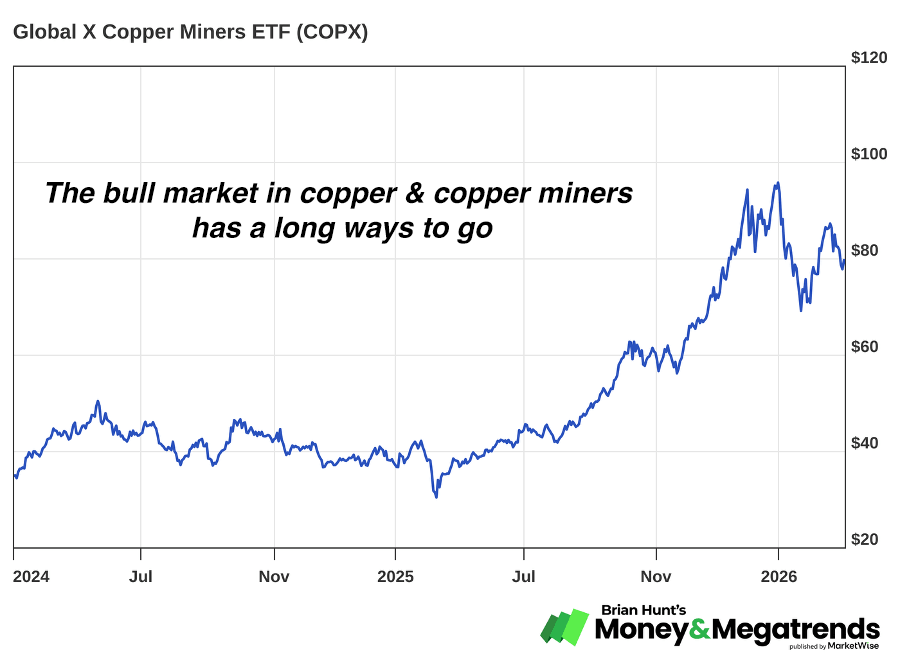
This bull case is proving to be very profitable. The copper market’s long-term bullish dynamics are creating a glacier-like megatrend of gradually rising prices. Copper prices are up about 35% over the past two years… which is driving the market values of copper mining firms like Freeport-McMoRan (FCX), Southern Copper (SCCO), and Teck Resources (TECK) higher and higher.
In a Sept. 25, 2025, note, I highlighted the copper mining sector’s bullish price action and reiterated my call to own it. The Global X Copper Miners ETF (COPX) has gained 51% since then.
After such a strong short-term performance, it’s reasonable to ask if the good times in copper are over. To this, I’ll remind you of something I’ve said many times in M&M: When critical resource markets trend, they often trend big. Their trends often go for hundreds of percent gains and last 5+ years.
This is because major shifts in resource supply and demand play out over years, not months. If the world decides it wants a new copper mine, it will not get that mine for a decade. You cannot print or code a copper mine into existence.
Many commodity market trends are glacier-like and play out over 5+ years. That means the uptrend in copper and copper miners – fueled by the AI and Power Grid Upgrade booms – will likely last at least as long. I’m still long.
Recommended Link:
Jeff Clark’s First-Ever “12 Trades to $1 Million” Challenge Goes Live May 14th

For the first time in his 44-year career, master options trader Jeff Clark is attempting a formal trading challenge: 12 trades, one goal. Turn a $5,000 stake into $1 million or more. He’s going live on Thursday, May 14th at 10 am ET to explain the market setup he says makes this uniquely possible right now, and how you can follow along. Click here to save your free seat.
How an ignored corner of the chip market could be AI’s biggest winner

Credit: Ignatiev
This week, Anthropic CEO Dario Amodei said his company tried to plan for 10-fold growth over the short-term. However, revenue and usage growth of the company’s hit AI model Claude recently increased 80-fold on an annualized basis in the first quarter.
Anthropic’s incredible growth has been fueled by Claude, which has taken the world of software development by storm. Top software builders say Claude has made them at least five times more productive… so demand for it is skyrocketing.
Anthropic is currently in talks with investors about raising money at a gigantic valuation of $900 billion. Anthropic and its chief competitor OpenAI are the fastest growing companies in history.
These are the latest extraordinary developments in the explosion of AI and the proliferation of AI agents, a megatrend we call the “Agent Supernova.”
AI agents autonomously perform work that only humans can perform now. Soon, we will see an explosion of AI agents performing work in factories, offices, stores, ships, building sites, labs, hospitals, schools, and businesses. Soon, we will have agents working with people. Agents working with other agents. Agents running businesses. Agents negotiating and haggling with other agents.
The Agent Supernova is poised to reorder how the world works. It will break and reform many businesses, industries, and societal norms. Of course, the business and investment implications here are huge. The Agent Supernova will end many businesses and jobs as we know them… while creating thousands of new ones at the same time. The economic deck is about to get reshuffled.
We are certain the explosion of AI agents is bullish for the “power management” sector of the semiconductor industry.
These days, you can’t read an AI investment research report or listen to an AI-focused podcast without hearing about its insatiable demand for electric power and how it is the limiting factor in AI proliferation. You hear about towns protesting AI data center power consumption. You hear how limited power access it is limiting Anthropic’s growth. You hear why limited power access is driving Elon musk to operate data centers in space.
All this means that the pressure to improve AI’s power consumption efficiency – or its “unit of intelligence per unit of power ratio” – is enormous. Any improvement in AI power consumption efficiency – no matter how small – can produce huge costs savings across the industry.
And that means companies that help improve AI’s power consumption efficiency stand to make huge amounts of money and make their shareholders very wealthy.
AI data centers need high-voltage, high-density power systems to keep everything running. Edge devices like robots, smart homes, and autonomous vehicles need efficient local power management to run locally without burning through batteries or generating excess heat.
You could think of the potential savings and efficiency gains here by thinking of America and its automotive fleet of 280 million+ cars driving billions of miles every year. All that driving consumes so much gasoline that tiny gains in overall fuel economy can result in giant fuel cost savings.
Now, instead of picturing car traffic and its gasoline consumption, think of AI’s data and “thinking” traffic and its electricity consumption.
Small power efficiency gains across many AI data centers, communication networks, and Edge Computing devices can result in huge overall power cost savings… plus greater growth opportunities for hundreds of AI applications.
The semiconductor industry is varied. It has dozens of large players that focus on different kinds of applications. One of these applications is electric power management: Ensuring AI data centers and communication networks use power efficiently. Ensuring cars, robots, factories, phones, hospitals, and office computer networks use power efficiently.
Since AI usage is poised to proliferate during the Agent Supernova, the demand for innovation and quality equipment from the power management semiconductor sector is poised to soar. This will benefit several companies with specialized technology solutions, including:
Texas Instruments (TXN) is a $245 billion company that has more recently developed 800V power architecture with Nvidia. 800V is the perfect next-generation voltage now because it strikes a balance between efficiency, safety, cooling, and overall practicality. This has made them a strong competitor in the data center space with data center revenue growing 90%. TXN are also developing microcontrollers which are smaller computers built onto a single chip. These don’t require huge compute power making them perfect for edge devices like sensors, motors, batteries, and smart appliances. This broadness gives TXN the ability to compete across the entire ecosystem from the data centers to the edge.
Navitas Semiconductor (NVTS) is a much smaller and earlier-stage company than the other three. Its core business is making chips that convert and deliver electricity more efficiently than traditional technology allows – think faster phone chargers, more efficient data centers, and better EV charging stations. The materials it uses to build these chips – gallium nitride and silicon carbide – are newer and more capable than the silicon that most chips have been made from for decades. The company is not yet profitable and has only around 190 employees, so this is a growth bet rather than an established business. The upside case is that its technology becomes the standard as the world builds out EV charging and AI data center infrastructure.
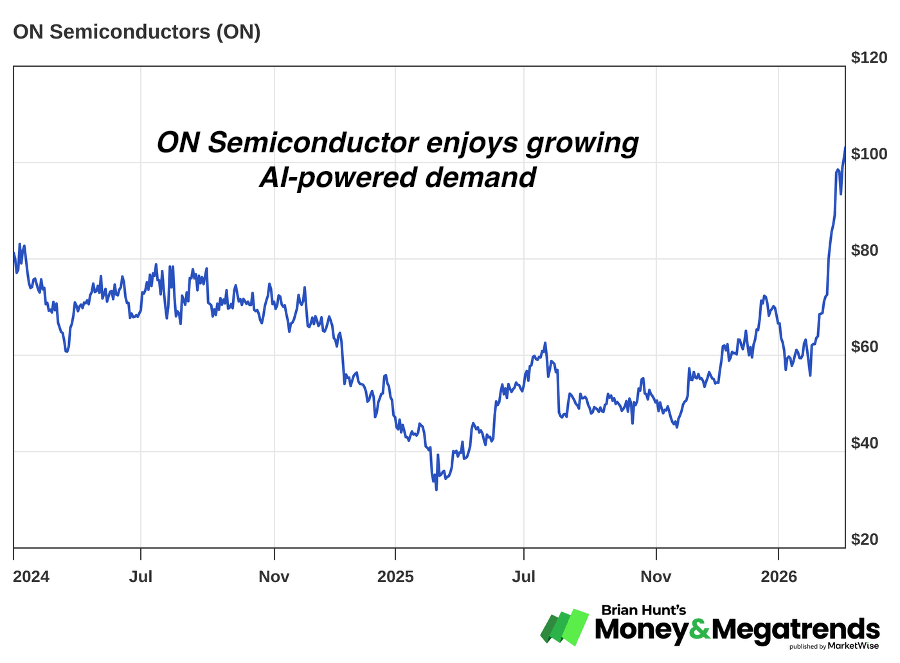
On Semiconductor Corp (ON) makes two types of products that are becoming increasingly important: chips that manage power in electric vehicles, and sensors that help machines “see” – used in factory robots, driver assistance systems, and automated cameras.
Wolfspeed (WOLF) is the most complicated story of the four. It went through bankruptcy in 2025. It makes chips from silicon carbide – a material that handles high power and heat far better than ordinary silicon, which makes it valuable for electric vehicles and power grid applications. The WOLF is only just getting started. If you’re comfortable with risk, WOLF could be an interesting idea.
Market Notes
-
Our recommendation to invest in the Agent Supernova via data traffic firms is off to a heck of a start. Leading data traffic firm Akamai (AKAM) soared 18% this morning to reach a new high after announcing a major AI infrastructure deal.
-
Our recommendation to ignore the AI bears and stay long AI infrastructure continues to pay off. The VanEck Semiconductor ETF (SMH) reached a new all-time high today. The fund is up 152% over the past year.
-
The bull market in solar energy, which we’ve highlighted many times, continues to run higher. The Invesco Solar ETF (TAN) reached a new one-year high today.
-
Our recommendation to invest in the robotics megatrend continues to be a home run. The ROBO Global Robotics and Automation ETF (ROBO) reached a new all-time high today.
-
Our January 12th recommendation to own AXT (AXTI) is now up 410% since our initial article. It just reached a new all-time high again today.
-
Our December 8th recommendation to own EnerSys (ENS) is still winning. It just hit another new yearly high and is now up 52% YTD and 56% since our recommendation.
-
Our February 13th recommendation to own Synaptics (SYNA) is up big now. SYNA is up 12% today after a strong earnings report.
Regards,


Brian Hunt
Editor, Money & Megatrends
An urgent message from our colleagues:
CNBC Calls Hims “The King of Quants”

Apple, Amazon, Google, Nvidia… Louis Navellier used his quant stocks system to catch them all early. Now, his system is giving a bullish rating to stocks tied to the May 15 Fed shift. He’s identified 53 stocks to watch — and will reveal his #1 pick live on May 13.
Save your seat here.