
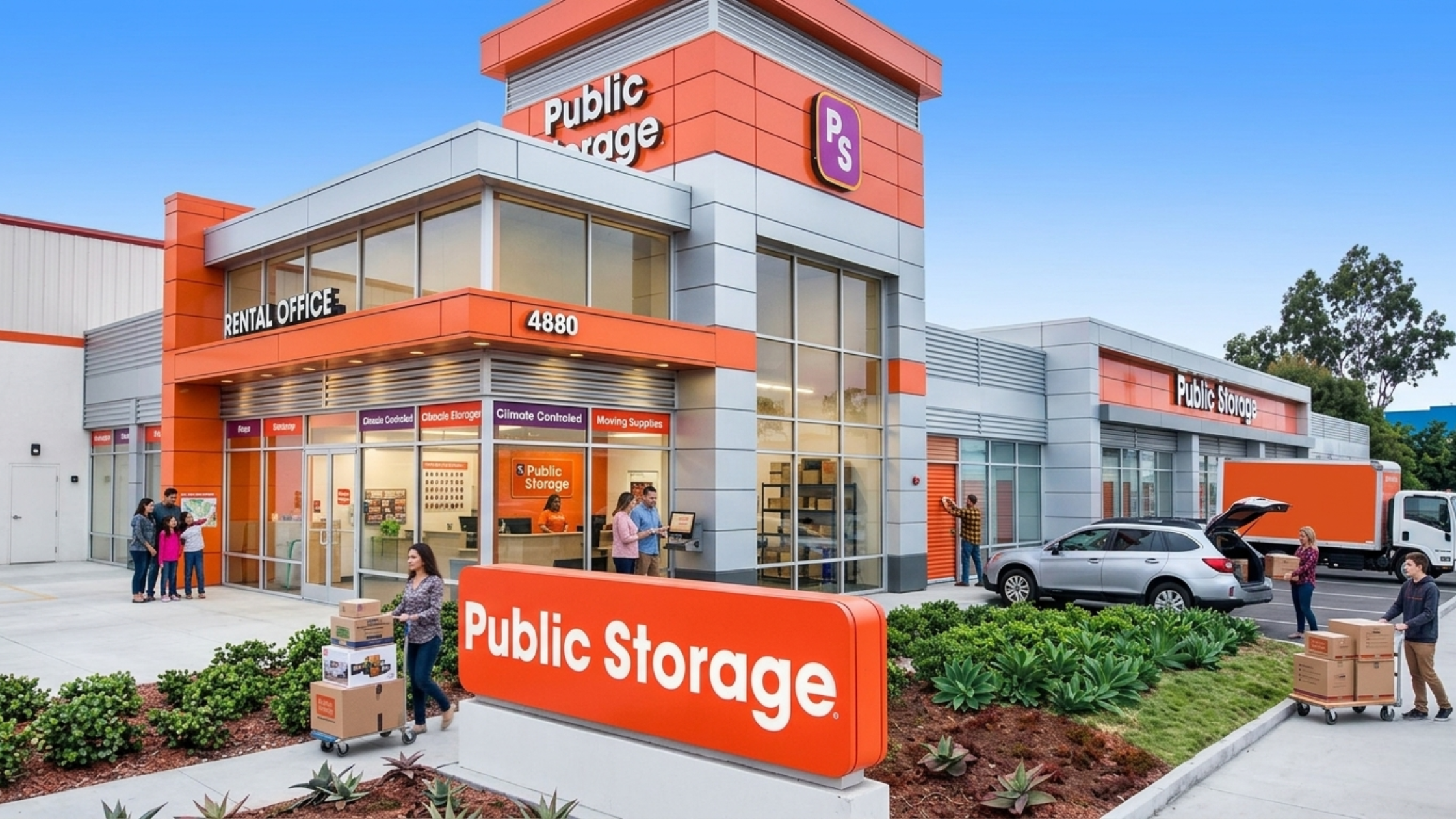
Public Storage (PSA) just announced a huge acquisition that should help kickstart its recently announced transformation. The real estate investment trust (“REIT”) is buying National Storage Affiliates Trust (NSA) in an all-stock deal with an enterprise value (stock plus net debt) of $10.5 billion.
For each of their shares, NSA investors will receive 0.14 shares of Public Storage, the largest self-storage REIT, with a reference price of $41.68 per share.
It’s a sizable deal and offers clear advantages for PSA investors. The REIT can improve operating efficiencies and reduce costs across the acquired properties.
Plus, management says the transaction is accretive to funds from operations per share in the year after closing. This suggests the new PSA shares issued for the deal will not dilute value for existing investors.
The Public Storage/NSA acquisition comes just as the REIT is transforming itself under what it calls PS4.0. It’s an initiative aimed at achieving higher total long-term shareholder returns. The initiative is also driving sweeping leadership changes across both its executive team and the board of directors.
The acquisition should be a positive move for a stock that sits where it did five years ago.
Sure, the stock enjoyed a run-up – like many REITs did – during the COVID-19 era when the Federal Reserve dropped interest rates to nearly zero. But with the stock flat since then, investors have enjoyed only that (admittedly) meaty dividend over that period.
The low return belies what is a fundamentally strong operational performance, particularly at its individual locations, where Public Storage puts up some industry-leading margins.
With the planned leadership transition, new management incentives, a solid dividend, and a reasonable valuation, Public Storage looks like an interesting buy, though not a slam dunk.
The Benefits of the Public Storage/NSA Acquisition
Public Storage has been a great performer over time, and it’s the market’s largest self-storage REIT. That has pros and cons.
On the positive side, management has shown a strong record of operational performance. It also has one of the most interesting balance sheets you’ll find – reducing its financing risk (more on this below).
The flip side is that its success means it’s large, and it needs needle-moving acquisitions like the NSA deal. It can’t just add a dozen new properties each year and show meaningful growth.
That’s where the Public Storage/NSA acquisition comes in.
The NSA deal quickly expands Public Storage’s footprint, providing it with more than 1,000 properties. Public Storage will wholly own 488 of them, focusing on core markets and higher-growth locations, like those in the Sun Belt. This complements Public Storage’s existing interest in nearly 3,200 locations and management of 362 facilities.
The NSA acquisition also consolidates Public Storage’s position in locations that it views as key to its long-term growth.
A key part of the deal’s value is the potential to increase margins across NSA’s properties. Those properties are currently running at store-level direct operating margins of 69%, in line with publicly traded peers. Management believes it can raise that to Public Storage’s 78%.
Between increased revenue and operating efficiencies, management expects to generate an incremental $110 million to $130 million in synergies.
The company is taking on some secured mortgage debt for the transaction. However, the overall leverage will remain the same if Public Storage cuts costs as management expects.
So, Public Storage’s credit rating – the best among publicly traded U.S. REITs – should remain unaffected. A strong credit rating helps Public Storage in at least a couple of ways:
- More efficient management: Low-cost financing is a key factor in how Public Storage can manage its assets more efficiently than its rivals can.
- More competitive bids: Its cost-of-capital advantage lets the REIT make more competitive bids on acquisitions – which investors should expect to continue.
Public Storage takes this financing advantage further with one of the most unusual financing structures, even for a REIT.
While REITs often issue preferred stock – which acts more like a bond than stock – they typically have up to three series of preferreds. In contrast, Public Storage is in a class by itself.
PSA has 14 separate series of preferreds.
One key advantage of preferred stock is that the dividend can be suspended, if need be. This reduces leverage risk in adverse scenarios, giving PSA added flexibility.
Another advantage is that preferred stock can be issued perpetually, so that it never matures. This lets a company lock in permanent financing – financing that literally never comes due.
Public Storage has taken full advantage of this latter feature to issue preferreds at ultra-low rates. Its coupon rates range from 3.875% on its Series N stock to 5.6% on its Series H stock. Management aggressively refinanced their preferred stock lower as interest rates fell in the past decade.
In total, all but three series of preferreds have coupon rates below 5% – and seven series have rates below 4.125%. That low-cost financing gives PSA a significant long-term cost advantage.
Is PSA Stock a Buy?
Public Storage offers several compelling factors – strong store-level operations, solid financing, a dividend currently at 4.1%, and the NSA acquisition that should add meaningful growth.
Two other factors make PSA worth watching: a more attractive industry environment and increased executive alignment.
Public Storage is looking to capitalize on a wave of potential company sales, as long-tenured founders plan their estates and look to exit the industry. That opens opportunities for PSA investors, given the company’s cost-of-capital edge.
The PS4.0 initiative aims to capitalize on this trend and accelerate portfolio growth generally. Great news for investors in a skilled operator.
Public Storage has also redesigned its incentive system for 2026 to focus more on “our primary objective of shareholder outperformance.” As the company says in its description of the system, “This represents an important cultural shift spurring urgency and execution obsession.”
For investors who have endured so-so returns in the past five years, this redesign is welcome news. It doesn’t hurt that management is using such emphatic words – “execution obsession” – to describe it. It’s a positive sign backed by the NSA acquisition.
So, is PSA stock a buy?
In the recent past, Public Storage may have been a better trade than a buy-and-hold. Wait for the industry fundamentals to brighten, hold for a couple years, and sell as the future looks dimmer.
But now that may be a less attractive approach.
PSA stock trades at about 18 times management’s low-end estimates of $16.35 core funds from operations for 2026. That’s neither cheap nor obviously expensive. But that 4.1% dividend gives investors plenty of reason to wait and see if the newly redesigned incentives work here.
Regards,
James Royal
Editor’s Note: Elon Musk reinvented the auto industry, sparked a new era of space exploration, and built the world’s largest satellite network. But his new initiative – “Project Apex” – could become the crown jewel of his career. And, like Tesla, it could make early investors incredibly wealthy. See below for the details…