Today’s issue in preview:
-
Soaring power demand sends natural gas stocks to new highs. They can run much higher from here.
-
The most concerning chart in the stock market right now.
-
The market values of safe critical resource depots are soaring. That’s great for Canada.
Soaring power demand sends natural gas stocks to new highs. They can run much higher from here.
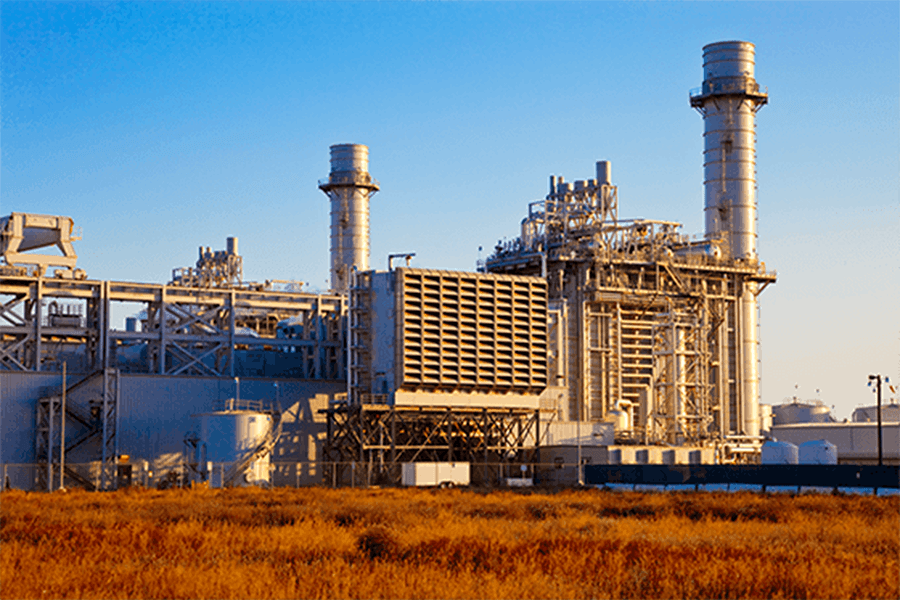
Credit: Ron and Patty Thomas
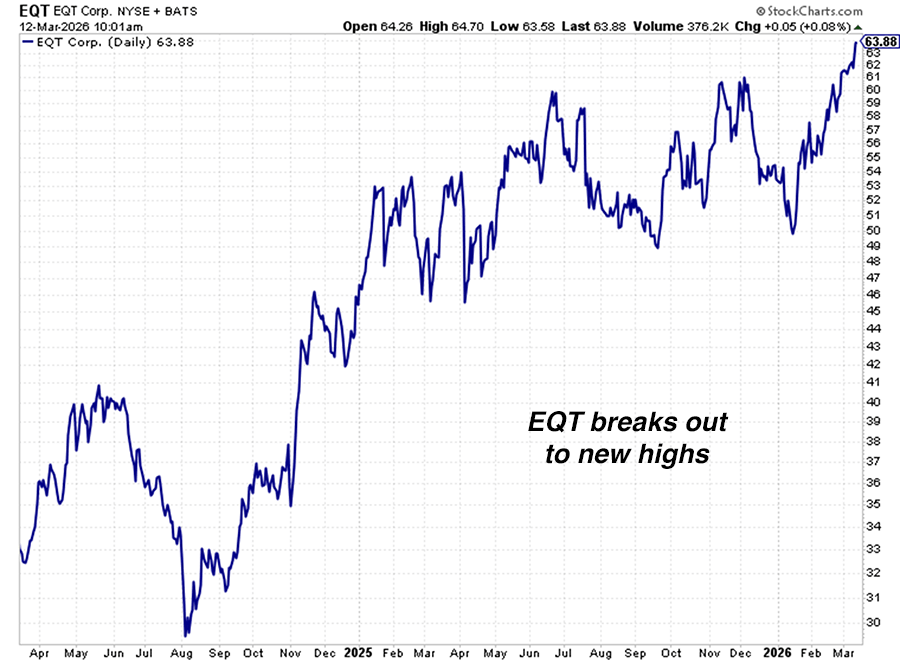
This week, shares of natural gas giant EQT (EQT) broke out to new all-time highs, in a sign the natural gas trade we’ve been covering is ready to run.
On October 2, 2025, I introduced the “bull case” for natural gas. Given AI’s incredible promise, big tech firms like Google, Amazon, and OpenAI will build dozens upon dozens of power-hungry data centers over the next five years.
This will drive increased demand for natural gas, which is the preferred clean-burning fuel for many power plants. Growing European demand for U.S. natural gas exports (to reduce reliance on Russia) is also poised to be a major driver of natural gas demand.
With this backdrop in mind, some of the world’s top investors have taken positions in major American natural gas producers, including EQT, Range Resources (RRC), Antero Resources (AR), and Expand Energy (EXE). These stocks could double, then triple, over the coming years as AI and Europe drive strong consumption.
As you size up the natural gas trade, remember that when a commodity market like natural gas, copper, or sugar trends, that trend can be very large and last a long time. The supply/demand dynamics in most metals, energy, and agricultural markets play out over years, not months.
For example, when the world decides it needs a big new copper mine, it’s not going to get that copper mine for at least 10 years. Big copper mines take a long time to finance, permit, and build. Same with big gold mines. Same with big oil fields.
As you can see from the chart below, natural gas stocks are trending higher. EQT just broke out of a long consolidation phase and hit new all-time highs. Fellow producer Range Resources looks much the same. Soaring demand plus a trend in motion is a recipe for higher prices ahead.
Recommended Link:
The coming 30 days will stress test your entire financial life… Here’s how to get “FutureProof”

Energy costs are soaring. Gas prices are through the roof. And now, your retirement savings are at risk of taking a major hit beginning April 24th. Three announcements in the final week of April could send up to $10 trillion flooding out of big-name stocks everyone owns and into a new, little-known class of “futureproof” companies – potentially sending some stocks soaring as high as 10X. Get the full list of 15 tickers you need to know at next week’s FutureProof 2026 event.
The most concerning chart in the stock market right now
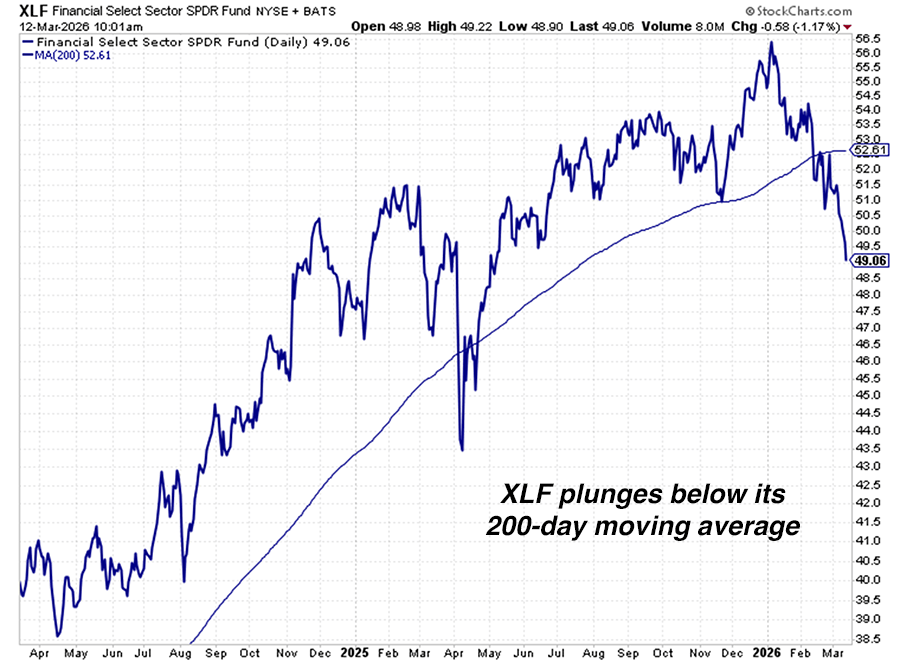
On January 6 of this year, the Financial Select Sector SPDR Fund (XLF) reached a new all-time high, signaling that the U.S. banking industry was doing well.
Today, it’s a much different story. XLF is trending lower and is the most concerning chart in the stock market right now.
XLF is the market’s largest and most liquid ETF focused on the U.S. financial sector. Major holdings include JP Morgan Chase (JPM), Bank of America (BAC), Wells Fargo (WFC), Berkshire Hathaway (BRK.B), Goldman Sachs (GS), and Visa (V).
These firms and others like them form America’s financial backbone. They rise and fall with America’s ability to make money, save money, start companies, service loans, invest money, and generally just “get along.”
From late 2023 to early 2026, XLF enjoyed a bull market, and its members reported robust growth. But over the past two months, investors have grown concerned about the health of U.S. banking and the larger economy. AI is threatening major industries, such as software, in which the banking industry has significant exposure. In addition, Operation Epic Fury could constrict supplies of critical resources and damage the economy.
In response, investors have sold XLF and its constituents so enthusiastically that XLF is down 11.5% from its high and has just reached its lowest point in nine months.
Importantly, XLF is also below its 200-day moving average, which is used to gauge a security’s long-term trend. Securities below their 200-day moving average are on the wrong side of the tracks. It’s the ugly part of town.
All the really bad things – crashes, panics, horrible bear markets – happen below the 200-day moving average.
XLF’s recent weakness is no guarantee of a U.S. recession or a bear market in stocks. It is, however, a point of great concern. America’s financial backbone is trading terribly. To say we’re in a healthy market, XLF needs to rally at least 6%, get back to at least the $53 area, and get back on the right side of the tracks.
The market values of safe critical resource depots are soaring. That’s great for Canada.
Credit: oversnap
Another day goes by with Operation Epic Fury straining the global economy… and another day Canada shines as a wonderful investment destination.
Over the past eight months, I’ve made the case that we are in a favorable environment for critical resources… one in which many individual resource sectors will generate strong returns.
Critical resources are the building blocks of the economy. Think raw materials like crude oil, natural gas, iron ore, copper, uranium, corn, and cotton.
Even today’s high-tech world of AI, apps, email, and Zoom calls is built on a “low-tech” foundation of steel, concrete, copper, lumber, and aluminum. Every day, our cars, trucks, and airplanes consume millions of barrels of fuel. Our lights turn on because we burn coal and natural gas.
Mining, extracting, planting, harvesting, processing, refining, and transporting critical vital resources is a multi-trillion-dollar business that affects every area of your life.
During this time, I’ve highlighted Canada as an excellent place for investment capital. Canada is the second-largest country in the world by total area, after Russia. This means there’s plenty of area to hold big oil and natural gas deposits… huge tracts of timberland… giant mineral deposits… and enormous farms. Canada is a major player in oil and natural gas production, ranking in the world’s top five producers for both.
Last week, I detailed how Canada’s Suncor Energy (SU) has soared thanks to Operation Epic Fury’s disruption of the global oil market. Suncor owns over 6 billion barrels of proven and probable reserves, which are located in a very safe country. (Caribou do not mine critical waterways, and they do not attack oil refineries.)
But don’t forget that Canada is a fertilizer production powerhouse.
Fertilizers such as potash and nitrogen are critical components of the global food supply. They play a key role in maintaining high crop yields and keeping people fed. Canada is one of the world’s largest exporters of these critical resources.
Much of the country’s production is thanks to the $40 billion fertilizer giant Nutrien (NTR). The company operates some of the world’s largest fertilizer mines, located in Saskatchewan.
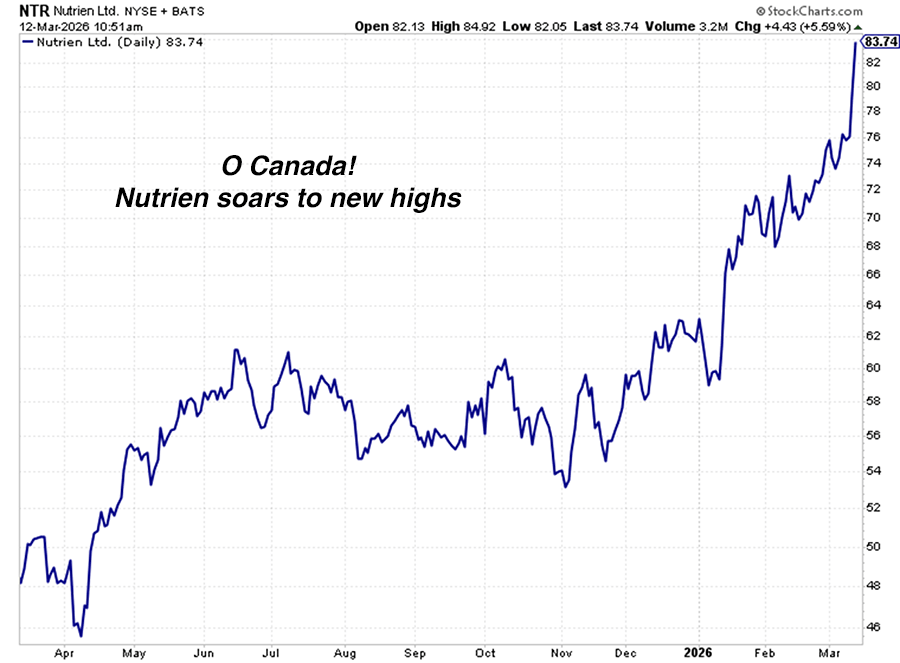
Like Suncor, the market value of Nutrien has soared recently thanks to Operation Epic Fury choking off exports from Middle Eastern producers. Nutrien stock is up 16% over the past month and just hit a new one-year high.
With this rally in mind, I repeat my big-picture analysis from last week’s Suncor note: In a deglobalizing world where individual countries and regional economic blocs hoard and nationalize scarce and desperately needed critical resources, the price of those resources will go up.
And when those resources are located in Canada, all the better.
Market Notes
-
The oil industry continues to lead the market. Oil giants Chevron (CVX), Shell (SHEL), Petrobras (PBR), BP (BP), Canadian Natural Resources (CNQ), Suncor (SU), and Cenovus Energy (CVE) reached new highs today.
-
Fertilizer giant Nutrien (NTR) reached a new one-year high today. Operation Epic Fury is constraining fertilizer shipments, making Nutrien’s production more valuable.
-
Alcohol giants Diageo (DEO) and Brown Forman (BF/B) both reached a new one-year low today. The booze industry is suffering from a decline in drinking rates.
-
Timberland giant Rayonier (RYN) reached a new one-year low today amid concerns that economic weakness will hurt the housing market.
-
European auto giant Stellantis (STLA) – the parent of Dodge, Jeep, and Fiat – reached a new one-year low today.
-
Aluminum product maker Century Aluminum (CENX) reached a new one-year high today.
Regards,


Brian Hunt
Editor, Money & Megatrends
An urgent message from our colleagues:
Why are companies flying spy planes over Elon’s closely-guarded AI lab?

Elon did the seemingly impossible – far faster than anyone expected… And it’s sent the tech industry into PANIC MODE. ChatGPT, Claude, Google Gemini, and DeepSeek could soon become obsolete. And three little-known firms could soar 10X or higher as a result.
Get the details here.