
Today’s issue in preview:
- Three stocks that will benefit from the next AI demand shocks
- A machine vision leader soars… are you making money in robotics yet?
- Our hot hand continues: The Boomer health care, defense, and housing rebound themes continue to generate winners.
Three stocks that will benefit from the next AI demand shocks

Credit: Sumedha Lakmal
For three years now, the ultimate way to make money quickly in stocks has been to locate an industry where an AI “demand shock” is about to strike… and then invest there before the shock arrives.
Not a supply shock, mind you, where a war or a pandemic abruptly cuts off the supply of a resource like oil.
Instead, I’m talking about a “demand shock,” where demand for a specific resource or manufactured product suddenly skyrockets… and sends its price hundreds of percent higher. This creates boom times for the companies involved, as their unit sales and per-unit prices skyrocket at the same time.
Twenty years ago, demand shocks for manufactured goods and natural resources were relatively rare. Businesses had time to anticipate new sources of demand and plan accordingly. For many industries, those days are over.
AI – the fastest-evolving technology in history and the focus of the largest capex spending cycle in history – has changed the rules.
AI’s power, adoption rates, and capacity are exploding… from just one quarter to the next.
AI is advancing at such a rapid pace… and large tech firms such as Google, Microsoft, and Amazon are spending such huge, unprecedented amounts of money on it (over $600 billion in 2026 alone) that AI-driven demand shocks are now happening every year… and creating the biggest, fastest stock market moves we’ve ever seen.
Of course, some people are making lots of money in the process…
**In 2023, just after ChatGPT was introduced, there was an AI demand shock for Nvidia’s advanced semiconductors. The company’s revenue soared as a result, and so did its stock price. Nvidia advanced 525% in less than two years.
**Around the same time, there was a demand shock for systems that cool AI data center components. This drove shares of cooling systems maker Vertiv up 1,050% in under three years. It sent shares of Comfort Systems up 1,000% in three years.
**Then there was a demand shock in AI data center power demand that sent shares of data center power generation company Bloom Energy up 1,232% in less than two years.
**AI data centers require advanced optical systems that allow fast data transfer. This demand shock drove the stock of optics firm Coherent up 295% in two years. It drove the stock of optics firm Lumentum up 1,164% in two years. It drove shares of optics materials firm American Xtai up by 1,035% over two years.
**AI data centers also drove a demand shock in memory systems that support computer processing. This drove SanDisk’s stock up 1,567% in just one year and Western Digital’s stock up 579% in two years.
These are some of the largest and fastest wealth-creation events in history.
They are happening because Big Tech’s historic investment spree and AI’s breakneck rate of advancement are creating massive demand spikes that traditional manufacturing and resource chains are simply not equipped to handle. They don’t have enough lead time to adjust to rapid demand shocks. The trends are taking shape and exploding too quickly.
One day, an aggressive demand forecast for AI infrastructure components such as optical lasers or memory or semiconductors is just a spot on the horizon to conventional thinkers… a futurist’s fantastical estimate…
… The next day, the demand spike is on us… and we don’t even have blueprints for the new factories we need today. So, prices explode by 3, 5, even 10 times or more. The demand shock hits the market like a meteor.
The typical manufacturing industry needs 5-10 years to build operations capable of meeting increasing demand. Same with mining industries that supply critical raw materials.
But our new, lightning-fast technological cycles now move way, way faster than that. They are hitting our economy like supersonic tidal waves. We now have crazy mismatches in the economy’s interlocking and interdependent parts. It’s like we have a 12,000-horsepower funny car engine but the drivetrain from a 1996 Hyundai Elantra.
These factors are creating a market environment where the market values of well-positioned companies can rise 100%… 300%… and 1,000% in less than two years.
With this in mind, an investor should ask: “Where will the next AI demand shock take place? Where will AI take almost everyone by surprise as it did in semiconductors, memory, optics, and cooling?”
Put differently, where can you invest $25,000 and walk away with $100,000… or even $250,000 in less than two years?
I suggest “Edge Computing.”
Edge Computing refers to “your local devices.” For individuals, it means the computers in your smartphone, your house, your car, and your medical devices. For businesses, it means factory robots, warehouse robots, and local servers.
Now that “Big Tech” has built useful “general purpose” AI programs and infrastructure, the next big thing is getting fully operational, incredibly useful, and incredibly addictive AI installed on “the edge”… where our local devices can run it without having to communicate with centralized facilities. This is the era where AI will achieve mass adoption.
This big shift to “the edge” will likely create another massive hardware supercycle that goes far beyond Nvidia. We need new chips, new memory, new power management, and new advanced sensors. And we need them all to work together so AI can run locally.
The giants that dominated the data center build-out won’t necessarily dominate the Edge cycle. The winners of the Edge will be the specialists – the companies building the precise, low-power, high-efficiency components.
Some companies poised to benefit from the Edge megatrend include:
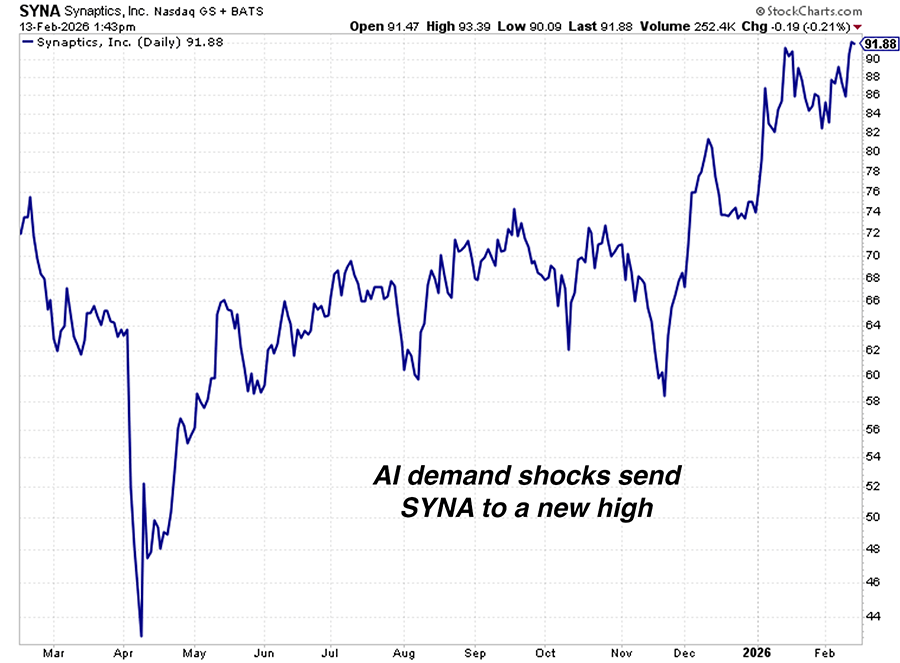
Synaptics (SYNA): SYNA specializes in Edge AI processors for smart home devices, appliances, TVs, robots, and smart gadgets. Core IoT (closely related to Edge) sales jumped 53% year over year, with total revenue up 13%. As robots and smart home products become more commonplace, SYNA demand will jump.
Ambarella (AMBA): AMBA specializes in high-performance chips for cameras, self-driving car tech, drones, security cameras, and robots. Edge AI makes up ~80% of its current sales, with revenue growing over 30% year over year.
NXP Semiconductors (NXPI): NXP targets Edge AI for cars and factories, like SYNA, but for the industrial and automotive part of the economy. Revenue growth is slower than SYNA’s, but NXP is a $62B company, making it a slightly safer bet.
Get ready to hear about Edge Computing a lot more. More importantly, get ready to invest in well-positioned companies before the next demand shock… and before the crowd arrives.
A machine vision leader soars… are you making money in robotics yet?

Credit: Borislav
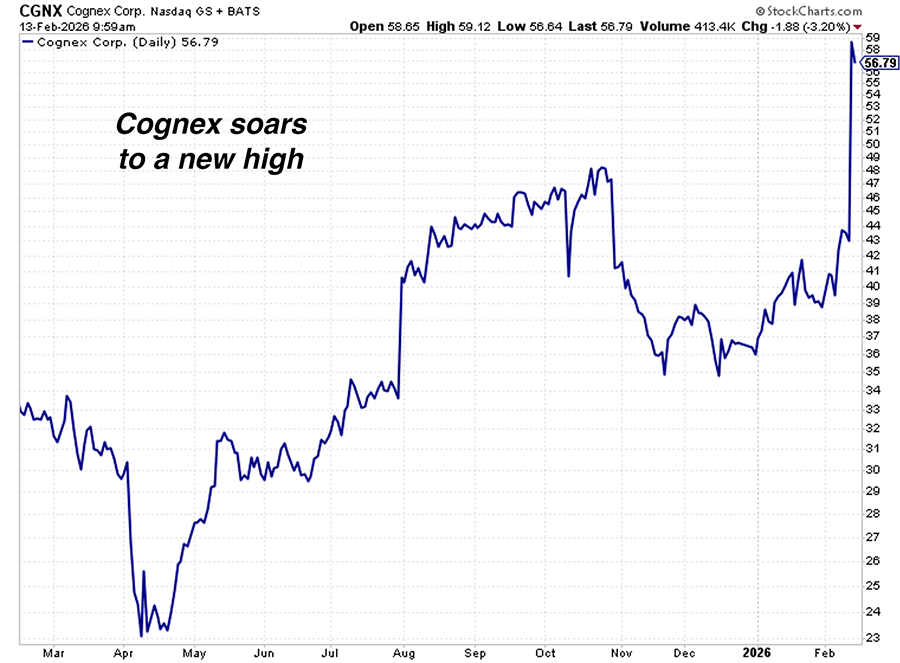
On Thursday, leading machine vision firm Cognex (CGNX) soared 36% after it reported strong earnings and revenue that beat Wall Street estimates. The company also shared strong future guidance. The 36% jump took Cognex shares to a new one-year high.
This is yet more evidence that the robotics megatrend is a good place for investors.
Over the past two years, I’ve urged friends and colleagues to become heavily involved in the robotics megatrend. It is one of the most significant financial opportunities of our lives.
It is a massive, multifaceted trend that will transform the world. It will yield greater factory automation, surgical robots, autonomous cars, autonomous air taxis, humanoid worker robots, and much more. It will allow us to interact with AI every day. Robotics investment is expected to increase by at least 15% annually through the rest of this decade. Within five years, Amazon will utilize more robots than employees.
Much more important than this forecast, however, is what the market thinks of this forecast. In the case of robotics, the market thinks highly of it.
On January 30, I highlighted how semiconductor and robotics leader Teradyne (TER) is soaring to new highs. Japanese robotics giant Fanuc (FANUY) recently hit a one-year high. The ROBO Global Robotics and Automation Index ETF (ROBO) recently hit a new all-time high. It has gained 28.9% over the past year.
In other words, Cognex’s strong performance is not an isolated case. The robotics industry has a “gale force” tailwind blowing at its back.
Robots must sense what is in front of them to be safe and useful, which is why one of this megatrend’s most promising sub-themes is machine sensory perception. This field includes cameras, lasers, heat sensors, force sensors, and magnetic field sensors. Cognex is a leader in this industry. Its strong earnings report and big stock gain are reminders that you want to be long robotics right now… and for years in the future.
Market Notes
- Our November 18th, 2025, recommendation to own healthcare is still in play. Astrazeneca (AZN) just hit a one-year high. It is up 57% in the last year. Merck & Co. (MRK) also just hit a three-month high. The Vaneck Pharmaceutical ETF (PPH) also hit a new yearly high today.
- Our December 11th recommendation to remain bullish on the semiconductor industry is paying off. Equipment supplier Applied Materials (AMAT) just hit a yearly high and is up 100% in the last year.
- Consumer goods giant Unilever (UL) just hit an all-time high.
- The defense megatrend continues to create winners. Defense giant Lockheed Martin (LMT) reached an all-time high today.
- Our recommendation to own pipeline operators continues to pay off. Big pipeline operators Enbridge (EB) and Enterprise Products (EPD) reached new highs today.
- The housing rebound trade is creating winners. Large homebuilders Toll Brothers (TOL) and Pulte (PHM) reached new one-year highs today.
Regards,


Brian Hunt
Editor, Money & Megatrends