
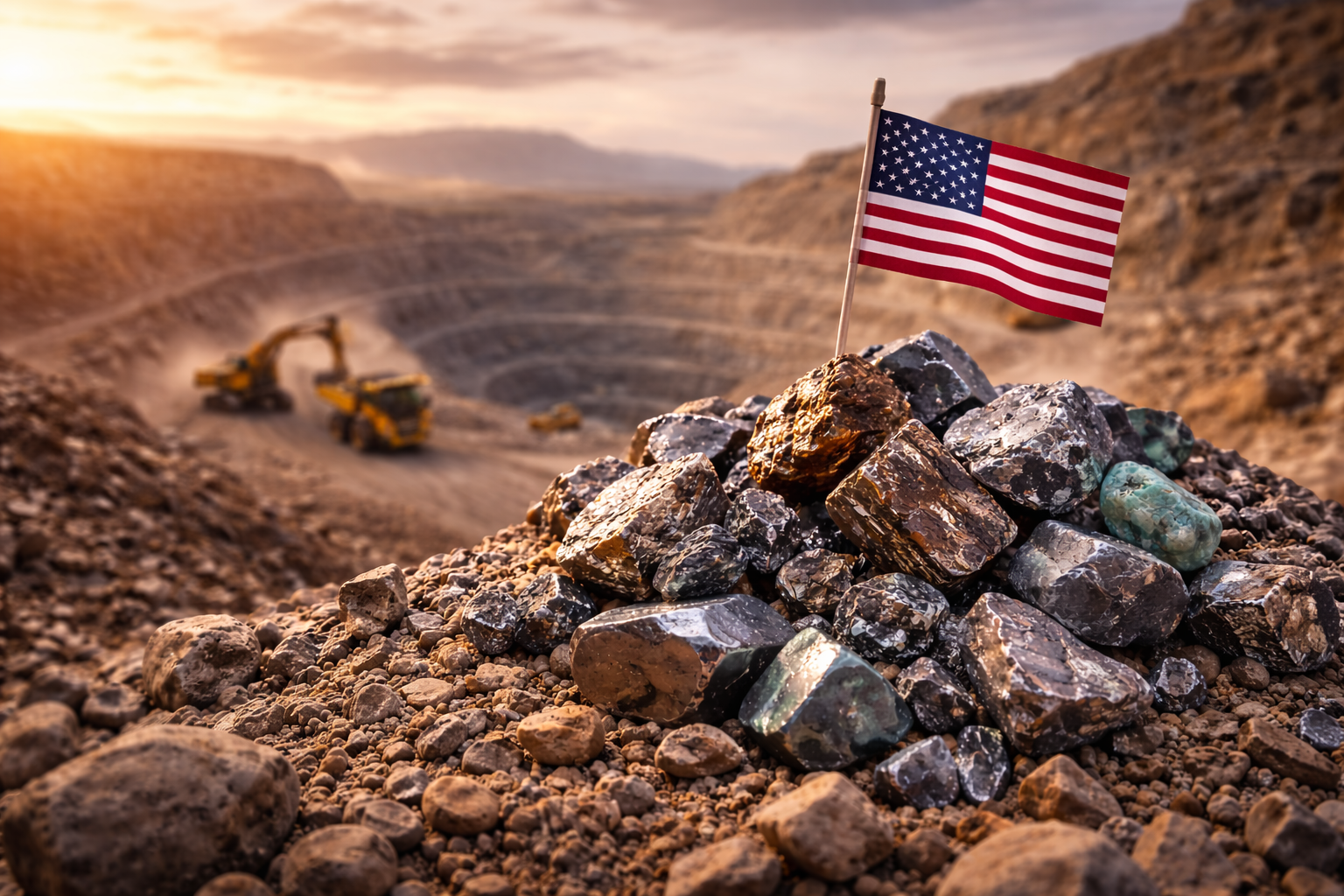
Image Credit: AI-generated illustration for editorial purposes.
A few years from now, we may look back on this month the way investors look back on the oil shock of 1973, when the price of strategically important materials exploded.
Deep in the Nevada desert, the hum of heavy machinery is trumpeting the arrival of a new kind of gold rush. But it’s not gold they’re after. It’s the rare earth elements and critical minerals fueling America’s “AI Boom.”
Right now, the United States does not control the raw materials powering its most important industries. In a bid to secure those strategic resources, President Donald Trump has launched “Project Vault,” a $12 billion U.S. critical mineral reserve reminiscent of a modern-day Fort Knox.
The goal is to break free from China’s stranglehold on the minerals that power everything from AI supercomputers to fighter jets.
The proof is in the price action.
On headlines alone, shares of Critical Metals Corp (CRML), developer of Greenland’s Tanbreez rare earth deposit, surged as much as 35% in a single day.
That’s what happens when investors realize the government may soon be one of the biggest customers in the room.
Yet here’s what many investors may be overlooking.
While headlines obsess over AI software, Nvidia (NVDA) chips, and rate-cut speculation, the real leverage may sit further upstream… in the companies digging, refining, and processing the materials that make the entire system possible.
MP Materials (MP) controls the only operating rare earth mine in the U.S.
USA Rare Earth (USAR) is developing one of America’s most significant heavy rare earth projects.
Energy Fuels (UUUU) is transforming from uranium production to rare earth processing.
American Rare Earths (ARRN) is advancing large domestic deposits.
And as we just saw, CRML sits at the center of Greenland’s strategic shift.
None of these are meme stocks. None are guaranteed winners. But all operate at the intersection of AI, geopolitics, and industrial policy.
The message is clear: rare earths are the “picks and shovels” play of the AI boom.
In this story, we explore why rare earth stocks sit at the center of that shift… and what Project Vault means for long-term investors.
The AI race isn’t just about algorithms.
It’s about who controls the materials underneath.
Let’s dig in.
Why Rare Earths Matter for AI Infrastructure and U.S. National Security
Why are rare earths suddenly making headlines? Because they are essential to manufacturing everything from precision-guided missiles and fighter jets to electric vehicles (EVs) and high-performance data center servers.
Massive cloud AI systems and advanced semiconductor manufacturing equipment depend on rare earth magnets, specialty alloys, and critical minerals to operate. Without them, the AI boom simply cannot scale.
The same dynamic is playing out across the clean energy transition.
Wind turbines, EV motors, robotics, 5G networks, and grid infrastructure all rely on a steady supply of rare earth minerals. These materials are not luxury inputs. They are core industrial components embedded in nearly every advanced technology platform.
China produces roughly 70% of global rare earth supply and controls about 90% of rare earth refining capacity. That dominance became clear during recent trade tensions, when Beijing restricted exports of key minerals used in semiconductors and EV batteries.
For decades, China invested in mines, refineries, and rare earth magnet manufacturing while many Western producers exited the market. By pricing aggressively and building vertically integrated supply chains, Beijing consolidated control over mining, processing, and downstream production.
The result is a strategic vulnerability. Rare earth magnets are a critical enabler of U.S. defense systems. Fighter jet engines, missile guidance systems, satellites, and advanced radar platforms depend on them. On the commercial side, AI chips, EV motors, and renewable energy systems require secure rare earth supply chains.
Without reliable access to rare earth elements and critical minerals, both economic growth and national security are at risk. That is why lawmakers increasingly describe rare earth supply as a strategic priority, drawing comparisons to the oil shocks of the 1970s.
How Project Vault Aims to Secure U.S. Rare Earth and Critical Mineral Supply
Project Vault is the Trump administration’s direct response to China’s dominance in rare earth elements and critical minerals.
Announced on Feb. 2, the initiative establishes a U.S. Strategic Critical Minerals Reserve, effectively a national stockpile of rare earth metals and battery materials funded by $10 billion in Export-Import Bank financing and $2 billion in private capital.
Think of it as a Strategic Petroleum Reserve for rare earth minerals like neodymium, praseodymium, dysprosium, lithium, and cobalt: the core inputs powering AI infrastructure, EV production, and defense systems.
The goal is straightforward: reduce U.S. dependence on Chinese rare earth supply and insulate American manufacturers from geopolitical shocks. If global trade tensions escalate or exports are restricted, domestic industries will have access to a secured reserve of critical minerals.
But Project Vault is more than a defensive stockpile.
By stepping in as a large-scale buyer of U.S.-produced rare earth elements and processed materials, the federal government creates price support and demand certainty for new mining and refining projects. In practical terms, this policy encourages investment in American rare earth mining, processing facilities, and magnet manufacturing capacity.
Export-Import Bank Chairman John Jovanovic described the plan as a catalyst to strengthen U.S. production and processing of critical raw materials. Commodities firms like Traxys and Mercuria are already participating in procurement efforts, signaling strong private-sector interest in rebuilding a rare earth supply chain outside China.
A central objective of Project Vault is diversification. By directing $12 billion toward suppliers outside China, the U.S. is attempting to rebalance the global rare earth market and break Beijing’s near-monopoly position.
That strategy extends beyond U.S. borders. It includes partnerships with allied nations such as Australia and Ukraine, both of which hold significant critical mineral reserves. It also includes renewed focus on Greenland, home to two of the world’s largest rare earth deposits: Kvanefjeld and Tanbreez.
Kvanefjeld contains vast quantities of magnet metals, including neodymium, praseodymium, dysprosium, and terbium — all essential for rare earth magnets used in EVs, wind turbines, and military systems. While political and environmental hurdles have slowed development, Tanbreez has continued advancing under U.S. ownership.
Critical Metals Corp, which controls Tanbreez, is working to bring the project into production. Investors have already shown how sensitive the stock can be to geopolitical shifts, with CRML at one point jumping 35% in a single trading session following renewed U.S.-Greenland discussions.
For rare earth stocks, this policy shift is significant. Federal backing, long-term offtake agreements, and diplomatic support reduce some of the uncertainty that has historically plagued Western rare earth projects.
Mining executive Robert Friedland recently noted that morale across the critical minerals sector is “sky high,” reflecting a broader belief that U.S. industrial policy has materially changed the outlook for rare earth supply.
In short, Project Vault represents one of the most aggressive efforts in decades to rebuild a domestic rare earth and critical minerals supply chain. Investors are beginning to price that policy shift into select rare earth stocks.
Rare Earth Stocks and Mining Infrastructure Plays to Watch Now
With federal backing and renewed focus on supply-chain security, investors are increasingly looking at rare earth stocks and mining infrastructure companies as a way to gain exposure to AI and clean-energy growth.
These companies operate upstream in the rare earth supply chain, including mining, processing, and magnet manufacturing. That positioning makes them direct beneficiaries of rising demand for rare earth elements used in AI servers, EV motors, defense systems, and renewable energy infrastructure.
MP Materials (MP) operates the only active rare earth mine in the United States at Mountain Pass in California. The mine produces roughly 15% of global rare earth concentrate. The company is expanding domestic refining and rare earth magnet production to reduce reliance on China. With U.S. government support and potential demand tied to the Strategic Critical Minerals Reserve, MP is positioned as a core U.S. rare earth supplier.
USA Rare Earth (USAR) is developing the Round Top project in Texas, one of the most significant heavy rare earth deposits in North America. Heavy rare earth elements such as dysprosium and terbium are critical for high-temperature magnets used in EVs and military systems. USAR is working to build an integrated mine-to-magnet supply chain within the U.S., though the project remains in the pre-production stage.
Energy Fuels (UUUU) is one of the most advanced rare earth processing companies in the U.S. Through its White Mesa Mill in Utah, it produces rare earth carbonate and is working toward full separation of neodymium-praseodymium oxide and heavy rare earth elements. Energy Fuels provides exposure to rare earth refining, a segment where China currently dominates.
Critical Metals Corp (CRML) controls the Tanbreez rare earth deposit in Greenland, one of the largest non-Chinese rare earth resources globally. The project is rich in magnet metals and has attracted attention amid U.S. efforts to diversify rare earth supply away from China. CRML’s stock has shown significant volatility tied to geopolitical developments.
American Rare Earths (ARRN) is advancing the Halleck Creek project in Wyoming, one of the largest rare earth deposits in the United States. While still in development, the asset could become strategically important as U.S. defense and procurement rules increasingly restrict Chinese-origin rare earth products.
Beyond miners, several industrial companies benefit from expansion of rare earth and critical minerals supply chains.
Olin (OLN) supplies chemicals used in rare earth processing.
Caterpillar (CAT) provides mining equipment essential for new rare earth and critical mineral projects.
Fluor (FLR) engineers and builds processing facilities and refineries tied to critical mineral development.
For investors evaluating rare earth stocks to buy, the opportunity spans the full supply chain, from mining and refining to industrial infrastructure, all positioned around growing demand for the AI buildout, electrification, and defense technologies.
The Big Picture on Rare Earth Stocks and U.S. Policy Support
U.S. government support for rare earth elements and critical minerals has materially changed the investment landscape. Through Project Vault and related initiatives, Washington is combining direct investment, loans, grants, and long-term purchase agreements to rebuild a domestic rare earth supply chain.
While formal price floors remain limited, federal backing and potential trade protections reduce downside risk for U.S. rare earth producers. Programs supporting companies such as MP Materials and USA Rare Earth signal ongoing government commitment to expanding domestic mining, refining, and magnet manufacturing capacity.
Still, challenges remain. Rare earth mining projects face permitting delays, environmental opposition, and high capital costs. Analysts estimate it could take three to seven years to meaningfully reduce China’s dominance in rare earth processing. Even then, the U.S. will likely rely on allied producers in Australia, Canada, and Europe to diversify supply.
Despite these hurdles, rare earth supply security is now a bipartisan priority. Both recent administrations have used tools such as the Defense Production Act and export financing to accelerate critical mineral development.
For investors, the core thesis is straightforward: rare earth elements and critical minerals are strategic inputs for AI infrastructure, electric vehicles, renewable energy, and defense systems. As governments increasingly treat these materials as national security assets rather than commodities, rare earth stocks tied to U.S. production and processing could benefit from sustained policy support.
Project Vault reinforces the shift toward domestic supply chain resilience. For long-term investors evaluating rare earth stocks, the opportunity centers on companies positioned to mine, refine, and process critical minerals outside China … and supply the industries driving the AI and clean energy transition.
Get in before the White House (our ticker list inside)
Rare earths and other critical mineral stocks have exploded higher this year — you could already have doubled your money 28 different times in 2025. But now the man ranked in 2020 as America’s #1 stock picker says the White House is set to buy a whole new group of stocks, in the biggest government buying spree in history. Here’s the name and ticker of every stock that could be next.