Image Credit: Associated Press
Gold is back in the headlines…
For most of the past decade, gold was essentially dead money. It sat there doing not much at all while stocks soared and crypto went parabolic. And so-called “gold bugs” looked like relics.
Then everything changed.
In the past two years, gold has more than doubled. It crushed the S&P 500 Index. It even outperformed bitcoin.
And the strangest part? The folks buying weren’t retail speculators or doomsday preppers. They were central bankers or billionaire hedge-fund managers who had previously spent their careers dismissing gold as a “pet rock.”
Now, some of Wall Street’s biggest banks project the price of gold could surge to unprecedented levels.
Stansberry Research Publisher Matt Weinschenk made a big prediction last summer:
Once upon a time, the idea that gold’s price would hit $5,000 was ridiculous. We used to laugh at folks who made such a claim. It looked like a flashy prediction just to get attention.
But that’s only a 50% move from today’s price. And with all the fundamentals in place, it now looks more like a conservative estimate.
So for everyday investors, the question is… how much higher will gold go? And more important, how can you profit from this boom?
Today, we’ll break down everything you need to know about this opportunity…
- From the big-picture forces driving gold higher…
- To the “secret” gold business model that has crushed other gold investments…
As you’ll see, there’s a specific type of gold company that has already turned a $2 million investment into more than $1 billion in cash payments. Early shareholders made returns north of 30,000%… some of the best returns we’ve ever seen in the gold space. And they could deliver extraordinary results for your portfolio, too.
Table of Contents
The Top Three Things You Must Know About the Gold Boom
The first thing investors should know is that this gold bull market is just beginning…
After a decade of stagnation, gold is breaking records and vastly outperforming stocks. Global political instability, high national and corporate debt, and central banks hoarding gold… all are ideal conditions for the price of gold to keep climbing.
Analysts think that this gold bull market could see the metal cross $10,000 an ounce… or even as high as $27,000 an ounce… before it ends.
And since we’re still in the early innings of a boom, getting in now is critical to capture the biggest gains.
Second, you probably haven’t heard about one of the most lucrative ways to get gold exposure…
My colleague James Royal recently detailed the three most common ways to buy gold… physical gold bullion or coins, established gold miners, and more speculative junior miners.
But there’s another, more secretive strategy that has historically outperformed both bullion and mining companies. It’s a “best of both worlds” way to profit from gold’s rise without the usual headaches of mining. (More on this business model in a moment.)
And finally, the single best gold investment right now may be a small gold company trading for less than $50 a share.
Companies like it have delivered 1,000%-plus returns over the past few decades, and this newer, smaller firm could have even greater upside ahead. It’s led by an experienced management team and is scooping up lucrative deals that the “big guys” overlook.
This company gives you a chance to leverage this secretive gold strategy and enjoy massive potential upside as the gold boom continues.
We’ll get to the specific company a little later on. First, let’s discuss…
Why Gold Prices Have Soared
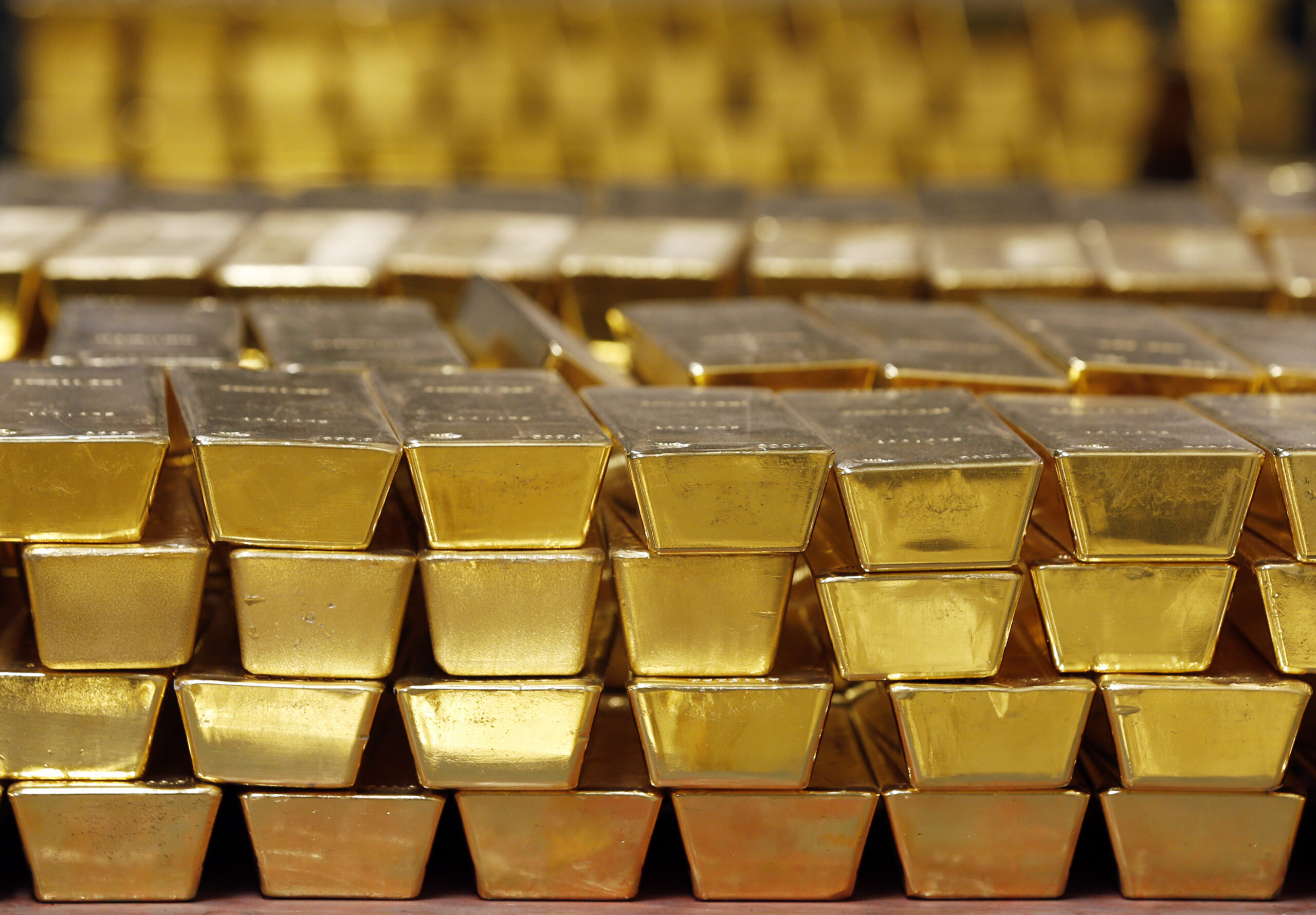
Gold recently crossed $5,000 an ounce for the first time ever… crushing stocks, bonds, and even cryptocurrencies like bitcoin.
This isn’t a blip. Something bigger is going on. And the forces pushing gold higher show no sign of letting up.
The biggest single buyers are central banks. They’ve been hoarding gold like they know something the rest of us don’t…
In 2024, they scooped up 1,045 metric tons, worth more than $100 billion at the time.
And last year, they bought another 860 tons, worth roughly $150 billion today.
Poland, China, India, and Turkey have been the hungriest buyers. They’re all trying to put some distance between themselves and the U.S. dollar.
All in all, this marks 15 straight years of net buying by central banks.
So why the rush? The short answer is debt and money-printing… along with the ramp-up in global political uncertainty.
Governments everywhere responded to recent crises by conjuring trillions of new dollars, euros, and yen into existence. That has consequences.
Global debt has never been higher, and while inflation has cooled from its peak, it hasn’t gone away.
Billionaire hedge-fund mogul Ray Dalio has been warning that as debt spirals and governments print their way out of trouble, the smart money will flow from paper assets into real ones.
Gold sits at the top of that list. It can’t be printed or inflated out of existence. That’s the appeal. As the dollar has weakened in recent years, gold priced in dollars has surged.
So the question you should be asking isn’t, will gold keep soaring higher? It’s…
How High Can Gold Go?
Major gold markets often start relatively slow… but they inevitably end with a boom.
For example, in the 1970s after President Richard Nixon severed the dollar’s link to gold, the metal crept from $35 an ounce to about $200 an ounce over several years.
Then panic set in…
Gold exploded to $850 an ounce in 1980 as inflation fears peaked… a more than 2,000% gain over the decade.
Could that kind of rally happen again?
It might. Most investors still own essentially no gold whatsoever. They’re “all in” on stocks… not commodities.
Commodities move in long, lumbering cycles. During quiet years and pullbacks, no one wants to pour money into an expensive business like digging up rocks with little bits of metal from the ground. So mines close and exploration stops.
Eventually, supply dries up…
But when demand starts to flood in again, the industry can’t just flip a switch to catch up… It takes time and physical resources.
That mismatch between buyers and scarce supply is how and why you get parabolic moves in real-world commodities.
And today, that’s where the gold cycle is at…
We mentioned the 1970s earlier, when gold started freely trading. In nearly every gold bull market since then, prices have at least doubled from trough to peak. And most of the time, they did far better than that…
In fact, out of roughly eight distinct upcycles, only one failed to deliver a 100% gain. Several produced five- or 10-fold increases.
None of this means gold rides a smooth escalator to the top. It won’t. The pullbacks will be ugly.
In late January, gold fell almost 10% in a single session as traders cashed in profits. That kind of drop rattles people. And it should!
But it’s also how a market resets… not how it ends. As Matt wrote last October, “Every gold bull market in history has tested conviction before rewarding patience.”
The ones who truly see windfall profits in a commodity supercycle, as gold is going through right now, are those who have the guts to make it through the shakeouts.
Case in point… Halfway through the 1970s gold boom, between 1975 and 1976, prices cratered nearly 50%. Most folks declared the party over. Then, gold ripped to new all-time highs by 1980.
You should expect plenty of volatility along the way… but don’t confuse a correction for the end of the story.
So how high does gold actually go this time around?
J.P. Morgan strategists see gold reaching around $6,300 by the end of 2026, driven by central-bank buying and investors hunting for hard assets. And Deutsche Bank is in the same neighborhood, forecasting $6,000.
Some forecasters go much further, of course…
Jim Rickards, an economist and former investment banker, has floated scenarios where gold could be “revalued” to $15,000, $20,000, or even $27,000 an ounce under extreme monetary conditions.
That’s an outlier view, but it shows how dramatically the conversation has shifted.
We don’t have a specific price target to give you today on where gold will peak. But we can confidently say its direction will be higher.
All the ingredients for a monster move are still on the table.
This gold bull market has a shot at being one of the strongest in the past century. Maybe the strongest in living memory.
If that plays out, the window to act won’t stay open forever. History suggests you get maybe one shot per generation to ride a commodities wave that can genuinely change your financial life. We’ve seen it before in oil, in uranium, in earlier gold booms… multi-hundred-percent gains compressed into just a few years.
Gold in 2026 and 2027 could be that kind of opportunity. But how you invest in gold matters almost as much as your timing…
A ‘Secret’ Gold Investment Few Investors Know About
Most investors who own gold do so through a gold exchange-traded fund (“ETF”), bullion or coins, or maybe via mining stocks.
All of these options are fine choices for getting gold exposure.
But they’re not the best option…
When it comes to the biggest profits, we prefer to own gold-royalty companies.
Most investors have never heard of them. They sit in a quiet corner of the market, largely ignored by the financial press. But they’ve produced some of the best returns the gold sector has ever seen.
Canadian entrepreneur and mining magnate Pierre Lassonde pioneered the business strategy. Here’s how it works…
A royalty company is like a venture-capital investor. It hands a mining operator a lump sum to develop a mine. In exchange for that money, the royalty company locks in the right to a set amount of that mine’s output for the life of the deposit or some other agreed-upon period. It could be a percentage of revenue from every dollar of gold sold or as a streaming deal, where the royalty company gets to “buy” gold from the mine at a bargain price for decades.
Either way, once the ink dries, the royalty company’s job is mostly done.
If the mine turns out to be a monster producer, the royalty company rides that wave for years without spending another cent. Or if gold prices spike, the royalty’s value spikes with them… After all, since the payment is tied to revenue, higher gold prices mean bigger checks for the royalty investors.
Most important, the royalty company’s costs stay the same… It doesn’t have to pay for labor crews, diesel, helicopter rides, environmental remediation, or any of the other physical, time-consuming things that eat into a miner’s margins.
Royalty companies are by far the most capital-efficient business model in the gold industry.
Lassonde and his business partner had previously made a fortune with royalties in the oil and gas business. So when he found a tiny advertisement in a small Nevada newspaper, placed by a mine owner looking to raise cash by selling an interest in his stake… he brought the royalty playbook to the gold business.
In 1986, his royalty company Franco-Nevada (FNV) invested $2 million in that Nevada mine. And since then, it has received more than $1 billion in royalty payments.
Early shareholders could have seen every $5,000 invested grow to more than $1.6 million today… a 32,000% return.
And that’s all while gold itself has whipsawed and mining companies have both boomed and busted. Throughout the entire period, Franco-Nevada kept cashing royalty checks and paying its shareholders.
This business model has proved to mint money in good times and protect wealth in terrible ones. And there are a few reasons why…
- First, these royalty companies have almost no overhead. Today, Franco-Nevada is a roughly $50 billion company with less than 50 employees.
- Second, the best of these companies own royalties on hundreds of properties around the world… Franco-Nevada alone holds interests in more than 400. So if one mine hits trouble, it can absorb the losses.
- And finally, many of these royalties last for the entire life of a mine… upward of 20 or even 30 years. So if a mine finds more ore or expands its operations, the royalty holder can benefit without putting up another dollar.
Franco-Nevada has compounded at roughly 16% a year since its founding, which means it has doubled investors’ money about every four and a half years. Try finding a gold fund or mining company that can say the same thing over multiple decades.
Of course, the leverage a royalty company has to gold is also what helps it boom during the good times.
Its costs are the original upfront, fixed payments… everything that comes in after that is essentially pure profit.
So when gold rallies, its profits explode far higher than what you’ll see in a mine, which has to expand operations, hire more staff, and buy more equipment in order to see the same kind of growth.
Legendary mineral investor Doug Casey once said…
Royalty companies are historically the safest way to invest in mining. They don’t have any of the big yellow trucks or any of that. They just pay money to buy a royalty stream from somebody who’s mining.
The three royalty heavyweights are Franco-Nevada, Royal Gold (RGLD), and Wheaton Precious Metals (WPM). They control the majority of existing precious metal royalties and streaming deals.
They’re excellent companies… and will each likely outperform the price of gold on the upside going forward.
But they’re also giants in the space – each with a market cap between $20 billion and $70 billion. That makes it more difficult to have the kind of multibagger potential we want when thinking about the best gold stock to buy today.
The good news is that these companies have gotten so big that they need equally large transactions to sustain their scale. That leaves plenty of smaller, more niche deals for hungrier royalty companies that are still in their growth phase.
A well-run, small royalty company can build out a wildly profitable portfolio… and potentially deliver far bigger returns. That’s where Matt has focused his efforts today… on one tiny gold-royalty firm currently trading for less than $50 per share.
About Stansberry Research
Stansberry Research has been publishing top-tier financial research for more than 25 years.
Founded in 1999 by Porter Stansberry, the firm made its name by providing market insights and stock recommendations that were independent of the big brokers and banks. It offers independent, often unconventional and contrarian investment analysis.
Stansberry is known for a wide range of investment newsletters… covering topics from value investing to biotech to commodities, like gold.
It’s not a brokerage or an asset manager. It doesn’t invest your money. Instead, it publishes newsletters and reports that help guide your investing, so you can keep full control… and pay far fewer fees.
Stansberry’s business model is simple: Investors pay for subscription access to its research. That’s it.
And it means that Stansberry’s analysts only succeed when they make calls that subscribers find valuable. Stansberry’s only incentive is to provide insightful ideas that help its readers make money.
This independent model has made firms like Stansberry a go-to source for folks who want an edge beyond mainstream investment advice. And indeed, Stansberry analysts have made some bold market calls over the years – some controversial, some prescient.
Today, Stansberry is a global research firm with hundreds of thousands of subscribers across more than 100 countries. It employs a variety of investment experts – from biotech analysts to technology wunderkinds. And it doesn’t try to squeeze its editors into one investment philosophy. Each editor runs their own strategy, from conservative income plays to aggressive speculation, and they stand behind their own track records.
It is, however, focused on identifying profitable opportunities that the broader market might be overlooking or mispricing. Stansberry tends to gravitate toward out-of-favor sectors, unloved companies, and ideas that make the crowd uncomfortable.
Gold and natural resources are a good example…
For most of the 2010s, nobody on Wall Street wanted to talk about mining stocks. Stansberry kept watching, kept doing the legwork, and when the turn came, its subscribers were ready. The firm recommended gold-resource company Seabridge Gold (SA) in the early 2000s, and it skyrocketed 995% for subscribers. It also flagged exploration company ATAC Resources, which saw a 597% gain… miner Jinshan Gold Mines, which soared 339%… and explorer Northern Dynasty Minerals, which rose 322%.
Not every recommendation works out, of course. But Stansberry publishes its numbers every year – both winners and losers – because it thinks its subscribers deserve to see both. Here’s what Matt said this year about Commodity Supercycles, a monthly newsletter that focuses on gold- and commodity-related recommendations…
Commodity Supercycles, led by Whitney Tilson along with Brian Tycangco and Bill McGilton, aims to do what it says in the name: capture huge gains when commodities go on their inevitable tear higher.
That’s happening right now.
The AI boom has rewarded energy and commodity investors. And Whitney and the team have been there to capitalize on it.
The Commodity Supercycles model portfolio includes nuclear stocks like BWX Technologies (BWXT) and Vistra (VST), up 139% and 82%, respectively.
It also has renewable plays like GE Vernova (GEV), up 99%, and Ormat Technologies (ORA), up 83%… traditional oil-rights picks like Viper Energy (VNOM), up 180%, and Black Stone Minerals (BSM), up 116%… and pipeline companies like Kinder Morgan (KMI), which is up 96%.
Those were all added to the portfolio within the last five years.
And then, of course, there are the metals. What a time it has been for metals.
Copper play Ero Copper (ERO) is up 154% since September. Kinross Gold (KGC) is up 341%. And the Sprott Physical Silver Trust (PSLV) is up 335%.
I could go on.
Commodity Supercycles demonstrates so much of the value of Stansberry Research.
We’ve published it for 21 years, through good commodity markets and bad… with real experts who focus on the industry and know its ins, outs, and opportunities.
So when commodities catch fire, we’re already in place. You know you can come to a trusted source to get the best research.
With a win rate of 66% and sextuple the annualized returns of its benchmark Bloomberg Commodity Index over the past five years, Commodity Supercycles earns a well-deserved A+.
All told, over the past five years, Commodity Supercycles posted a 35.5% average annual return… against its benchmark’s annual return of 5.5%.
That’s incredible performance. But it also shows the dedication that Stansberry provides to its subscribers, some of whom have been with the firm for more than 20 years.
That kind of loyalty isn’t built on hype. It comes from getting the big calls right often enough to earn trust, and from being transparent when you’re wrong.
Who Is Matt Weinschenk?
Matt Weinschenk is publisher and director of research at Stansberry Research. He oversees the editorial team, serves as the senior analyst behind Dr. David “Doc” Eifrig’s family of publications, edits the free weekly newsletter This Week on Wall Street, and sits on the Investment Committee for Stansberry Portfolio Solutions.
Matt has two decades of experience as an equity analyst, but he got his start in the investing world at the worst possible time… He began picking stocks right before the 2008 financial crisis. That’s a valuable education since, as he’s put it on the Stansberry Investor Hour podcast, you need to “get slapped in the face a few times” before you really understand what’s at stake.
That early education made him a more cautious, risk-aware investor than he might have been otherwise. It also gave him an appreciation for the boring stuff that actually protects people’s money… position sizing, focusing on quality, and knowing when not to swing for the fences.
Matt’s investing methods blend old-school fundamental research and business-quality analysis with a quantitative read on the factors that move stocks over weeks, months, and years.
He has been a CFA charterholder since 2014. He holds bachelor’s degrees in economics and political science from the University of Pittsburgh and a master’s in applied economics from Johns Hopkins University.
And last year, he predicted exactly what we’re talking about today… $5,000 gold.
Matt’s Video Interview Predicting $5,000 Gold… And a Case for $6,000 or Higher
In this video from last June, Matt explained the macro forces creating a “perfect storm” for precious metals… including the “sell America” trade, record central-bank hoarding, and the simple relationship between the dollar and gold.
It’s worth a watch…
You could have made massive gains if you had watched – and acted – on Matt’s advice last summer.
The good news is that it’s not too late… gold has more upside ahead. And you can get immediate access to the No. 1 gold stock to buy in 2026 by clicking right here.
Frequently Asked Questions
Question: Hasn’t gold already gone up too much?
Answer: Gold has risen a lot, yes. It recently crossed $5,000 for the first time ever.
But if you adjust for inflation and money-supply growth, gold would need to exceed $6,000 just to match its 1980 peak in real terms.
More important, the fundamentals driving gold higher haven’t changed. Central banks are still buying. Government debt is still growing. And retail investors haven’t arrived in force. The final blow-off phase of a gold bull market typically produces the biggest percentage gains. We’re not there yet.
Question: Why not just buy gold bullion or an ETF?
Answer: Gold bullion and ETFs give you 1-to-1 exposure to the gold price. If gold doubles, your position doubles. That makes them fantastic hedges and time-tested stores of value.
But gold-royalty stocks can do much better. Their costs are essentially fixed, so when gold rises, their profits rise faster. Franco-Nevada’s profit margins expand dramatically as gold prices increase. A well-positioned royalty company in a strong gold bull market can deliver 3, 5, or even 10 times the return of bullion itself.
Question: What are the risks of gold-royalty companies?
Answer: Royalty companies aren’t immune to downturns. If gold prices collapse and stay low for years, their revenue falls and their stocks will decline. During the 2013-to-2015 gold bear market, royalty stocks dropped, though less than miners.
Individual mines can also underperform. If a major mine in a royalty company’s portfolio shuts down unexpectedly, that hurts the business. Diversification helps… For example, Franco-Nevada owns more than 400 royalty and streaming interests specifically to spread out this risk.
Management matters, too. A royalty company that overpays for bad assets will destroy value. Sticking with experienced teams with good track records reduces this risk.
Question: How do I buy the No. 1 Gold Stock?
Answer: Out of respect for Stansberry subscribers, we can’t name the stock here. But we’ve detailed everything you need to know about the company in our report, “The No. 1 Gold Stock to Buy in 2026.” It’s included with your subscription to Commodity Supercycles, and you can even take 30 days to decide if the research is right for you. Click here to learn more.
Once you’re a subscriber, you will receive full details about the No. 1 gold stock, its ticker symbol, company history and investment analysis, potential upside, as well as how and where to buy it.
Question: Should I sell my physical gold to buy the No. 1 Gold Stock?
Answer: We don’t recommend that, no. Physical gold serves a different purpose. It’s insurance against extreme scenarios where you might not be able to access financial markets at all. Gold bars or coins are a good hedge and store of value.
Royalty stocks make more sense when you’re looking to grow your gold allocation. They offer higher upside paired with reasonably managed risk.
How Should Investors Prepare for $10,000 Gold?
Gold’s recent run-up has already been nothing short of historic… But it’s far from over.
In fact, gold could hit $10,000 an ounce sooner than most expect – and even that might be too low an estimate. One expert has even issued a $20,000-plus price target.
But however high gold ultimately goes, and before you invest another penny in mining stocks or gold coins, it’s critical you know how to take advantage of the next big move… by checking out the BEST possible gold stock you should buy immediately.
Currently trading for less than $50 per share, it’s easy for anyone to take a stake in this tiny company… which we expect to leap higher and higher as the bull market in precious metals continues to pick up steam.
Every so often, the right forces align… the right people, the right properties, and the right kind of macroeconomic conditions… to set up what is likely to be one of the most powerful investment opportunities you will ever see in your financial life. For all the details and to find out how much you could collect, get the full story.
Recent Articles

Robots Could Soon Take Over 80% of Meta’s Data-Center Workload – and There’s a $145 Billion Reason Why

SB Energy IPO: Plenty of Risk for This AI Data-Center Stock, But Is There Any Return?