
Image Credit: Associated Press
The cannabis industry received a significant jolt on December 18 when President Donald Trump signed the “Increasing Medical Marijuana and Cannabidiol Research” executive order (“EO”).
This EO doesn’t federally legalize the use of marijuana. But it speeds up moving marijuana from Schedule I to Schedule III under the Controlled Substances Act.
This is important for a couple of reasons involving the Internal Revenue Service (“IRS”) Code Section 280E.
Section 280E forbids companies that traffic Schedule I or II substances from deducting business expenses. Schedule I substances include marijuana, heroin, LSD, and other hallucinogens. Schedule II drugs include opium, cocaine, amphetamines, codeine, morphine, PCP, and others.
Schedule III substances, on the other hand, are not subject to Section 280E. So, assuming marijuana becomes a Schedule III substance, regulated cannabis businesses would be allowed to claim business exemptions on their federal taxes for the first time.
It’s worth noting that the EO doesn’t finalize the rescheduling of marijuana. Rather, its intent is to speed up the process. This involves a review of scientific and medical findings and public comment. The Department of Justice, the Department of Health and Human Services, and the Drug Enforcement Administration all weigh in here.
Still, this EO is a major win for the cannabis industry. Section 280E has handcuffed cannabis operators and the industry for years.
If rescheduling succeeds, it may open several doors… one being more opportunities for cannabis research. For the industry, being classified as a Schedule III drug would show that there is some medical benefit to marijuana. It would also illustrate how, for decades, the federal government impeded cannabis-related medical research because of its Schedule I classification.
This matters perhaps even more than any tax exemptions for operators. Should this rescheduling come to fruition, it would lend the marijuana industry the medical credibility it has been seeking for years.
And that could pave the way for future Food and Drug Administration (“FDA”) approvals, as well as a role for marijuana in our health care system.
These are all positive developments for investors. And there may be a bull case for marijuana stocks on the horizon.
The Two Pillars of the 2026 Cannabis Stock Bull Case
The End of IRS 280E: Why Marijuana Stocks Could See a Cash-Flow Reset
Financially, cannabis companies stand to benefit from marijuana’s Schedule III classification and the elimination of 280E. Suddenly, regular business expenses like payroll, rent, marketing, and interest become deductible.
Right now, most cannabis businesses deal with suffocating tax rates of 70% or more. By moving closer to the standard 21% corporate tax rate, the industry could be looking at a collective $2.3 billion tax break.
Tax savings are just the tip of the iceberg. Cannabis companies should also see:
- Improved cash flow: Deducting operating costs rather than just the cost of sold goods (which is all cannabis businesses can deduct under Schedule I) instantly helps net income and cash flow.
- New access to capital: Most cannabis companies operate as cash-only or cash-heavy businesses. Schedule III classification greatly reduces a cannabis company’s risk profile, and that could lead to partnerships with banks. With those partnerships come the possibilities of loans, banking services, and credit-card processing. That fundamentally changes how these companies do business while lowering the cost of capital.
- Better valuations: Improved after-tax earnings will help increase the valuations of cannabis companies, making them more attractive to investors.
The 2026 Hemp Cliff: How Federal Rules Favor Regulated Cannabis Companies
On November 12 of this year, new marijuana restrictions will go into effect. This date is known as the federal “hemp cliff.” And it’s a critical date for the cannabis industry, which we’ll come back to in a moment.
First, some background…
In November 2025, Trump signed H.R. 5371, a federal funding bill that tightens the legality of hemp for several consumable products. In other words, the federal government cut back on what qualifies as legal hemp.
All hemp-related products will now need to meet stricter THC-related requirements and caps. If products don’t satisfy those requirements, they would need to be reformulated, repackaged, or even discontinued.
As law firm Sheppard, Mullin, Richter & Hampton wrote for the National Law Review:
For hemp brands, retailers, manufacturers, and ancillary partners, the immediate issue is not theory: it is whether current product portfolios, contracts, and distribution channels remain viable under the new federal definition and potency limits.
This bill all but eliminates unregulated, intoxicating hemp products… better known as “gas station weed,” so named because these products can be purchased from convenience stores, vape shops, and gas stations.
Some of these items include Delta-8 THC products like edible gummies, vape cartridges, and tinctures. Also included are THCA-forward flower products, which are raw cannabis buds rich in tetrahydrocannabinolic acid (“THCA”).
Now, back to that November 12, 2026 hemp cliff…
On that date, all the changes signed into law in November 2025 will take full effect. These include:
- A 0.3% total THC standard dry-weight limit on hemp products. This will render most THCA flower and similar products illegal.
- A 0.4 mg total THC cap per package. This means that any finished product made for consumption or inhalation (drinks, vapes, gummies, tinctures, etc.) may not exceed 0.4 mg of total THC per container. Most of these intoxicating hemp products contain more than 0.4 mg per serving. So, nearly all will be illegal.
- A ban on synthetic or converted cannabinoids. This includes any cannabinoid that’s either not naturally derived from the hemp plant or synthetically created through chemical conversion (Delta-8 and Delta-10 THC, THCP, and HHC, for example).
These new regulations will have severe consequences on the American hemp business. Industry executives are bracing for what could amount to a 95% reduction of the $28-plus billion intoxicating hemp retail market. And it could impact more than 300,000 American jobs.
Once Trump signed H.R. 5371, the yearlong countdown to compliance began. For hemp- and cannabis-related businesses, there’s a lengthy checklist to complete – not only for compliance purposes, but for charting the future course of their companies.
For example, businesses selling noncompliant products must consider reformulating those products, changing suppliers, or removing them altogether. If they decide to reformulate, they need to factor in the time needed to sign contracts with new suppliers and change packaging.
Companies will also need a plan for selling down or destroying their existing – and soon-to-be-illegal – inventory. Or they could turn their business into a state-regulated operation in compliance with the law.
This all must be completed before November 12.
Before then, there are a couple other key dates worth noting.
- By February 12, the FDA must publish new lists of permitted cannabinoids, as well as those with intoxicating effects. This should help retailers determine their inventory choices and business models.
- In April, the Centers for Medicare & Medicaid Services (“CMS”) is expected to create a model allowing eligible Medicare beneficiaries to receive up to $500 a year for hemp-derived CBD products. The idea here is to sway the cannabis market toward a “wellness” position… and away from intoxicating “gas station” products.
Removing these unregulated products from the market will push consumers into dispensaries, which are strictly regulated for product quality and safety.
And that creates a significant moat for the licensed multi-state operators (“MSOs”) that control regulated, licensed cannabis dispensaries.
With that in mind, let’s look at a few cannabis stocks that could benefit the most from America’s changing marijuana policy.
Green Thumb Industries (GTBIF): One of the Best U.S. Cannabis Stocks for Profitability
Chicago-based Green Thumb Industries is one of America’s leading cannabis consumer packaged goods companies and retailers. Green Thumb owns and operates roughly 100 RISE dispensaries in 14 states. And it holds a wide portfolio of branded edibles, topicals, vapes, flowers, and pre-rolls.
Green Thumb is a rarity… a pure-play operator that regularly turns a profit. The company maintained positive generally accepted accounting principles (“GAAP”) income in both the first and third quarters of 2025 (full-year earnings will be released in late February).
Revenue for each of the first three quarters was in the $280 million to $293 million range. GAAP net income was $23.3 million in Q3 and $8.3 million in Q1. (Green Thumb took a slight loss of $650,000 in Q2 due to a one-time asset sale.) Additionally, operating cash flow was strong in each quarter, with $74 million in Q1, $56 million in Q2, and $74.1 million in Q3.
The elimination of 280E could benefit Green Thumb in a big way. Once consumers are funneled into licensed dispensaries, Green Thumb should see an influx of cash that the company can allocate toward expansion, shareholders, or debt.
GTBIF is an over-the-counter (“OTC”) stock, so Stansberry Research does not assign GTBIF a Stansberry Score… a valuable tool that helps investors determine the quality and long-term value of a stock.
Trulieve Cannabis (TCNNF): The Medical Marijuana Leader
With more than 230 dispensaries across nine states, Trulieve has established itself as a leading MSO focused on medical marijuana, though it does offer recreational cannabis products as well.
Trulieve is a “seed to sale” operator. The company controls the entire process – from cultivating to selling – to ensure its products are of the highest quality for patients.
With Trump’s EO potentially opening the door to more marijuana research, Trulieve may be a prime candidate for possible medical-research partnerships with the federal government.
Plus, the pilot Medicare program that would reimburse patients for certain CBD and hemp-derived medical treatments may be ready to roll out as soon as this spring. Trulieve could be an ideal partner for that program.
The company generated strong margins and cash flow through the first three quarters of 2025 (Q4 earnings will be released in late February). Year to date, Trulieve reported $888 million in revenue, $214 million in cash flow, and a 60% gross margin.
The company also completed payment on $368 million in debt, putting it in even better financial shape for 2026.
TCNNF is another OTC stock to watch as the cannabis industry transforms.
Innovative Industrial Properties (IIPR): A Cannabis Stock for Income-Focused Investors
Some investors may want to get in on the cannabis industry without investing in the plant itself. Innovative Industrial Properties (IIPR) is an intriguing option.
The company is a real estate investment trust (“REIT”) that invests only in cannabis facilities. IIPR purchases the industrial assets of cannabis operators and then leases the facilities back to the operators. This is a win-win, as it brings the company revenue while providing operators with capital.
Most IIPR shares are held by institutional investors. This adds credibility, as well as stability to the share price movement.
The government’s rescheduling of marijuana should benefit IIPR because it will help the company’s tenants. Operators’ sales should grow as more consumers are pushed toward licensed dispensaries. With more cash flowing into operators (IIPR’s tenants), IIPR should see fewer rental defaults.
And those rental defaults directly impacted IIPR’s bottom line in 2025. As of September 30 (the end of IIPR’s fiscal Q3), the company owned 112 properties. But roughly 20% of the rent IIPR should have collected from tenants was not paid to the company.
That contributed to a roughly 15% year-over-year dip in revenue, to roughly $199 million, for the first three quarters of 2025.
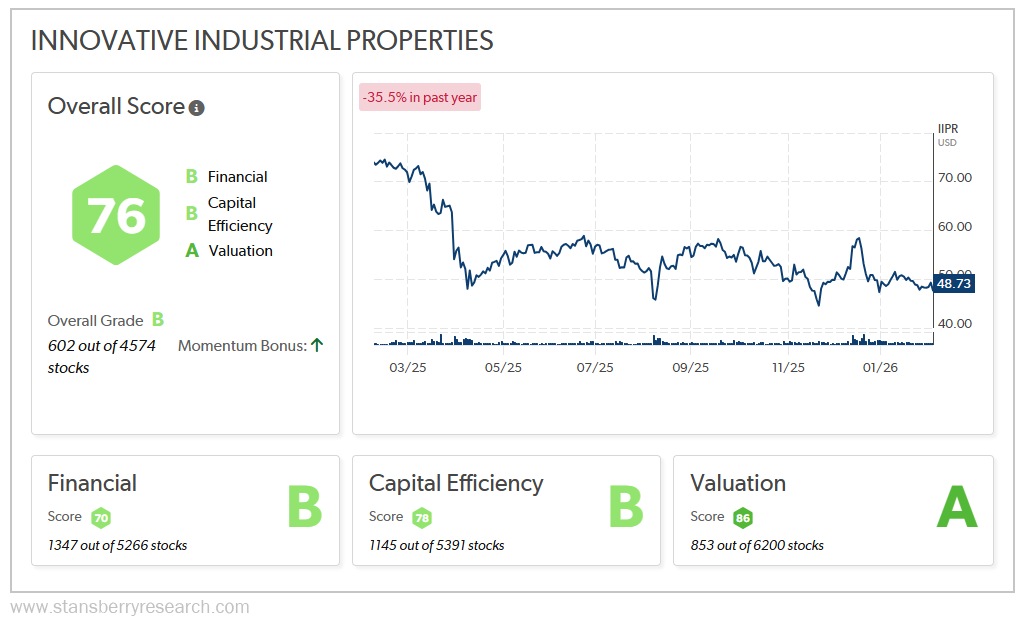
Despite the drop in revenue, IIPR’s Stansberry Score is a strong “B.” IIPR is solid across the board, with an “A” in Valuation and a “B” in Financials and Capital Efficiency.
Curaleaf Holdings (CURLF): A Large-Cap Cannabis Stock Positioned for Uplisting
Curaleaf is the largest American cannabis company by market cap at around $1.8 billion. The company operates more than 170 dispensaries across 14 states (including 70 alone in Florida). Its footprint is international as well.
Curaleaf controls production, operations, facilities, distribution, and a handful of clinics in seven other countries: Canada, Sweden, Poland, Portugal, the United Kingdom, Spain, and Germany.
Its 2025 net revenue will likely come in at roughly $1.28 billion, a drop from 2024’s $1.34 billion in net revenue. But Curaleaf’s robust international presence helps compensate for the loss, with international revenue… up 63% year over year to $121.8 million in the first three quarters of 2025. Curaleaf is also anticipating an adjusted gross margin of around 50%.
Right now, Curaleaf is only traded on the Toronto Stock Exchange and the OTC market. However, if cannabis is officially reclassified to Schedule III, that may create some opportunities for more cannabis-related businesses to uplist from the OTC market to major American exchanges like the NYSE or Nasdaq.
Curaleaf would be an ideal candidate. But uplisting is far from guaranteed for any cannabis business. However, if companies like Curaleaf show profit increases after rescheduling, exchanges may reconsider their positions on cannabis-related stocks.
Risks to Cannabis Stocks in 2026
Even with potentially positive reform coming, cannabis stocks still face risks.
Litigation
In December, after Trump signed the EO focused on rescheduling marijuana, the organization Smart Approaches to Marijuana (“SAM”) released a scathing statement accusing Trump of “a full betrayal of the President’s promise to keep all Americans safe and healthy.”
SAM has promised legal challenges to marijuana’s rescheduling. The group has already retained Trump’s former Attorney General Bill Barr to take up the case. If this does make its way into court, rescheduling could be delayed until the matter is resolved.
Regulatory timing
Uplisting to major stock exchanges would represent a major turning point and a win for the cannabis industry. But that’s far from a sure thing.
In December 2023, Senator Jeff Merkley of Oregon introduced the SAFER (Secure and Fair Enforcement Regulation) Banking Act bill. This legislation was designed to provide state-legal cannabis businesses access to traditional financial services. By doing so, there would be less risk for all involved – financial institutions, lenders, and insurers – even with federal restrictions on cannabis still in place.
That bill has not yet been signed into law. Major exchanges may be hesitant to allow cannabis-operators uplistings until it is. And there has been no indication that it will become law anytime soon.
Execution
Rescheduling of marijuana to Schedule III would provide significant tax relief for cannabis businesses. But if that happens, it won’t be until November. That means crushing tax rates and stifled cash flow will remain challenges in the meantime.
Then there’s the hemp cliff looming on November 12. On that date, the federal ban on intoxicating hemp products like Delta-8, Delta-10, and THCA flower kicks in. When it does, a huge chunk of operator revenue will vanish.
Remember… this could wipe out 95% of the nearly $30 billion intoxicating hemp retail market. The reality is, some operators may not survive this transition unless they completely rework their business model before November 12. It’s no easy feat.
Bottom Line – Are Cannabis Stocks a Smart Investment in 2026?
For the cannabis industry – and cannabis stocks – 2026 is a pivotal year. It’s important to remember that none of the recent legislation made cannabis federally legal. Nor has it opened the door for interstate commerce or solved the issues between state-licensed operators and federal controlled-substance laws.
But it does offer hope for substantial improvements in operator cash flow, via possible tax breaks, a potentially significant increase in MSO and dispensary customer growth, and perhaps even access to the typical banking and payment processing options available to other business operators.
Plus, with the possibility of Medicare reimbursement for some CBD treatments, cannabis is poised to make its mark on the health care industry.
These are all potentially huge wins for the cannabis industry and those who invest in it. Investors should pay close attention to established operators that are already profitable… like the ones discussed above.
As the marijuana industry continues to expand, those are the businesses best positioned for success in the coming years.
Regards,
David Engle
Editor’s note: If you’re 50 or older… or thinking ahead to retirement… legendary investor Whitney Tilson says this could be your smartest financial move of the entire AI boom.
It’s time to look past Nvidia and the “Magnificent Seven.”
Whitney, a retired hedge-fund manager once dubbed “The Prophet” by CNBC, is sharing a new AI story.
His brand-new stock system just gave one company a near-perfect grade… and it’s not a name you’ve heard on the news.
The company just signed a huge new AI deal with a key tech partner, and you’ll soon see a massive nationwide rollout.
Whitney’s giving away the name, ticker, and full breakdown for free.