
Listen to the audio version of this article (generated by AI).
Today’s issue in preview:
-
Three ways to invest in Elon Musk’s next big move
-
The longevity gold rush has a clear winner. How to invest.
-
These stocks are quietly crushing the rest of the market. Are you profiting?
-
Learn Our Top Themes to Buy Now
These stocks are quietly crushing the rest of the market. Are you profiting?

Credit: Ridofranz
To help us track and trade the world’s strongest business and technology trends, our Global Trend Tracker monitors over 170 industry groups, over 30 proprietary thematic indexes, over 70 ETFs, and over 3,500 public stocks.
This trend-tracking system serves as our “all-seeing eye” – an early-detection system that continuously monitors money flows and shifts in the market climate.
It is designed to identify powerful trends very early in their lifespans, giving us the opportunity to capitalize on them before they become popular investment themes. A business, product, or technology trend can barely twitch without being picked up by our Global Trend Tracker.
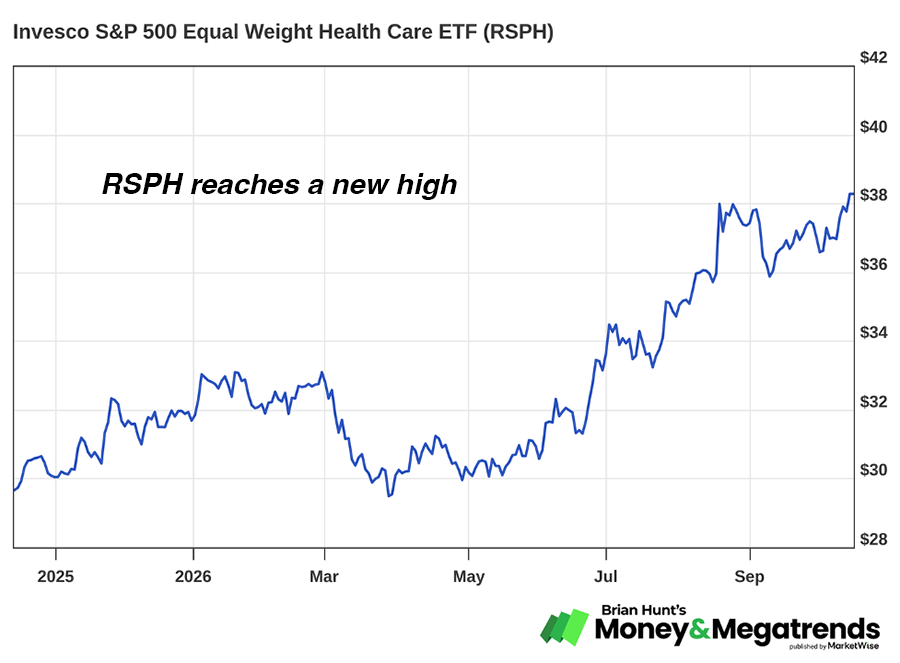
This week, our tracker emphatically states that in a market where many important sectors are trading weakly – including defense stocks, small caps, homebuilders, and banking stocks – the healthcare sector is displaying terrific “relative strength.”
For example, while many sectors are down significantly over the past month, the Invesco S&P 500 Equal Weight Health Care ETF (RSPH) just reached a new one-year high.
This fund is an equal-weighted, diversified basket of large health care firms such as Illumina (ILMN, genomic sequencing), Revvity (RVTY, life sciences), Intuitive Surgical (ISRG, surgical robotics), Biogen (BIIB, biotech), ResMed (RMD, sleep devices), and Pfizer (PFE, pharma). The fund is up 29% over the past year and is one of the few equity ETFs outside of the oil and gas complex to reach a new one-year high this week.
Avid Money & Megatrends readers know that “Boomer healthcare” is one of our highest-conviction long-term investment megatrends. We don’t know of another investment research publication that has written more bullishly, more often about this booming industry than we have.
Over the past year, we have published more than two dozen pieces on opportunities in drug development, biotechnology, senior living facilities, genomics, cardiology, diagnostics, and more.
Our bullish stance has produced a parade of home runs, with the healthcare industry dominating the stock market’s list of new highs over the past year.
Healthcare stocks are generating extraordinary returns because they are benefiting from several megatrends simultaneously…
One is demographics. More than 10,000 Americans reach retirement age every day. The U.S. population aged 80 and older is projected to roughly double, from 14.7 million in 2025 to 29.4 million by 2045.
This is the enormous Baby Boom generation entering the phase of life where health care and longevity spending skyrocket. For many boomers, a typical month involves going to see at least one doctor to have something looked at, removed, or treated.
This means many health care businesses are experiencing huge demand now – and will for at least the next decade.
Two is exponential technological progress. Thanks to major advancements in genomic sequencing, AI-powered analytics, imaging technology, and preventative treatment, healthcare is becoming much better and more personalized. This is driving strong demand for all kinds of new tests, tools, and treatments.
After all, when a useful and important service you buy gets much better, you typically buy more of it
Investing in many healthcare businesses over the next decade will be investing with a gale-force tailwind at your back. If you’re a parent and worried about your child getting a job, just point them to the booming healthcare industry.
The new high in RSPH serves as a reminder: The giant business, tech, and demographic trends that shape our world tend to play out in five or more years, not five months. This means the stock market trends they manifest play out over the same time periods. With this trend truism in mind, I once again remind you that if you like money, keep it invested in healthcare.
Recommended Link:
My Nearly $20 Million ‘Bar Tab’ With Stansberry Research

I’m an ordinary guy – a financial newsletter reader like you. But a few years ago, I landed in an extraordinary position: unmasking a priceless secret from inside Stansberry Research, unfiltered, on camera. In the years since, my ongoing efforts have COST Stansberry nearly $20 million and counting – money that has stayed in readers’ bank accounts instead. Today, I’m speaking out one FINAL time.
The longevity gold rush has a clear winner. How to invest.

Credit: svetikd
As with any large part of our economy, the booming healthcare sector (see above) comprises many smaller “sub-industries” that often perform much better or much worse than the broader sector.
Currently, one prominent member of the “doing better” category is the business of selling GLP-1 drugs.
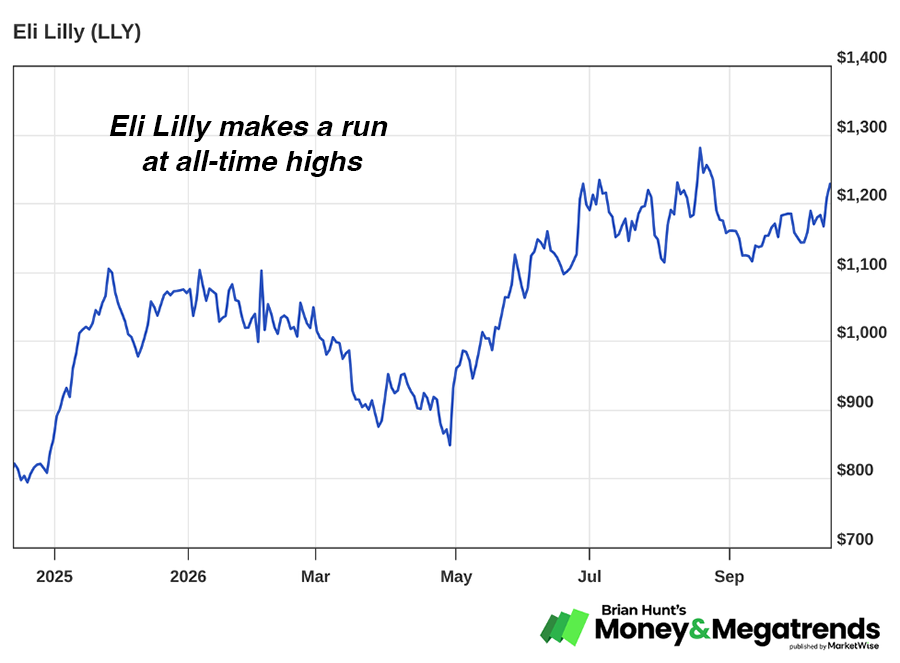
As evidence, we cite the surging revenues and strong stock trend of one of our top healthcare “picks to click,” Eli Lilly (LLY).
Back in June, I detailed how drug giant Eli Lilly is uniquely positioned to benefit from soaring health care and longevity spending.
Data from the Federal Reserve shows that between 15 million and 20 million baby boomers are millionaires. More than 1 million boomers are worth more than $10 million. As mentioned above, the U.S. population aged 80 and older is projected to roughly double, from 14.7 million in 2025 to 29.4 million by 2045.
This is the largest group of wealthy people in history. It includes many motivated, older, wealthy people who can spend big on longevity.
One of the leaders of this investment trend – you could even call it the poster child – is drug giant Eli Lilly.
Lilly is the world’s largest seller of glucagon-like peptide-1 (GLP-1) medications. GLP-1 drugs mimic a natural gut hormone. They control blood sugar by stimulating insulin release, thereby slowing digestion and reducing appetite.
Over the past 5 years, this class of medications has exploded in popularity. A representative of healthcare giant IQVIA says GLP-1 therapies for weight loss generated $55 billion in sales over the past 12 months, which is up from $2 billion in 2022.
Many people who take GLP-1 drugs see drastic weight loss in less than six months… which should extend their lives.
Studies indicate that GLP-1 drugs may also lower cholesterol, slow cancer growth, and reduce the risk of cardiac disease. They are also prescribed to treat sleep apnea, which is a pervasive problem whose effective treatment should extend many lives.
In other words, GLP-1s are believed to be the closest thing to “miracle longevity drugs” that we currently have.
As a result, Eli Lilly’s sales are skyrocketing. The company recently reported quarterly sales growth of 48%. The results were driven by a 91% jump in demand for Lilly’s weight-loss drug, Mounjaro.
Soaring GLP-1 revenues are driving strong returns for Lilly shareholders. The stock has returned 49.7% over the past year… and is currently making a run to eclipse its all-time high reached in August. The Boomer health care theme continues.
Three ways to invest in Elon Musk’s next big move
Credit: Walter Cicchetti
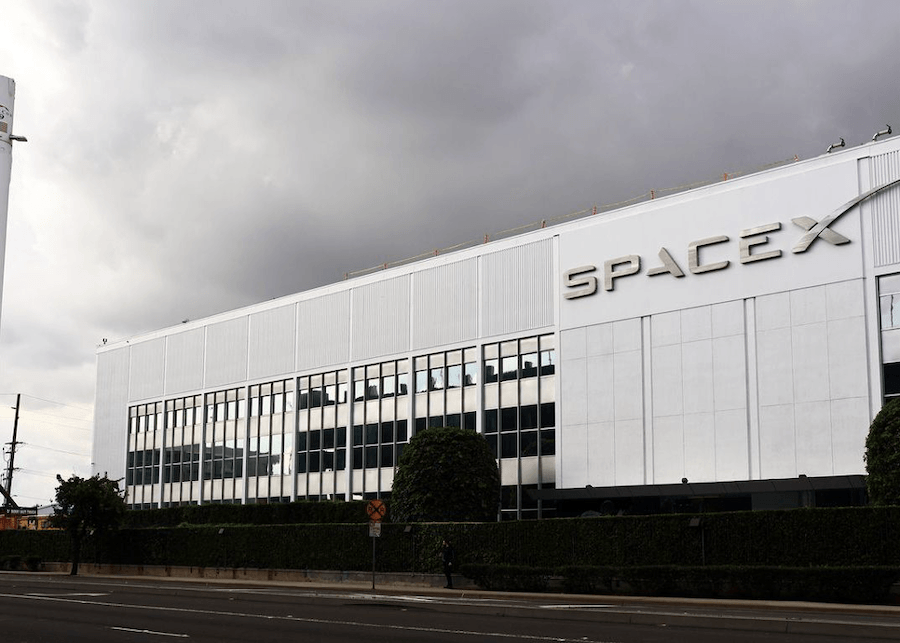
Last week, shares of America’s three biggest telecommunication firms took one of their worst beatings in decades, thanks to Elon Musk’s SpaceX (SPCX).
Verizon (VZ), AT&T (T), and T-Mobile (TMUS) all dropped between 9% and 13%, wiping roughly $45 billion off their collective market value.
The trigger?
SPCX announced it was acquiring a nationwide spectrum license to become a major mobile carrier in the U.S. It’s paying about $8 billion for up to 14 megahertz of low-band airwaves. In other words, it is buying the legal rights to transmit wireless signals over specific radio frequencies.
Musk called it a “very big deal.” It potentially puts SpaceX on a collision course with Verizon, AT&T, and T-Mobile.
For years, Starlink has been considered a backup phone service… one that kicked in when you lost signal on a hiking trail or a rural highway. Not anymore. Investors now see a fourth national carrier coming to take customers from the incumbents.
And SPCX isn’t starting from zero. An estimated 13.5 million people already pay for Starlink internet, including about 4.1 million in the U.S. Those are likely easier wins: customers who already trust the brand and pay a monthly bill. Bundling a phone plan for those customers is the next logical step.
Obviously, there’s a long way to go to disrupt incumbents like Verizon, which has about 147 million wireless connections. But in a market estimated at $600 billion annually, even a few percentage points of customers switching to Starlink each year would be worth a lot.
In any case, the threat of SPCX disruption is likely still years away. The spectrum deal still needs approval from the Federal Communications Commission. SPCX’s next-generation direct-to-phone satellites won’t start launching until the second half of 2027. And it takes years for people to upgrade their phones and decide to switch away from their current provider.
But in the background, while all of this plays out, the demand for hardware to build this network will arrive long before the first customers sign up.
As a result, the “picks and shovels” suppliers behind Starlink are already seeing orders.
When a company with SPCX’s scale and speed decides to build, its suppliers feel it first. That’s where you want to be positioned as an investor.
Compelling investment candidates inside this long-term trend include:
Filtronic (FTC.L) is a roughly $800 million UK-listed company that builds the powerful amplifiers Starlink uses to transmit enormous amounts of data between satellites and ground stations. SpaceX is its largest customer, accounting for 68% of annual revenue, and holds warrants to acquire up to 15% of Filtronic’s shares. On Oct. 1, Filtronic announced its largest-ever SpaceX order: $68.1 million for advanced amplifiers, with deliveries expected primarily in fiscal 2028.
As SpaceX launches thousands of additional satellites and pursues millions of mobile phone customers, its network will need to handle vastly more data traffic. That should drive growing demand for Filtronic’s specialized amplifiers, making this sub-$1 billion company an intriguing way to invest in the satellite communications boom.
STMicroelectronics (STM) is a roughly $42 billion semiconductor giant that has spent a decade co-designing custom chips with SpaceX. Its advanced BiCMOS technology is a critical component of Starlink’s satellite dishes, and the company has reached a remarkable delivery rate of more than 5 million chips per day.
STM also supplies chips used aboard Starlink satellites and in ground infrastructure. Now SpaceX plans to expand into traditional mobile phone service, potentially installing small cellular base stations alongside its existing Starlink dishes. This could create another enormous market for advanced communications chips. STM expects to generate more than $3 billion in cumulative space-related revenue between 2026 and 2028, making it one of the clearest publicly traded beneficiaries of the satellite communications boom.
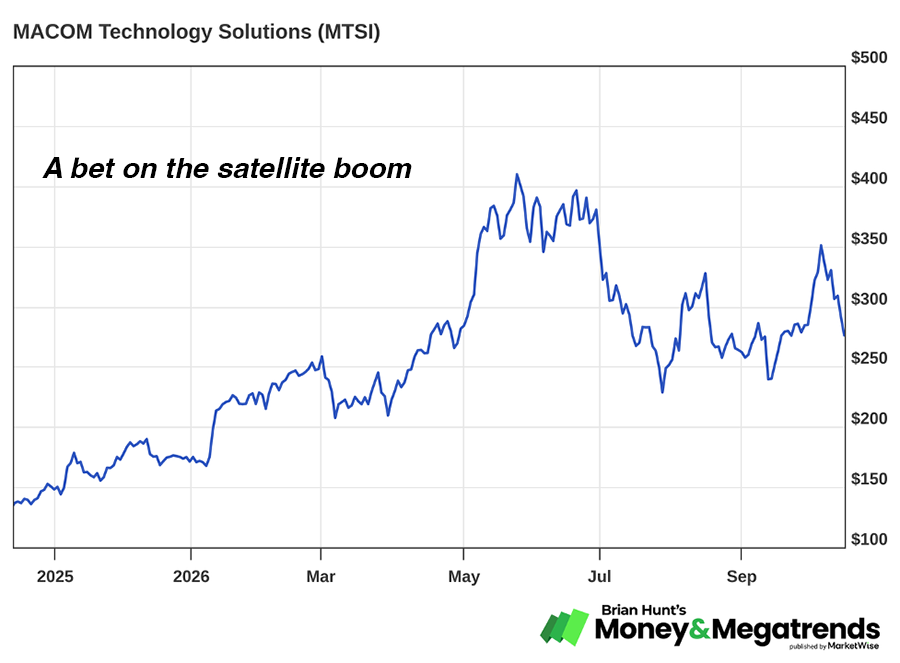
MACOM Technology Solutions (MTSI) is a $22 billion semiconductor company that makes the powerful radio-frequency chips satellite communications networks depend on.
Its specialty includes amplifiers that boost weak radio signals, allowing enormous amounts of data to travel between space and the ground. These chips are critical components of phased-array antennas, which use hundreds or thousands of tiny antenna elements working together to electronically steer signals.
In June, MACOM introduced new amplifier technology specifically designed for satellites that communicate directly with ordinary smartphones. That’s important because SpaceX plans to deploy up to 15,000 next-generation direct-to-phone satellites, each of which requires sophisticated communications hardware.
MACOM hasn’t been confirmed as a direct SpaceX supplier, but its technology positions it to benefit from the enormous satellite communications boom SpaceX is helping create.
Whether Starlink Mobile becomes America’s fourth major carrier in three years or ten, the hardware must be built first. STM, MTSI, and FTC all stand to benefit from the boom in satellite-based communications that SpaceX is leading.
Market Notes
-
The Boomer health care megatrend continues to generate winners: Pharma giant Pfizer (PFE) reached a new one-year high today.
-
Worries over mid-term elections and potential changes in defense spending helped send military firms Aerovironment (AVAV) and Kratos Defense (KTOS) to new one-year lows today.
-
Quantum computing stocks Rigetti Computing (RGTI) and D-Wave Quantum (QBTS) reached new one-year lows today.
-
Uranium miners Denison Mines (DNN) and Uranium Energy Corp (UEC) reached a new one-year low today.
-
Air taxi firms Joby Aviation (JOBY) and Archer Aviation (ACHR) reached new one-year lows today.
-
Nuclear energy technology firms Oklo (OKLO) and NuScale Power (SMR) reached new one-year lows today.
Top Themes to Buy Now
🇧🇷 One of the world’s best investors bets on Brazil. Why it’s poised to head higher
📈 How to make 1,000%+ returns from the next wave of AI winners
Regards,


Brian Hunt
Editor, Money & Megatrends
An urgent message from our colleagues:
Free AI Demo – 10X Your Money

Keith Kaplan, one of America’s top AI experts, leads a firm that spent $17 million building some of the most advanced AI models around. Today, he’s agreed to publicly demo a brand-new breakthrough, which he says could help you make more than 10X your money.