Today’s issue in preview:
-
A new kind of AI trade is emerging. Here are the stocks to play it.
-
Why Apple could be one of the biggest winners of the AI agent boom
-
A new development for the world’s most important trend… and what it means for your portfolio
-
Learn our Top Themes to buy now
A new kind of AI trade is emerging. Here are the stocks to play it.

Credit: valentinrussanov
After we’ve invested more than a trillion dollars in AI infrastructure, new, leading AI models such as OpenAI’s ChatGPT-6 Astra and Anthropic’s Claude Fable 5.1 have become far more than just great search engines compared to the models of 18 months ago.
These models have extraordinary capabilities. They can analyze complex information, solve difficult problems, make decisions, and automate a wide range of tasks and business functions. They can generate useful “agents” that do lots of work for us.
So how in the heck do we leverage this new, awesome power inside our business?
That’s the question thousands of executives, corporate boards, and entrepreneurs are asking themselves today. It’s one of the hottest topics in the business world… one that will create huge opportunities for you as an investor.
After all, a company that successfully uses AI to increase efficiency, reduce costs, and generate more revenue could gain an enormous advantage over its competitors.
And a company that fails to embrace and master AI could find itself falling hopelessly behind.
That’s why many business leaders – especially those in knowledge industries such as law, software, consulting, research, marketing, and media – justifiably view mastering AI as one of their defining challenges of 2026 and beyond. Failure to do so poses an existential risk.
And when something is an existential risk that could result in a business leader getting fired, losing a big executive salary, and seeing her stock grants lose 75% of their value, that business leader is going to go to great lengths to prevent that potential risk from becoming real.
This means spending lots of money on enterprise software and data analytics firms that help companies integrate and leverage AI.
Enterprise software refers to applications and technology platforms that help businesses manage operations, organize and analyze data, automate tasks, and improve productivity. These systems support functions such as finance, sales, R&D, human resources, and supply chain management. Increasingly, enterprise software incorporates AI to help companies make better decisions and operate more efficiently.
In fact, to capitalize on the “mad dash” of businesses trying to incorporate AI, a smart enterprise software company will sell itself as an “enterprise AI” company.
Consulting giant Gartner expects AI software spending to rise from approximately $283 billion in 2025 to $453 billion in 2026.
Enterprise software has such strong AI-related growth prospects because taking old, legacy databases and software platforms and transforming them into lean, mean, AI-centric systems is a messy, complicated business.
This cannot be done by purchasing a ChatGPT subscription and having two run-of-the-mill employees work on it. Transitioning a large company’s disparate tech systems into a safe, reliable package of AI-powered systems is a huge task whose bill can run into the many millions of dollars.
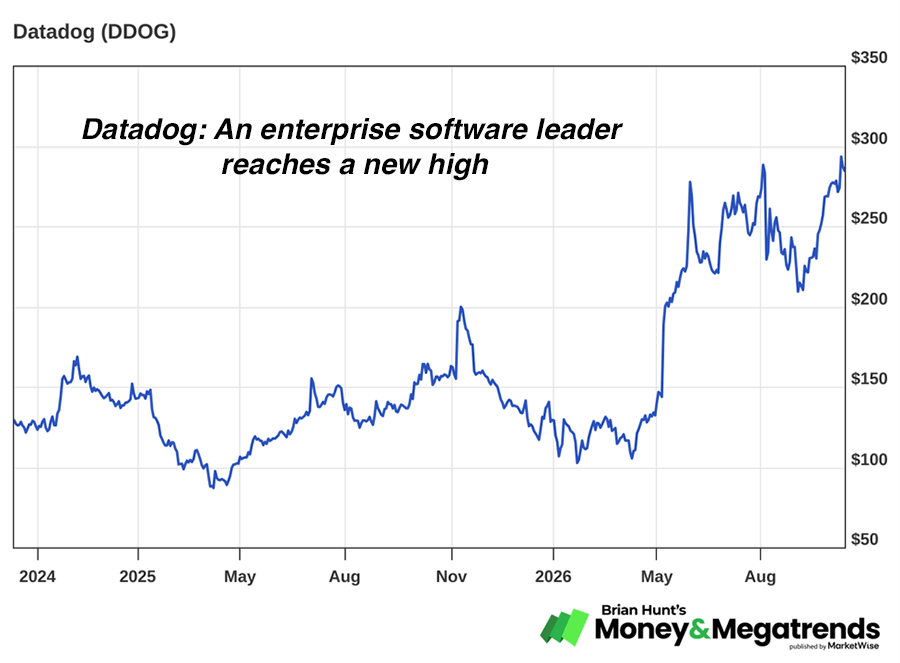
This situation is proving to be bullish for enterprise software firms such as Palantir (PLTR), Datadog (DDOG), Dynatrace (DT), Snowflake (SNOW), ServiceNow (NOW), MongoDB (MDB) and UiPath (PATH).
This under-the-radar tech trend is one of the strongest themes in the market right now. Palantir, Datadog, Snowflake, and Dynatrace recently reached new one-year highs. Many such firms are enjoying 15%+ annual revenue growth.
The AI boom is entering a powerful new phase. After spending more than a trillion dollars building AI infrastructure, the business world is now racing to put that technology to work. For large corporations, integrating AI into existing systems is a complex, expensive, and increasingly urgent undertaking.
That creates an enormous opportunity for enterprise software and data analytics companies. As businesses scramble to harness AI’s capabilities, or risk falling behind, the companies helping them make that transition could generate big stock returns.
Recommended Link:
Debunking the SpaceX Phone Rumors

“I spent years as a Bloomberg tech reporter… and as an analyst for one of Wall Street’s most ruthless hedge fund billionaires. Here’s what I think about Elon building an AI phone…” Click here.
Why Apple could be one of the biggest winners of the AI agent boom

Credit: valentinrussanov
In yesterday’s issue, we detailed how the “AI Applications Layer” is a business and investment area with extraordinary potential over the next three years.
We expect to see dozens of businesses follow in the footsteps of legendary winners such as Amazon, YouTube, Facebook, and Netflix.
These winners didn’t build the physical network of fiber optic lines, routers, servers, and switches that made up the internet. Instead, they built the wonderful businesses on top of that revolutionary infrastructure.
They were the “applications” layer of the internet.
It’s important to understand the applications layer concept because we’re on the cusp of a historic boom in companies that don’t build critical AI “hard infrastructure” such as data centers and semiconductors…but instead build wonderful businesses on top of that infrastructure… just like Apple, Amazon, and Google did with the internet.
I’m talking about AI-centric businesses that revolutionize how we invest, how we develop medicines, how we educate, how we entertain ourselves, how we manufacture, how we shop, how we transfer money, and much more.
The internet changed every industry and created many new ones. AI will do the same.
Investors who follow the Internet applications layer playbook into big AI applications layer winners stand to make giant returns.
In yesterday’s issue, we highlighted how AI-centric data analytics firm Palantir (PLTR) is a powerful example of this strategy. The business is booming and its stock is up more than 1,100% since Jan. 1, 2024.
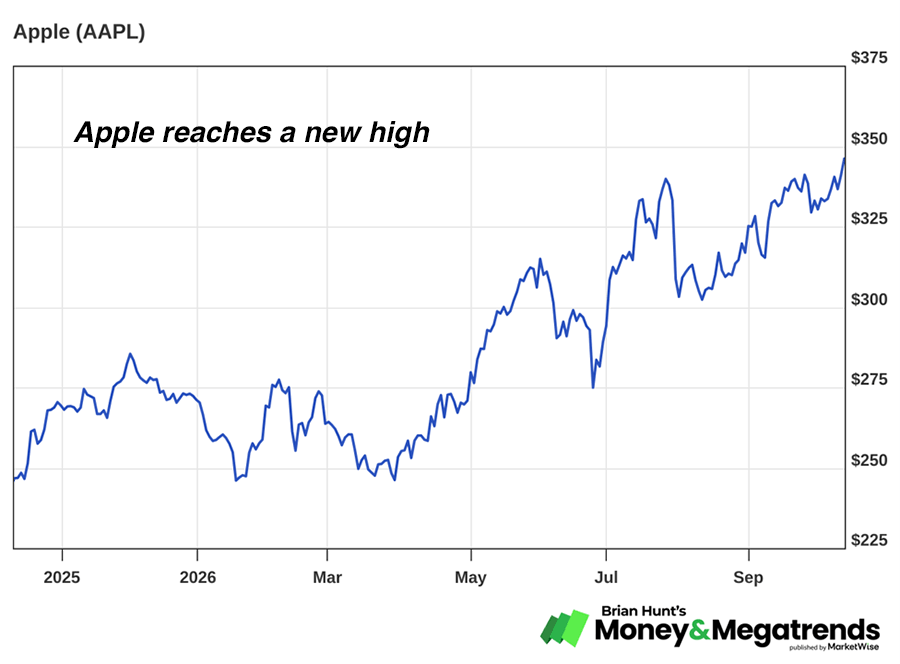
Today, the market is sending us a message that Apple (AAPL) is emerging as a winner in this trend.
Apple is the largest smartphone seller in the U.S. It also generates substantial revenue by selling iPads, Mac computers, and Apple Watches.
For more than 145 million Americans and more than 1 billion people globally, Apple devices are the primary gateway to the internet and, increasingly, to AI applications. In other words, Apple owns one of the most powerful and valuable digital product distribution networks in all recorded history.
As AI agents become more powerful and useful, consumers will increasingly spend money on agentic apps and services that perform complex tasks, solve problems, and manage their daily lives.
And for more than a billion people, Apple products will be the primary gateway to this new world. Their iPhones, iPads, and Macs will serve as the interfaces through which they interact with AI agents, issue instructions, and receive results. Apple doesn’t have to develop the world’s smartest AI models to become a big beneficiary of the agentic AI revolution. It already owns one of the world’s most valuable digital distribution networks.
Don’t take our word for it, however. Take the market’s word. This week, Apple reached a new all-time high. The stock has returned 40% over the past 12 months. It looks like, in Apple’s case, AI is going to help the big get bigger, and the rich get richer. And if the company could make Siri “not terrible,” then the sky is the limit!
A new development for the world’s most important trend… and what it means for your portfolio

Credit: BlackJack3D
Apple’s new high (see above) isn’t good news just for Apple shareholders.
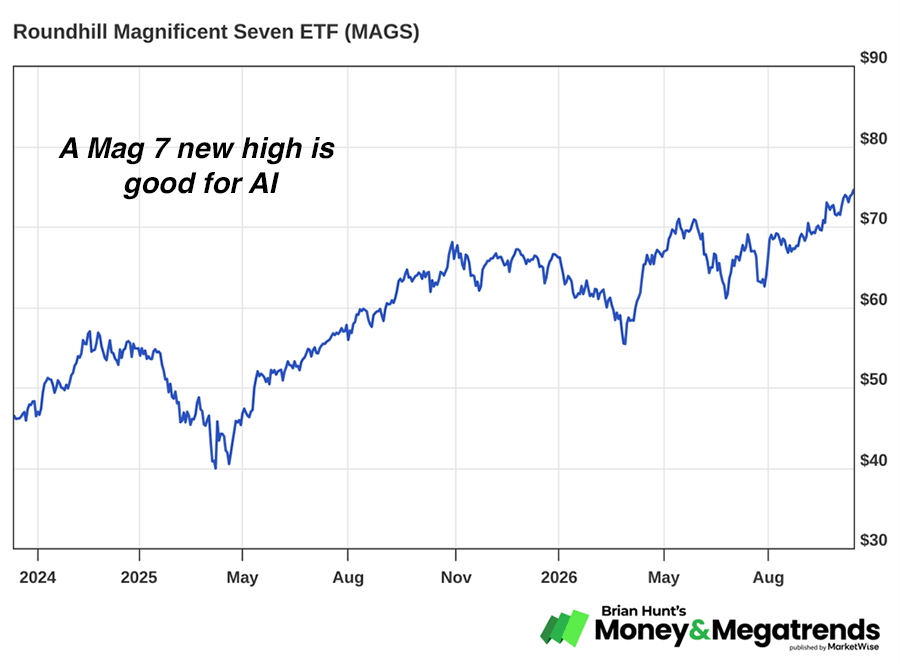
Strength in the stock helped power the Roundhill Magnificent Seven ETF (MAGS) to a new all-time high today.
That’s a great signal for the technology sector in general and the AI infrastructure trade specifically. It tells us the “world’s most important trend” is alive and well… and continuing to confound the very vocal group of AI bears that claim the trend is in a bubble.
MAGS is the largest ETF specifically designed to give investors exposure to the “Magnificent 7,” a group of dominant technology firms comprised of Nvidia (NVDA), Microsoft (MSFT), Alphabet (GOOG), Tesla (TSLA), Amazon (AMZN), Apple (AAPL), and Meta (META).
Together, these firms are worth about $25 trillion and make up roughly 31% of the benchmark S&P 500. No group of companies in history has wielded this group’s awesome combination of power, technological expertise, and vast financial resources. This group includes nearly all the “hyperscalers” leading the AI revolution.
And the ETF that tracks this group reached an all-time high today.
This is a huge development for “the world’s most important trend.”
Over the past two months, we’ve published a special series of research notes analyzing the AI infrastructure megatrend.
The status of this critical trend has become one of the great sagas of the business and investment world… a source of intense disagreement among industry bulls and bears. It’s a trend whose outcome could have large effects on your portfolio.
Given AI’s enormous promise, the firms above have invested over $1 trillion in AI infrastructure. They are on pace to invest over $700 billion this year alone and more than $4 trillion after that.
Both the scale and the velocity of this investment boom are unprecedented. It is the largest collective investment effort in history.
Big Tech’s historic investment boom has made the entire “AI infrastructure” trend responsible for a large share of America’s GDP growth and stock market returns over the past two years. It has also drawn the skeptical scrutiny of many widely followed investment analysts who claim the trend is a bubble… one that will soon explode and cause tremendous damage to stock prices and the global economy.
If this hugely consequential trend isn’t the most important trend in the stock market, then it is certainly in the top three.
I believe the AI infrastructure trend has years to run. I believe the world’s smartest, most connected tech insiders who know the true state of bleeding-edge AI development and have real-time stats on AI investment ROI, such as Elon Musk, Jensen Huang (Nvidia), Satya Nadella (Microsoft) and Andy Jassy (Amazon), could possibly… perhaps maybe… just might… know far more about AI and their businesses than outsiders know about it.
As much press as AI gets, let’s remember that less than 1% of the global population pays for top-tier AI programs. And I estimate less than 10% of large companies believe AI has made a meaningful impact on their businesses.
This revolutionary technology hasn’t yet proliferated, achieved mass adoption, or had mass impact. Plus, as I’ve recently pointed out, anyone who says AI is a “bubble” should have their brain checked for defects.
Regular readers know I care a lot more about what the market thinks of any stock, trend, or theme than what any one person thinks of it, including me. You can be bullish or bearish on a trend all you like, but if that trend is moving strongly against you, then your idea isn’t worth much in my book.
Over the past few months, we have analyzed price action in critical areas of the AI infrastructure trade – including the VanEck Semiconductor ETF (SMH), computer memory giant Micron (MU), and optical networking stocks – to guide our trading.
Since the Mag 7 plays a central role in AI infrastructure, it is central to our analysis. Several of these firms have been singled out by bears for issuing debt to invest in AI data center construction.
However, right now, the market is saying debt issuance and ROI on AI infrastructure spend aren’t much of a worry… and that things are going quite well for the Mag 7.
As you can see in the two-year chart below, MAGS is in a clear uptrend and just broke out to an all-time high. This is bullish for the AI infrastructure trade, bullish for the tech sector in general, and bullish for America.
Market Notes
-
Payment giants Visa (V) and Mastercard (MA) just hit yearly highs. This is a positive sign for the economy.
-
The Iran War and its constriction of oil and refined products continue to benefit U.S. refiners. Refining giants Phillips 66 (PSX) and Marathon Petroleum (MPC) reached new one-year highs today.
-
Our September 2025 recommendation to invest in oil and gas stocks continues to pay off. Oil and gas giants Shell (SHEL), BP (BP), Suncor Energy (SU) and Petrobras (PBR) reached new one-year highs today.
-
Last October’s recommendation to own the Boomer healthcare trend is paying off. AbbVie (ABBV) just hit new yearly highs. It’s now up 12% over the last month alone. Other healthcare-related names Oscar Health (OSCR), Haemonetics (HAE), and Hinge Health (HNGE) also reached new highs today.
-
Space economy leader AST SpaceMobile (ASTS) reached a new one-year low today.
Top Themes to Buy Now
🇧🇷 One of the world’s best investors bets on Brazil. Why it’s poised to head higher
📈 How to make 1,000%+ returns from the next wave of AI winners
Regards,


Brian Hunt
Editor, Money & Megatrends
An urgent message from our colleagues:
“The Prophet’s” #1 Retirement Stock Right Now — Free

Whitney Tilson — the man CNBC calls “The Prophet,” twice featured on 60 Minutes — is revealing the name and ticker of what he calls America’s Greatest Retirement Stock. Completely free. It’s already outperformed Apple, Amazon, and the S&P 500 combined… A billionaire put 60% of his $9 billion fund into it… And Google’s former CEO just partnered with it directly. Right now it’s trading at a rare discount.
No email required. Get the name free.