Today’s issue in preview:
-
The massive bull market nobody is talking about
-
Are you an AI moron? Take our quiz!
-
Learn our Top Themes to buy now
The massive bull market nobody is talking about

Credit: Martin Philip
The hits keep coming for the Healthcare Diagnostics and Genomics themes.
And the healthcare gold rush continues to generate winner after winner
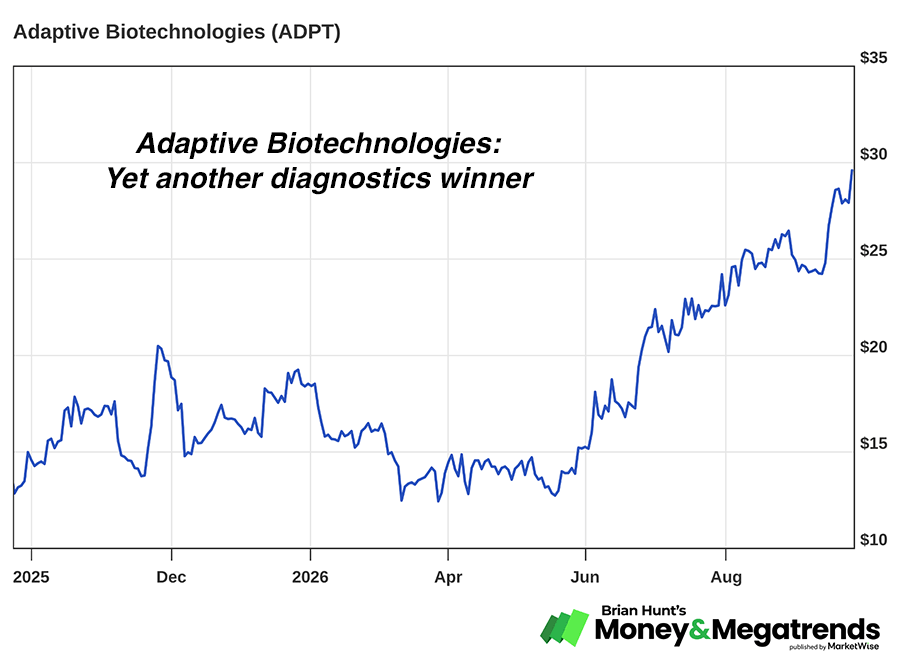
This week, Adaptive Biotechnologies (ADPT) advanced to a new all-time high. The stock is up 14% over the past month and up 124% over the past year.
Adaptive is a $4.7 billion market cap specialized diagnostics firm whose tests are used to detect and monitor minimal residual disease (MRD) in blood cancers such as multiple myeloma and certain leukemias. Adaptive also performs advanced genetic sequencing analysis to study how the immune system responds to disease and treatments.
Its fellow diagnostics firm, Biodesix (BDSX), recently reached a new high as well. The stock is up 262% over the past year. Biodesix is a $304 million lung-cancer diagnostics firm. It uses blood-based tests that help evaluate suspicious lung nodules and guide treatment.
Two familiar names to Money & Megatrends – genetic testing giants Natera (NTRA) and Illumina (ILMN) – also reached new one-year highs. The stocks are up 152% and 198%, respectively, in 2026.
Adaptive, Biodesix, Natera, and Illumina are unique firms where our Healthcare Diagnostics theme overlaps with our Genomics theme. As we’ve covered many times this year, both themes are high-growth segments of the larger Boomer health care megatrend.
Thanks to huge advances in next-generation genomic sequencing, all kinds of new screens and tests are being developed, moving the healthcare system from “reactive, one-size-fits-all treatment” to much better “preventative and personalized treatment.”
An ounce of prevention is worth a pound of cure. And advanced genetic testing – that analyzes both the patient and the disorder at a fundamental genetic level – is the current ultimate expression of this axiom.
Natera may be the best large-company example of how this technology is translating into sales. The company’s revenue increased 35.9% in 2025 to $2.31 billion, while tests processed increased about 15% to 3.53 million.
Cancer testing giant Guardant Health (GH) provides another strong example. Revenue increased 33% to $982 million in 2025. Oncology test volume increased 34% to approximately 276,000 tests, while oncology revenue rose 26%.
I worry some readers may tire of reading about these booming healthcare trends. We’ve devoted so much attention to them because they’ve been paying off so well for us. This is where the money is. It’s like the stock market version of what the famed bank robber Willie Sutton said. When asked why he robs banks, Sutton said, “Because that’s where the money is.”
We publish a lot on healthcare because that’s where the money has been for the past year. It’s a trend that is paying us. Given the very large and long-term nature of the Boomer healthcare megatrend, we expect it to continue. Stay bullish on Genomics and Healthcare Diagnostics.
Recommended Link:
I paid $5,000 to hear Elon say this

I recently paid $5,000 to be in a room with Elon Musk in Los Angeles. What he’s launching right now could be his biggest move yet (and make you more money than anything he’s done so far). If you buy just one stock in 2026, I urge you to make it the one I’m giving away for free: Get the ticker & full details here.
Are you an AI moron? Take our quiz!

Credit: da-kuk
Are you an AI moron?
Or, do you understand what stock market bubbles look and feel like?
Today, you can take our test and find out if you are an “AI moron” or not.
Don’t worry. It’s the easiest test you’ll ever take.
It’s just one question. And it’s a yes-or-no answer.
But the answer to this test could help you make a lot of money in stocks.
And if you end up getting the answer wrong and find yourself in the “AI moron” category, don’t worry. We can help you get out of it quickly and easily.
Before you take the test, let’s provide some context…
If you’ve been reading Money & Megatrends for the past few weeks, you know we’ve been running a special research series on what we call “the world’s most important trend,” which is the trend of the enormous AI infrastructure boom.
The status of this critical trend has become one of the great sagas of the business and investment world… a source of intense disagreement among industry bulls and bears. It’s a trend whose outcome could have large effects on your portfolio.
Given AI’s enormous promise, large technology firms such as Amazon (AMZN), Meta (META), and Microsoft (MSFT) have invested over $1 trillion in AI infrastructure. They are on pace to invest over $700 billion this year alone and more than $4 trillion after that.
Both the scale and the velocity of this investment boom are unprecedented. It is the largest collective investment effort in history.
Big Tech’s historic investment boom has made the entire “AI infrastructure” trend responsible for a large share of America’s GDP growth and stock market returns over the past two years.
It has also drawn the skeptical scrutiny of many widely followed investment professionals who claim the trend is a bubble… one that will soon explode, and cause tremendous damage to stock prices and the global economy. (Most of these guys have been saying the same thing for two years and missing massive opportunities.)
You probably know where I sit in this debate. I believe the AI infrastructure trend has years to run. I believe the world’s smartest, most connected tech insiders who know the true state of bleeding-edge AI development and have real-time stats on AI investment ROI, such as Elon Musk, Jensen Huang (Nvidia), Satya Nadella (Microsoft) and Andy Jassy (Amazon), could possibly… perhaps maybe… just might… know far more about AI and their businesses than outsiders know about it.
As much press as AI gets, let’s remember that less than 1% of the global population pays for top-tier AI programs. And I estimate less than 10% of large companies believe AI has made a meaningful impact on their businesses.
This revolutionary technology hasn’t yet proliferated, achieved mass adoption, or had mass impact. Yet, as we’ve detailed in past issues, the Total Addressable Market (TAM) for super intelligence across all industries and countries over the next decade is north of $100 trillion.
The true leader of the AI revolution is Nvidia (NVDA).
Nvidia is the world’s largest company and the most consequential AI company.
Nvidia founder and CEO Jensen Huang saw the AI revolution coming before virtually anyone… and positioned his company to benefit. The company’s annual revenue has climbed from $27 billion in fiscal 2023 to $215 billion in fiscal 2026 (which was almost entirely the 2025 calendar year) and is forecasted to grow to around $410 billion in fiscal 2027 (which is almost entirely the 2026 calendar year) and to roughly $675 billion in fiscal 2028 (which is almost entirely the 2027 calendar year).
Nvidia designs a large portion of the world’s most advanced AI semiconductors. It has also used its enormous cash flows to become a key investor in many AI firms… and to become essentially a “central bank of AI,” capable of financing many very large AI companies and initiatives.
Nvidia is not an 800-pound gorilla of AI… but perhaps an 800,000-pound gorilla of AI. Few companies in history have wielded Nvidia’s awesome combination of power, influence, technological expertise, and vast financial resources. If you wanted to argue that zero companies have, I wouldn’t protest.
AI is Nvidia. Nvidia is AI.
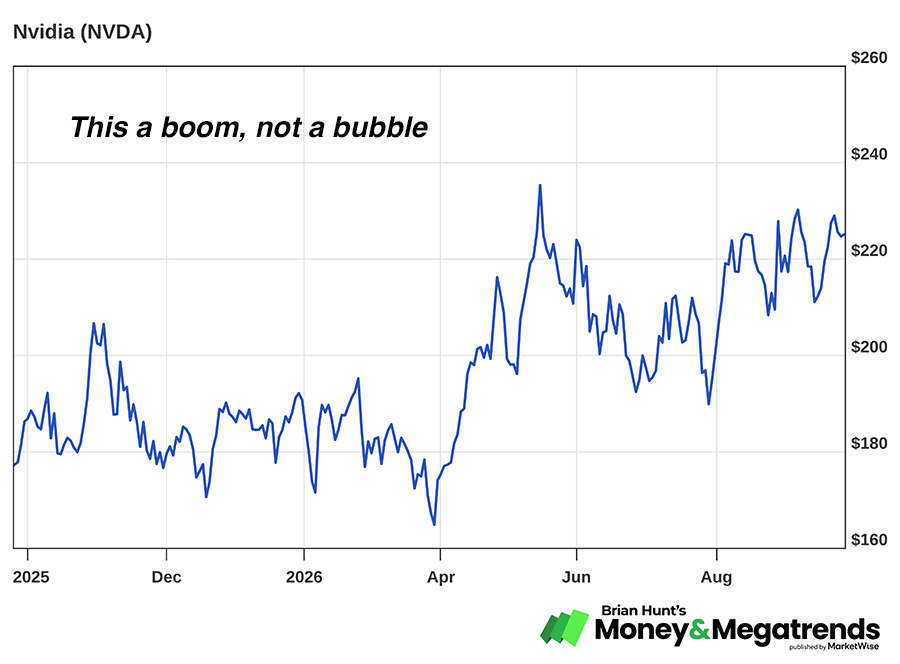
Now, as bright as Nvidia’s future is, the stock trades for only about 24 times this year’s estimated earnings and less than 15 times 2027 expected earnings. That’s a relatively low current P/E and forward P/E for any company that is rapidly growing earnings like Nvidia.
The entire market has looked at the AI boom, evaluated its future prospects, and collectively awarded Nvidia … a multiple often placed on middling fast-food chains. Too many people running large investment funds believe the AI boom will slow down, so they refuse to “pay up” for this leader. Too many people believe Nvidia’s earnings will decline substantially soon.
This brings us to our one question test:
Do you think AI is in a bubble?
Think about it for a few seconds.
Okay, if you answered YES, then you are an AI moron.
Or, you are at least terribly misinformed about what the word “bubble” means when used in an economic or stock market context.
As mentioned above, many high-profile investment professionals proclaim “AI is a bubble” every time they get within five feet of a microphone, keyboard, or video camera.
They see the historic amounts of infrastructure spending, the borrowing by big tech firms to fund some of it, the big AI claims, and the enormous stock returns produced by AI companies and say, “AI is a bubble.”
Hmm.
I’ve lived and traded through a bubble. I’ve studied history. And I can tell you this is not a bubble. It does not feel like one. It does not look like one. It is not one.
A financial bubble occurs when widespread speculative fever grips a large portion of society, and the price of an asset, such as stocks, rises far beyond its economic utility and far beyond feasible growth forecasts.
Bubbles are typically fueled by unbridled optimism and a nearly nationwide speculative fever. In a bubble, virtually every time the bubble asset is featured on TV, newspapers, or magazines, it is highly favorable coverage that asks NOT IF it’s going to go up, only “HOW MUCH” it is going to go up. In a bubble, extraordinary expectations are taken for granted.
One of the “must have” attributes a market must have to be accurately labeled as a bubble is widespread “fever-like” bullishness among people who normally don’t invest or play the stock market.
The legendary Joe Kennedy famously provided the salient example of this. According to Wall Street legend, Kennedy knew speculation had reached dangerous levels before the 1929 crash when his shoeshine boy began giving him stock tips. In modern times, it’s when taxi drivers, Uber drivers, and bartenders give you tips and trade stocks or crypto on their phones as they work. Again, a nationwide fever. Extreme froth.
Sure, there are skeptics of the bubble, but most people talking about it are bullish.
Another “must have” hallmark of a bubble is that speculative fever drives companies in the industry to insane valuations. For example, both Cisco and Qualcomm traded for over 100 times forecasted earnings in 2000. At the height of the Japanese stock bubble of the 1980s, the entire index traded for around 60 times earnings.
Okay. With the defining features of a bubble in mind, I ask you, How in the hell can AI be in a bubble when AI’s “poster child” – the #1 most consequential AI stock – is trading for less than 15 times next year’s expected earnings?
Has the AI bubble crowd read a single financial history book?
Do they have AI Derangement Syndrome?
Did they hit their heads on something and forget what “bubble” means?
Did they mean to say “AI will double” instead of “AI bubble”?
Instead of nationwide fever, unbridled optimism, and absurdly expensive market leaders, we see a lot of the opposite right now.
Right now, we see:
-
Massive opposition to AI data centers
-
Massive distrust of AI leaders such as Dario Amodei of Anthropic.
-
Massive skepticism of AI infrastructure investment ROI.
-
Massive worry over “AI will kill us all.”
-
Massive worry over AI taking jobs.
-
The most consequential, highest profile “poster child” AI stock trading for about 15 times next year’s estimated earnings.
These are not the characteristics of a bubble. So, when you say AI is in a bubble, you sound like a moron. I’m sorry.
The talking head that says AI is a bubble may reply to my assertion by saying the AI infrastructure boom is a bubble, not necessarily the AI stocks. Or they will say there’s a bubble in a handful of overvalued companies, such as OpenAI or the compute provider CoreWeave.
If that’s how you feel, then make that distinction. Because when you make the blanket statement that “AI is in a bubble,” you sound like a moron. You sound like someone who doesn’t know what “bubble” even means when applied to stocks.
You cannot be in a bubble when the most consequential stock in the industry is trading for 15 times next year’s expected earnings. An industry cannot be in a bubble (aka “mania”) when a giant portion of the population is not only avoiding investing in it but openly detests it!
The taxi driver and the bartender are not passing along AI stock tips.
They hate AI!
They think AI is going to kill us all.
To be clear, AI infrastructure stocks do not need to be in a bubble to trade sideways or drop 30%. I’m not saying AI stocks can’t or won’t go down from here. They can. But being vulnerable to a decline is not remotely the same as being in a bubble.
Will the AI trade ever form a bubble?
I hope so. The ride up will be full of opportunity. Plus, bubbles create enormous market distortions, extremes, and opportunities. Plus, they are entertaining. I like to see people do insane things as long as I’m watching from a distance or on a big-screen TV.
However, we are not in bubble territory right now. Sure, there are pockets of high valuation. Sure, there are some aggressive and leveraged companies that will fail. Of course. That happens in every garden-variety boom.
But there is no nationwide speculative fever.
There is no mania driving taxi drivers and shoeshine boys to issue stock tips.
When Nvidia starts trading for 80 times forecasted earnings, give me a call, and we’ll talk bubbles. I will agree with you. But for now, if you’re saying, “AI is a bubble,” stop being a moron.
Market Notes
-
A good sign for the AI infrastructure trade: Semiconductor leader Advanced Micro Devices (AMD) hit an all-time high and is now a $1 trillion company.
-
Clothing and footwear giant Nike (NKE) reached a new one-year low today.
-
Food and beverage giant Pepsico (PEP) reached a new one-year low today.
-
Elevator giant Otis Worldwide (OTIS) reached a new one-year low today.
-
Alcoholic beverage giant Constellation Brands (STZ) reached a new one-year low today.
-
Grocery store giant Sprouts Farmers Market (SFM) reached a new one-year low today.
-
Home improvement and building materials giant Lowes (LOW) reached a new one-year low today.
Top Themes to Buy Now
₿ Three stocks to invest in the coming revolution in money
⚡ Soaring AI Power Consumption is driving a bull market in this unique technology. How to invest
🦾 The machine sensory perception theme is quietly booming. Are you profiting?
Regards,


Brian Hunt
Editor, Money & Megatrends
An urgent message from our colleagues:
Wall Street Legend: “I’ve discovered a fatal flaw built into Elon’s AI model”

60-year Wall Street legend Marc Chaikin has discovered a fatal flaw built into Elon’s AI model and every AI frontier model on earth… and says the race to fix it could send one obscure stock soaring. Right now, behind a high-security fence in rural Tennessee, the U.S. government is quickly working to solve it by building a new form of AI – what Marc calls “Sovereign AI.” He believes it could trigger a $248 trillion boom, 56x bigger than today’s AI market.
Click here for the full story and get the name and ticker of Marc’s No. 1 stock to buy now, 100% free.